Armenians vote in parliamentary election shaped by EU tilt and Russian pressure
Yerevan, 7 June 2026
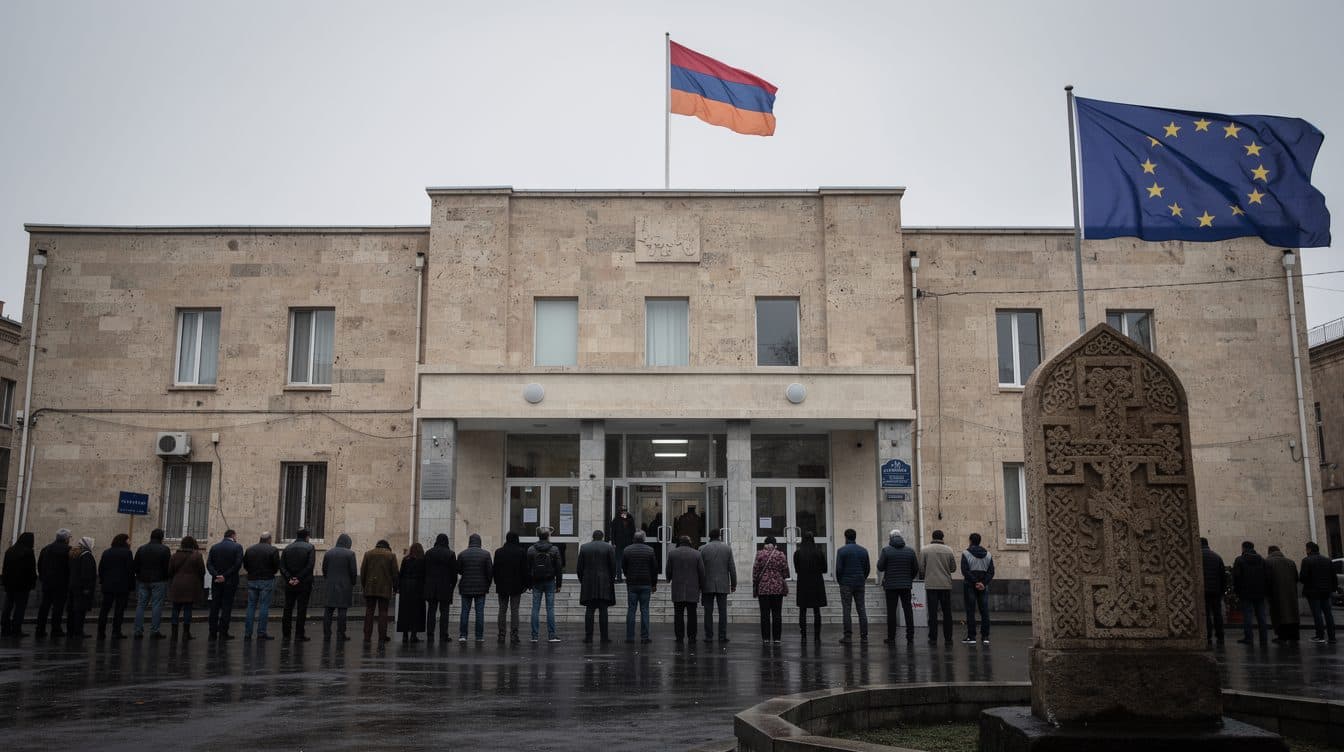
AI-generated image (flux-2/pro-text-to-image via Kie.ai)
Summary
Armenians voted in a parliamentary election on Sunday that is testing Prime Minister Nikol Pashinyan's push to deepen ties with the European Union against fierce Russian opposition. Moscow has imposed new trade restrictions and officials have made thinly veiled threats, while the opposition accuses Pashinyan of provoking a confrontation with Moscow.
Yerevan, 7 June 2026
Armenians voted on Sunday in a parliamentary election that has become a referendum on Prime Minister Nikol Pashinyan's bid to steer the country closer to the European Union and further from Moscow, against a backdrop of Russian economic pressure and security warnings.
Background: a vote about direction
Pashinyan and his ruling Civil Contract party entered the vote seeking a strong mandate for a new geopolitical course that would deepen cooperation with Brussels. Casting his ballot, the prime minister said the country would continue strengthening its independence, statehood, democracy and the rule of law. He added: "The European Union is our main partner in democratic reform implementation, and we will continue that path."
The election takes place under sustained pressure from Moscow. President Vladimir Putin and other Russian officials have made thinly veiled threats comparing Armenia's trajectory to that of Ukraine, which was invaded by Russia. Speaking after Russia's Victory Day parade on May 9, Putin said that if Armenians saw benefits in joining the EU, Russia would have nothing to say against it, while also warning that the Ukraine conflict began with Kyiv's attempt to join the bloc. According to the Armenpress news agency, Pashinyan played down the friction, saying: "our relations with Russia are institutional and based on mutual respect."
Economic pressure from Moscow
Russia has also escalated the economic pressure. Russian authorities imposed new restrictions on Armenian produce ahead of the vote, banning imports of Armenian flowers, certain cognac and wine, eggplant, potatoes, dried fruits, fish and more, citing violations of agricultural import rules. Moscow controls a significant portion of Armenia's energy and infrastructure and supplies it with cheap gas, giving it substantial leverage.
The European Commission on Thursday described Russia's move as "nothing short of economic coercion" and accused Moscow of weaponizing economic relations for political pressure. A commission statement said: "By extending export restrictions on Armenian products, Moscow is weaponizing economic relations for political pressure. We know this playbook all too well."
Crackdown on the opposition
Putin has insisted that Armenia cannot simultaneously be in a customs union with the European Union and remain within the Russia-led Eurasian Economic Union. "Being in a customs union with the European Union and the Eurasian Economic Union is impossible. It's simply impossible by definition," he said. Pashinyan has pushed back, arguing that Armenia can manage a dual orientation even as it draws closer to the West.
The campaign was also marked by legal action against the opposition. Armenian investigators issued six arrest warrants for members of the Strong Armenia party the day before the election, accusing them of buying votes. Armenia's Central Election Committee confirmed on Saturday that the party could run after a member of the Republic party appealed for it to be barred over corruption allegations.
Strong Armenia's head, the Russian-Armenian businessman Samvel Karapetyan, is under house arrest for allegedly advocating the government's overthrow, a charge he has rejected as politically motivated. Karapetyan said the arrests "would not change the minds of Armenian voters." He was escorted to a polling station, where he told reporters: "The Armenian people will make the right choice and Armenia will finally have a legitimate government."
The opposition field is fragmented but vocal. Former President Robert Kocharyan leads the Hayastan bloc and has accused Pashinyan of undermining relations with Russia. The Prosperous Armenia Party is led by pro-Russia business owner Gagik Tsarukyan, while Strong Armenia seeks closer business ties with Moscow and has accused Pashinyan of attempting to start a war with Russia. Two political blocs and 17 parties took part in the vote, with parties needing at least 4% of the vote and blocs of three or more parties needing 8% to win seats in the 101-member National Assembly, whose members serve five-year terms.
Karabakh and the wider neighbourhood
Sahakyan Elina, a supporter of the Prosperous Armenia Party, said at a rally on Thursday that she was looking for change. "I want this government to change, because the condition of our country is getting worse," she told The Associated Press.
The vote also comes as Armenia tries to lock in a peace deal with Azerbaijan after decades of conflict over Karabakh, a breakaway region that had been controlled for decades by ethnic Armenian forces backed by Armenia before Azerbaijan retook the entire area in a 2023 offensive. Pashinyan and Azerbaijani President Ilham Aliyev initialed a document on moving toward a peace deal at the White House alongside Donald Trump in August. On social media, Trump endorsed Pashinyan, writing: "Prime Minister Nikol Pashinyan, of Armenia, a great friend and Leader, is making his Country strong, wealthy, and very secure" and urging Armenians to "Make (Armenia) Great Again."
Hripsime Grigoryan, a Civil Contract member of the outgoing parliament, said Armenians had clear expectations of the vote. "I think Armenians expect, first of all, a peaceful, independent and prosperous Armenia from this election, as we have today," she said. Pashinyan first came to power in 2018 following sweeping street protests, and Sunday's vote will determine whether voters endorse the strategic shift he has pursued since then.
Turkey and Iran both border Armenia, giving the small Caucasus country a sensitive geopolitical position between the EU, Russia and its own neighbors as the results of the vote are tallied in the coming days.
Questions & Answers
Who is Nikol Pashinyan and what is he seeking in this election?
Nikol Pashinyan is Armenia's prime minister, who came to power in 2018 following sweeping street protests. He and his ruling Civil Contract party entered Sunday's vote seeking a strong mandate to deepen cooperation with the European Union and loosen ties with Moscow.
Why has Russia imposed new restrictions on Armenian exports?
Russian officials imposed the restrictions in the weeks before the vote, citing agricultural import violations, and the European Commission accused Moscow of weaponising economic relations for political pressure. Analysts link the move to Armenia's push to deepen ties with the EU.
What role did Samvel Karapetyan play in the election?
Karapetyan, a Russian-Armenian businessman and head of the Strong Armenia party, is under house arrest on charges of advocating the government's overthrow, which he has rejected as politically motivated. He was escorted to a polling station and told reporters the arrests would not change Armenian voters' minds.
Armenia election 2026: Pashinyan, EU and Russia in standoff | allfacts360