Celtic Prince's Grave Discovered Near Bad Camberg – Sensational Find Along the A3
Bad Camberg, 08 June 2026
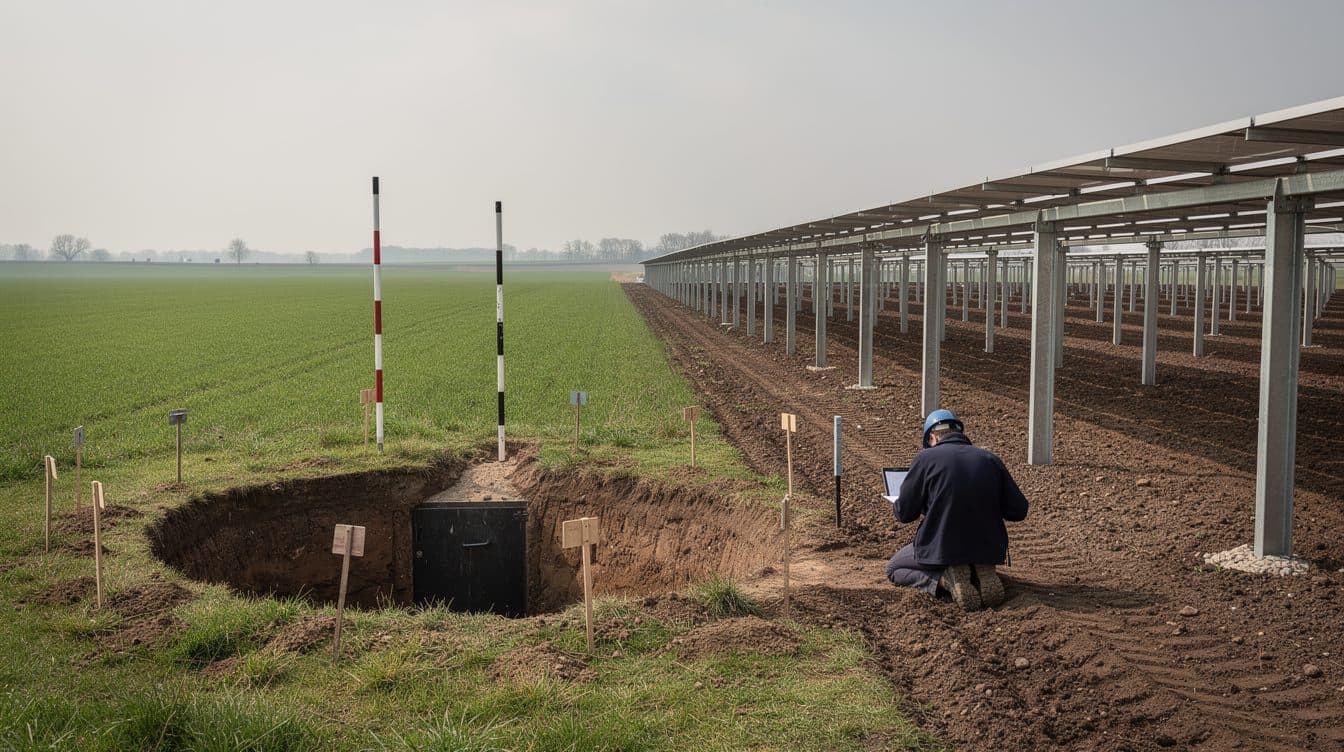
AI-generated image (flux-2/pro-text-to-image via Kie.ai)
Summary
During construction work for a solar park along the A3 near Bad Camberg, a Celtic prince's grave dating to the early Iron Age has been discovered. The find, which includes gold rings, a wagon, and an Etruscan jug, is considered one of the most significant archaeological discoveries ever made in Hesse.
Bad Camberg, 08 June 2026
Archaeologists have discovered the first Celtic prince's grave in the region near Bad Camberg in the Taunus, which was uncovered during construction work for a solar park along the A3 motorway.
The discovery stems from a geomagnetic prospection carried out as part of the development of the solar park. Kai Mückenberger recognized on the measurement images two thin parallel lines that led to a circle with a sharply defined rectangular interior – a pattern reminiscent of processional paths to burial mounds such as those at the Glauberg in the Wetterau. A planned photovoltaic field there was already under construction, those involved report.
From the Measurement Image to the Burial Chamber
When an excavator pulled metal from the earth, the find site was clearly identified. "Die Baggerschaufel hatte Metall ausgegraben, Eisenreste von einer Lanzenspitze, eine typische Grabbeigabe", the documentation states. Mückenberger recalls his first reaction to the measurement results: "Ich hab gelacht und gerufen: Mensch! Ein Fürstengrab!". The restoration workshop in Wiesbaden has since recorded some 100 finds from the Bad Camberg grave.
The grave goods include three gold rings, worn around the neck, arm, and fingers at the time of burial, as well as small bronze ornamental beads, possibly made of glass or amber. In addition, there are rings that likely came from a belt, a small sickle-shaped everyday knife, and ceramic sherds from a so-called lens-shaped jug. In one find block, for example, an Etruscan jug made of bronze sheet is clearly hidden, described as an Etruscan beak jug.
Gold, Wagon, and Etruscan Jug
Particularly striking are the remains of a two-wheeled wagon that – unlike in the case of the world-famous "Keltenfürst vom Glauberg" in the Wetterau district – could be documented in the Bad Camberg grave. The two wheels were up to 1.20 meters high and were presumably removed and leaned against the wall of the burial chamber. They were richly decorated with large round hub caps and cuff-like axle fittings made of non-ferrous metal, possibly bronze, which once gleamed reddish-golden. In one of the wheel fittings, even remnants of the wooden wagon axle have been preserved.
The wooden chamber walls and the body of the buried individual had completely decomposed over the millennia, while the grave goods – including massive gold rings – survived the passage of time comparatively well. Since burials with this kind of equipment generally contained male dead, according to Mückenberger's words, the wagon is interpreted as a war chariot, and the well-preserved spearhead is regarded as an indication of a male burial. Whether the person was a druid, a wise woman, or a warrior prince, the researchers cannot yet determine – what is certain is that the buried individual was wealthier, more influential, or otherwise more significant than their contemporaries.
Significance for Research
The archaeological classification is of international scope: Axel Posluschny, research director of the Keltenwelt am Glauberg, explained that with the combination of grave goods – gold rings, wagon, and jug – the Camberg "prince's grave" ranks among the "absolute pinnacle" of graves from this era in Europe. Udo Recker described the find as "eine der größten archäologischen Entdeckungen, die es in Hessen je gab" and at the same time emphasized that the discovery makes it possible to "die bis dato nur angenommene Präsenz einer lokalen keltischen Elite nachweisen". According to Recker's information, only about three other Celtic wagon burials are known in Hesse, none of which approaches the quality of the Bad Camberg finds.
The find can be assigned to the so-called Hunsrück-Eifel culture and dates to the first half of the 5th century BC, that is, to the beginning of the early Iron Age. According to Recker's words, the grave is likely to date from the middle of the first millennium BC, "damit aus einer ähnlichen Zeit wie der weltberühmte ‚Keltenfürst vom Glauberg‘ im Wetteraukreis". The sensational find thus joins a small group of outstanding Celtic elite graves that attract attention across Europe.
Laboratory Investigation
The fragile objects were not uncovered on site, but were recovered in earth blocks and transported to the state archaeology office in Wiesbaden. There, they are being restored under laboratory conditions and examined using X-ray and CT imaging, which has already revealed further grave goods yet to be uncovered. The Bad Camberg finds are currently being examined by experts from hessenARCHÄOLOGIE and from the research center of the Keltenwelt am Glauberg in cooperation with the Leibniz Center for Archaeology in Mainz. The archaeologists hope to gain important insights into the Iron Age as a result.
Mückenberger sums up the scale of the find in a personal formula: "Einen solchen Fund macht man in seiner archäologischen Laufbahn nur einmal." In doing so, he also underscores that the sensational find is a highlight not only scientifically but also biographically for the researchers involved.
The responsible specialist authority, hessenARCHÄOLOGIE, is in charge of the recording, preservation, and study of archaeological and paleontological ground monuments in the state of Hesse. With the ongoing investigation of the grave using the latest examination methods, the authority states, the scientific analysis of the first Celtic "prince's grave" in the Taunus is only just beginning.
Questions & Answers
Who discovered the Celtic prince's grave near Bad Camberg?
Kai Mückenberger identified the find site on the basis of a geomagnetic prospection carried out during construction work for a solar park along the A3 near Bad Camberg.
What grave goods were found in the grave?
The grave goods include three gold rings, parts of a two-wheeled wagon with richly decorated wheel fittings, an Etruscan beak jug made of bronze sheet, a spearhead, small bronze ornamental beads, a sickle-shaped knife, and ceramics from a lens-shaped jug.
Why is the find considered scientifically significant?
Udo Recker described the find as "eine der größten archäologischen Entdeckungen, die es in Hessen je gab" and as being of European significance, because it provides the first evidence of a previously only assumed local Celtic elite in the Taunus.
Celtic Prince's Grave Discovered Near Bad Camberg | allfacts360