Iran rockets hit Israel ceasefire June 2026 | allfacts360
Iran fires rockets at Israel for first time since April ceasefire, complicating US diplomatic push
Jerusalem, 08 June 2026
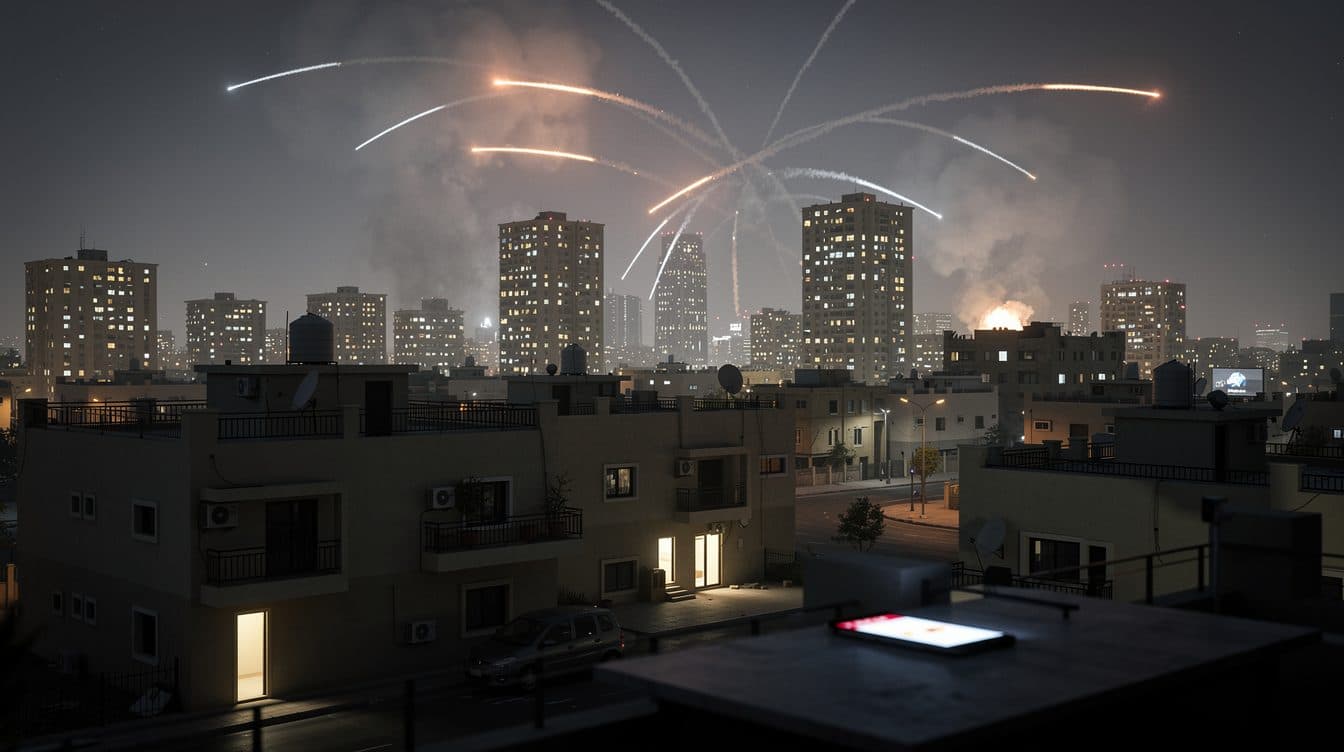
AI-generated image (flux-2/pro-text-to-image via Kie.ai)
Summary
Iran launched multiple rocket salvos at Israel late on Sunday, the first direct attack on Israeli territory since a ceasefire took effect in April. The strikes followed Israeli airstrikes on Hezbollah targets in Beirut and prompted urgent US efforts to prevent a wider regional escalation.
Jerusalem, 08 June 2026
Iran fired multiple rockets at Israel late on Sunday, the first direct attack on Israeli territory since a ceasefire in April, prompting urgent calls from US President Donald Trump for restraint and a return to negotiations.
The strikes: what happened
Iran's armed forces confirmed the rocket attacks in a statement broadcast by state radio, saying the strikes were carried out in response to what it described as repeated Israeli violations of a Lebanon ceasefire. The Israeli military said it had identified two waves of incoming fire, with the broadcaster N12 reporting that at least ten projectiles were launched in total.
The Israeli army said that all of the incoming projectiles were intercepted by air defense systems, and that there were initially no reports of injuries or significant damage. However, Israeli TV channel N12 reported that rocket debris struck areas of northern Israel, including near the city of Tiberias, and one injured person was later reported.
Air raid sirens sounded across large parts of Israel, from Haifa in the north to the coastal city of Caesarea further south. The Israeli Home Front Command sent precautionary instructions directly to mobile phones in affected areas and tightened security measures across the country, while Israel's Civil Defense canceled school classes nationwide on Monday.
The trigger: Israeli airstrikes in Beirut
The Iranian barrage came hours after Israeli airstrikes hit what the Israeli military described as 'terrorist headquarters' in the southern suburbs of the Lebanese capital Beirut, including the Shiite suburb of Dahiyeh, a long-established Hezbollah stronghold. Israeli Prime Minister Benjamin Netanyahu and Defense Minister Israel Katz said the army had struck those targets in response to prior Hezbollah fire on Israel.
According to the verified facts, at least two people were killed in the Israeli attacks in Beirut. Israel's army said the strikes were a response to rocket fire from Lebanon and added that launch installations that had previously fired at northern Israel were also destroyed. A renewed evacuation call was issued in southern Lebanon, and Israel said it had pushed residents of the Beirut suburbs to flee.
Iran justified its attacks as a response to those new Israeli strikes, which it said took place despite a ceasefire announced by Trump. Iran's central military command confirmed the rocket launches, and the country's Revolutionary Guards described the attack as a warning following recent Israeli airstrikes. Ebrahim Rezaei, spokesperson of the foreign policy committee of the Iranian parliament, posted on X: 'Beobachtet heute Nacht den Himmel über den besetzten Gebieten.'
Context: a war that began in February
Israel and the United States began their war against Iran on February 28, according to the verified facts. A two-week ceasefire that took effect on April 8, the same night Iran last fired rockets at Israel, was subsequently extended. Since the war began, Iran has blockaded the Strait of Hormuz, a key global oil shipping route, and tanker passage through the strait came to a near standstill, contributing to a significant rise in global energy prices.
The US response was unusually cautious. Trump urged Israel to refrain from counterattacks on Iran and, in remarks to the US news magazine Axios, called on both sides to return to the negotiating table. He told Fox News that the Iranian attacks on northern Israel would 'not help' negotiations with Tehran, and said to Israeli journalist Barak Ravid: 'Both have had their strike — we don't need another one.'
Trump also said he had not been happy about Israel's airstrikes in Beirut and indicated he would 'immediately call' Netanyahu to urge restraint. He said Washington and Tehran were on the way to a 'good' deal and that an agreement could be reached 'Monday, Tuesday, or Wednesday of next week,' though critics question whether there has been any real progress in the negotiations.
Trump pushes for restraint
Israeli public broadcaster Kan reported that Trump wanted Israel not to respond to the attacks. The Israeli broadcaster Kan also reported that, according to Trump's will, Israel should refrain from striking back. Trump said to a Kan correspondent: 'Israel hat genug reagiert.'
An unnamed Israeli government representative said: 'Der Iran kann vergessen, dass wir das hinnehmen werden – die Reaktion wird hart ausfallen,' according to N12 and ynet. The same source said Israel would not allow Iran to set new rules of engagement or violate its sovereignty, and that the response would be 'hard.'
Israel weighs a harsh response
Jerusalem assessed the barrage as a direct breach of the ceasefire. Netanyahu held a security consultation with military and intelligence representatives, and Israeli army chief Samir threatened Iran with a harsh response 'sobald es dafür grünes Licht gebe' — as soon as there is a green light to do so.
Several Iranian missiles also entered Jordanian airspace during the attack, according to the Jordanian government. Iraq and Syria each temporarily closed their airspace in response. In recent days, Iran had also fired missiles at Kuwait and Bahrain according to US information; both Gulf states condemned those strikes as violations of their sovereignty, and most of the projectiles were intercepted. The US military said it shot down two Iranian drones in the region, according to the responsible US regional command on X.
Regional fallout and the Strait of Hormuz
Iran's chief negotiator had earlier threatened retaliation after Israeli attacks on Lebanon and warned of possible strikes on US bases. Trump, in turn, said that Iran sanctions will not be lifted without a peace agreement, and tied the extension of the ceasefire to the reopening of the Strait of Hormuz.
The Iranian attacks represent a double setback for Trump: they complicate his efforts to mediate a ceasefire in Lebanon and an Israeli-Lebanese rapprochement, and Tehran has demanded a halt to fighting in Lebanon as part of US-Iran negotiations. The rise in energy prices caused by the Strait of Hormuz disruption has also placed domestic political pressure on Trump.
Iran is described as Hezbollah's most important state backer, and the Iranian attack was framed by Tehran as a move to support the Shiite militia in Lebanon. Israeli Iran expert Danny Citrinowicz wrote on X that Trump 'scheint eher bereit zu sein, nahezu um jeden Preis eine Einigung mit dem Iran zu erzielen, als ein Abgleiten in eine umfassendere regionale Konfrontation zu riskieren.'
A hospital in the Gaza Strip, cited in the verified facts, reported five killed in a separate Israeli attack. One person was killed and others injured in a suspected attack in Israel. Schools in Israel were set to remain closed in the coming days, gatherings were restricted, and the population was asked to keep shelters accessible. The international airport near Tel Aviv remained open following the Iranian attacks, according to media reports.
The report was broadcast on Deutschlandfunk on 08.06.2026 and distributed via the dpa news channel. As of that broadcast, negotiations between the US and Iran on a permanent end to the war had not yet produced an agreement, and Trump had said the US had been very close to a deal and had expected an agreement to be signed that same week.
Questions & Answers
Why did Iran fire rockets at Israel in June 2026?
Iran launched the rocket attacks in response to new Israeli strikes in the suburbs of Beirut, including in the Dahiyeh stronghold, on Sunday afternoon, despite a ceasefire announced by US President Donald Trump.
What is the connection between the Iran attacks and Hezbollah in Lebanon?
Iran described the strikes as a warning and said they were carried out to support the Shiite Hezbollah militia in Lebanon, which is described as Iran's most important non-state ally.
How has the US responded to the renewed Iranian attacks on Israel?
US President Donald Trump urged Israel to refrain from counterattacks on Iran, called on both sides to return to the negotiating table, and said he would 'immediately call' Prime Minister Benjamin Netanyahu to press for restraint.