Runoff Election in Saalfeld-Rudolstadt: Wolfram and Benninghaus to Face Off on June 21
Saalfeld, June 7, 2026
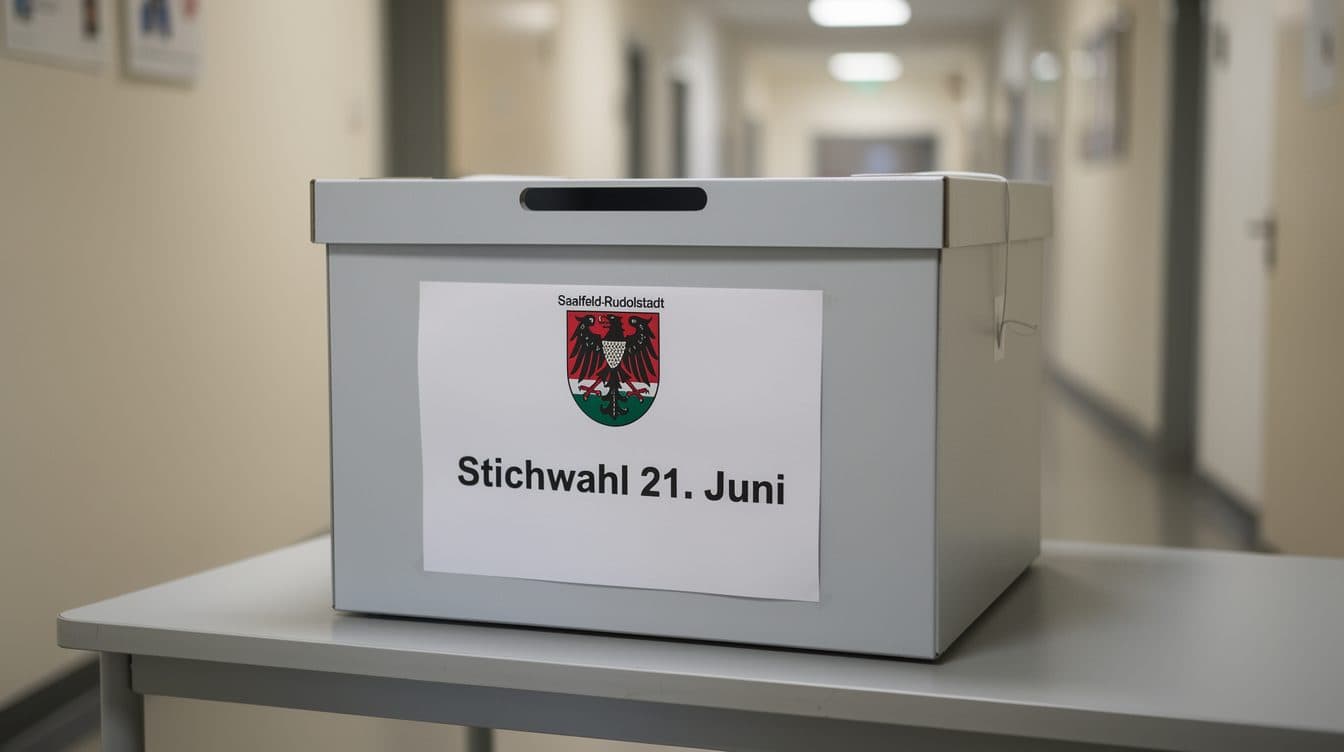
AI-generated image (flux-2/pro-text-to-image via Kie.ai)
Summary
In the district of Saalfeld-Rudolstadt, a runoff election between incumbent Marko Wolfram (SPD) and AfD candidate Thomas Benninghaus will determine who holds the office of Landrat. The first round of voting last Sunday failed to produce an absolute majority; voter turnout at 56 percent was significantly higher than the figure from six years ago.
Saalfeld, June 7, 2026
Two weeks after the first round of voting, incumbent Marko Wolfram (SPD) and AfD candidate Thomas Benninghaus will face off on June 21 in the runoff election for the office of Landrat in the district of Saalfeld-Rudolstadt.
In the district of Saalfeld-Rudolstadt, the succession at the head of the district administration will be decided in a runoff election. As the district returning officer announced on Sunday evening after all precincts had been counted, none of the three candidates in the first round received an absolute majority of votes cast. A second round of voting on June 21, that is, in two weeks, will now have to deliver the decision. „Die Stichwahl zwischen Wolfram und Benninghaus findet in zwei Wochen, am 21. Juni, statt."
Incumbent Marko Wolfram of the SPD received 47.1 percent of the votes after all precincts had been counted. The AfD candidate Thomas Benninghaus garnered 40.2 percent. The independent candidate Wolfgang Wehr obtained 12.7 percent of the votes. Because no absolute majority was reached, a runoff between the two top-placed candidates is required.
Voter turnout at 56 percent was significantly higher than six years ago, when it had stood at 42.4 percent. A total of around 80,000 and roughly 83,000 voters, respectively, had been called upon to cast their ballots. The increase in turnout was interpreted in reporting as a notable signal, especially in light of the political constellation in the state.
Traditional SPD Stronghold Under Pressure
The district in southeastern Thuringia has hitherto been considered an SPD stronghold. „Seit der Kreisgründung 1994 standen mit einer zweijährigen Unterbrechung stets Sozialdemokraten an der Spitze der Kreisverwaltung in Saalfeld." The SPD currently provides Landräte in three other districts in Thuringia. Should Benninghaus win the runoff, it would be – following the election victory of Robert Sesselmann in Sonneberg three years ago – the second AfD success in a Landrat election in Thuringia. „Die AfD hatte vor drei Jahren im südthüringischen Sonneberg erstmals in Deutschland mit Robert Sesselmann eine Landratswahl gewonnen."
For the 52-year-old SPD politician Wolfram, a qualified economist, the runoff is about securing a third term. In 2020, he had already won the first round with a result of 58.5 percent – likewise against two competitors, including an AfD candidate. Now his lead from the first round is not enough for a direct victory, and the outcome of the runoff remains open.
Candidate Profiles: Wolfram and Benninghaus
The AfD candidate Thomas Benninghaus was born in 1973 and, according to his own information, is a qualified commercial clerk (kaufmännischer Fachwirt). Benninghaus had won a direct mandate in the region for the first time in the state election two years ago. The AfD candidate for the top municipal office in Saalfeld is attributed to the political camp of the party's right-wing figure Björn Höcke. His candidacy therefore also stands in the context of the AfD's strength in state politics: „Die AfD stellt seit der Landtagswahl 2024 im Parlament die stärkste Fraktion."
In a statewide comparison, the SPD had received only 6.1 percent of the votes in the 2024 state election. All the greater, then, is the weight that the runoff in Saalfeld-Rudolstadt carries for the question of whether the SPD can defend its traditionally dominant position in the Thuringian district. Observers point out that, in a constellation with a strong AfD and a weakened SPD, it is precisely the municipal elections that become an indicator of the social rootedness of both camps.
Role of the Third Candidate, Wolfgang Wehr
The third candidate, Wolfgang Wehr, is independent. He is a civil engineer and professor at the Erfurt University of Applied Sciences. With 12.7 percent of the votes, he achieved a respectable result but missed advancing to the runoff. His share of the vote could prove decisive on June 21, because voters who cast their ballots for Wehr in the first round must reorient themselves in the runoff.
For the second round, a brisk turnout is again to be expected, given that the first round was already well above the comparative figure from 2019/2020. The exact voting hours and polling stations will be announced by the district returning officer in the coming days. Immediately after the polling stations close on June 21, first projections are expected, with a final result anticipated following the count.
What Is at Stake on June 21
Should Wolfram lose the runoff, the change at the top of the district administration would also represent a personnel turning point. Should Benninghaus win, the district would have to politically reposition itself. Regardless of the outcome, the runoff is regarded as a barometer of political alignment in southern Thuringia. The national attention is explained not least by the fact that the political balance of power in Thuringia has been in significant flux since 2024.
For voters in the district of Saalfeld-Rudolstadt, the date of June 21 means that they will be called to the polls for the second time within barely three weeks. Initial analyses suggest that mobilization will continue to increase in the coming days, as there are now only two candidates to choose from. The district returning officer pointed out that voting will be possible at the familiar polling stations as well as by mail.
Political observers assess the constellation as unusual: while the SPD has lost considerable support at the federal level and in the state, it can still post a strong result in its long-standing stronghold of Saalfeld-Rudolstadt with incumbent Wolfram and 47.1 percent in the first round. At the same time, the AfD has succeeded, with more than 40 percent of the votes, in placing a candidate in the runoff who could shape the district politically in the years to come. How the camp of Wehr's voters will behave is considered one of the central questions ahead of the second round.
National Significance of the Runoff
The reporting on the runoff is being followed beyond the borders of Thuringia, as local elections in eastern Germany are regarded as a seismograph of the overall social mood. Should the AfD also provide a Landrat in Saalfeld-Rudolstadt – as it previously did in Sonneberg – this would have a signal effect for the upcoming election campaigns in the region. The SPD, for its part, could underscore its position as a local political force in southern Thuringia with a victory by Wolfram.
Overall, the first round shows that the political camps in the district of Saalfeld-Rudolstadt are clearly defined. The decision on June 21 will show whether the SPD can defend its stronghold or whether the AfD will secure its second top municipal office in Thuringia. Until then, both sides will court the votes of those voters who did not yet participate in the first round or who gave their vote to the independent candidate Wolfgang Wehr.
Questions & Answers
Who is running in the runoff election in Saalfeld-Rudolstadt?
In the runoff on June 21, incumbent Marko Wolfram (SPD) and AfD candidate Thomas Benninghaus will face each other. The independent candidate Wolfgang Wehr missed advancing to the second round with 12.7 percent.
Why is there a runoff election in the district of Saalfeld-Rudolstadt?
A runoff is required because none of the three candidates achieved an absolute majority of votes cast in the first round. Wolfram received 47.1 percent, Benninghaus 40.2 percent, and Wehr 12.7 percent.
How high was voter turnout in the first round?
Voter turnout stood at 56 percent and was thus significantly higher than in the previous Landrat election six years ago, which had recorded a turnout of 42.4 percent. Around 80,000 to 83,000 people were called upon to cast their votes.
Runoff Election Saalfeld-Rudolstadt: Wolfram vs | allfacts360