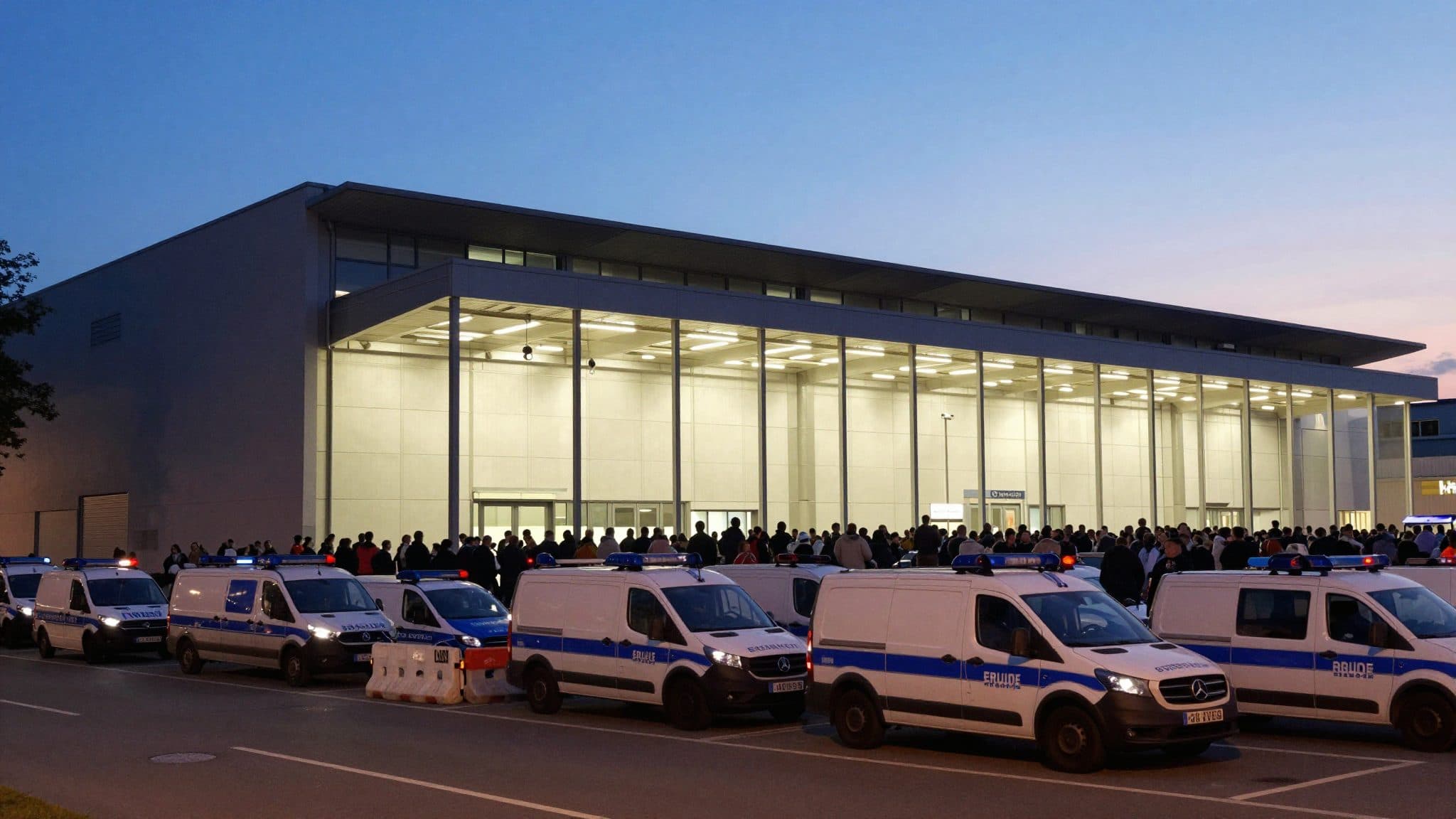
AfD Federal Party Conference in Erfurt begins despite massive protests and road blockades
Erfurt, 04 July 2026
AI-generated image (z-image via Kie.ai)
Summary
The AfD's federal party conference began on schedule in Erfurt on Saturday, although thousands of counter-demonstrators blocked roads, highways, and tram tracks. Police counted around 20,000 protesters during the day; up to 50,000 had been expected. In the election of the dual leadership, the delegates confirmed Alice Weidel and Tino Chrupalla in their positions.
Erfurt, 04 July 2026
The AfD's federal party conference began on schedule in the Erfurt trade fair halls on Saturday, although thousands of counter-demonstrators blocked roads, highways, and tram tracks, and police were deployed in large numbers.
On-schedule start in the trade fair halls
The two-day delegates' congress of the AfD, which is in parts right-wing extremist, began at 10:00 a.m. on Saturday in the trade fair halls of the Thuringian state capital. As early as the previous evening, the first delegates had arrived by bus in order to evade the blockades announced for the morning. According to the AfD, by 7:30 a.m. some 540 of the approximately 600 expected delegates had already gathered at the venue — more than two hours before the scheduled start.
AfD co-chairman Tino Chrupalla opened the party conference with a speech to the delegates in which he sharply attacked the counter-demonstrators. "Dear early risers, the early bird catches the worm. We can start on time today," he said. He also scoffed: "The rioters from the Antifa have slept through their own disruption operation." With a view to the protests, Chrupalla said: "They believe they have a monopoly on democracy. To these demonstrators I say: This democracy is just as much our democracy as it is yours." Holding party conferences is a "constitutional right."
Content of the party conference: personnel matters in focus
No substantive policy decisions were on the agenda for the meeting; no key motion from the federal executive board was tabled. The focus of the two-day delegates' meeting is personnel decisions. Both co-chairs, Alice Weidel and Tino Chrupalla, stood for re-election. On Saturday afternoon, the delegates confirmed Weidel and Chrupalla in their positions. Weidel received around 81 percent of the votes, Chrupalla around 70 percent; two years earlier in Essen, Chrupalla had still received 82.7 percent.
The co-chairs presented a united front in their speeches. "We were, we are, and we remain one heart and one soul," Chrupalla said of the dual leadership. He also thanked the police officers "who truly protected democracy with body and life, who did an outstanding job." Weidel announced that the AfD would close the borders and described the party as "the new people's party in Germany." Addressing political competitors, she said: "You will not break us, quite the opposite. We will grow ever stronger and larger."
Looking ahead to the state elections in September in Saxony-Anhalt, Mecklenburg-Western Pomerania, and Berlin, Chrupalla formulated a claim to power: "Perhaps we will soon be able to govern on our own." The AfD is clearly leading in polls in Saxony-Anhalt and Mecklenburg-Western Pomerania; in Saxony-Anhalt, it could even win an absolute majority of seats at the current standings. The leading candidate there is Ulrich Siegmund. In her speech, Weidel attacked the CDU: "The CDU is pursuing politics against Germany, against the Germans … refugee rescue, climate rescue, Ukrainian rescue."
Withdrawn motion on the incompatibility list
The party conference was originally also supposed to consider a motion from the orbit of Thuringian AfD leader Björn Höcke that aimed to significantly loosen the rules of the incompatibility list. According to this, groups should only be regarded as extremist if their program aims to abolish parliamentary democracy and establish a dictatorship, and pursues these goals systematically and in an actively militant manner. The motion was withdrawn at short notice and was no longer to be dealt with at the party conference. Weidel also announced a review of the incompatibility list within one year.
The party conference was accompanied by massive protests. According to the Erfurt city administration, more than 30 assemblies had been registered, including rallies by trade unions, civil society alliances, and initiatives such as "Grandmas Against the Right," "Stand Up Against the Right," and the anti-fascist alliance "Widersetzen" (Resist). The organizers expected several tens of thousands of participants; the authorities anticipated around 50,000 counter-demonstrators.
Blockades on highways and roads
On Saturday morning, according to police, several hundred counter-demonstrators blocked the A71 autobahn at the Erfurt interchange as well as the B7 and B4 federal highways. At at least four points, thousands sat on the roadway; the A71 had to be fully closed at times. According to police, activists also glued themselves to tram tracks or were lowered from a bridge. Banners read slogans such as "No peace with the AfD," "Stop the arsonists," and "Against racism, fascism, and war." At the main railway station, a large rainbow flag was unfurled, according to police.
Police initially estimated the number of demonstrators in the morning at 15,000, later at 20,000. Mobilization thus fell short of expectations of up to 50,000. Over the course of the day, around 31,000 people took to the streets, according to police. Erfurt's head of public order, Heike Langguth, expressed relief that the night and the initial demonstrations in the city center had passed peacefully. Erfurt's CDU mayor Horn told the Protestant Press Service of a "wonderfully relaxed" atmosphere in the squares and called the colorful protest scene "advertising for the city."
Large-scale police deployment
Public transport in Erfurt was partially paralyzed by the protests. Several tram lines suspended operations, and tram traffic at Gothaer Platz was temporarily halted. Police called for drivers to give the A71 area a wide berth and appealed to demonstrators: "Stay peaceful." According to a ministry spokesperson, there were initially no indications of serious injuries among participants or officers. However, police spoke of individual "clashes" in which pepper spray and batons were also used; paint-filled bags were thrown at police officers. In the city center, masked left-wing extremists had overturned individual trash cans and set off pyrotechnics in the morning, police said.
According to police, an AfD constituency office in Erfurt was also attacked. The security authorities had feared left-wing violence in advance; according to police, they did not rule out that up to 2,500 demonstrators prepared to use violence could arrive. On the B7, police aborted a clearance operation because they were significantly outnumbered by the demonstrators. On the fringes of a demonstration march, blocking demonstrators were pulled or carried away by police officers, according to a reporter's observation.
For security, thousands of police officers were deployed according to authorities, supported by forces from almost all federal states and the federal police, who also provided, among other things, horses and water cannons. Conditions included a ban on bottles, cans, and drinking vessels made of fragile, splintering, or particularly hard material that could serve as projectiles, as well as a ban on carrying and consuming alcoholic beverages at the assemblies.
Dispute over assembly bans
In advance, the Weimar Administrative Court had overturned, in expedited proceedings, assembly bans imposed by the Thuringian State Administrative Office for certain access routes for the weekend. The court objected that the general decree had also prohibited peaceful assemblies; the existence of a police emergency had not been proven. The city of Erfurt lodged an appeal against this decision with the Higher Administrative Court. A ban on demonstrations remained in force for certain streets, however, according to police.
The "Widersetzen" alliance had set itself the goal of preventing the party conference entirely through blockades and, according to its own figures, had mobilized 50,000 to 80,000 participants and around 250 buses. Spokesperson Suraj Mailitafi declared: "Erfurt will become the anti-fascist capital today. The AfD is barricading itself in the trade fair halls, we are blocking from all sides." Left Party Bundestag member Luke Hoß, who participated in the blockades, told the news agency AFP: "There can be no talk of failure. Civil society has mobilized en masse and shown that it can stop a fascist party in its tracks." In the morning, police said that, as things stood, the party conference could begin as planned.
Voices from the protest camp
Under the Political Parties Act (§ 9), the AfD is obliged to hold party conferences. The date in Erfurt fell, as Green politician Göring-Eckardt pointed out, on a historic day: exactly 100 years earlier, a Nazi Party Reich Party Congress had taken place in Weimar. Göring-Eckardt said on Deutschlandfunk that the AfD is "not a completely normal party, but in parts right-wing extremist"; peaceful blockades are covered by freedom of assembly. Erfurt has been designated a "Place of Diversity"; for the weekend, the city had called for peaceful assemblies under the motto "United in Diversity."
At the party conference, Stefan Möller, co-spokesperson of the Thuringian AfD and a lawyer, was newly elected to the federal executive board, among others. The election of the remaining board members was to continue on Sunday. According to the assessment of political scientist Sabine Kropp of the Free University of Berlin, Weidel and Chrupalla cater to their voters
AfD Party Conference Erfurt 2026: Protests, Blockades | allfacts360