Attacks in Thessaloniki: one dead and four injured in assaults targeting New Democracy officials
7/1/2026
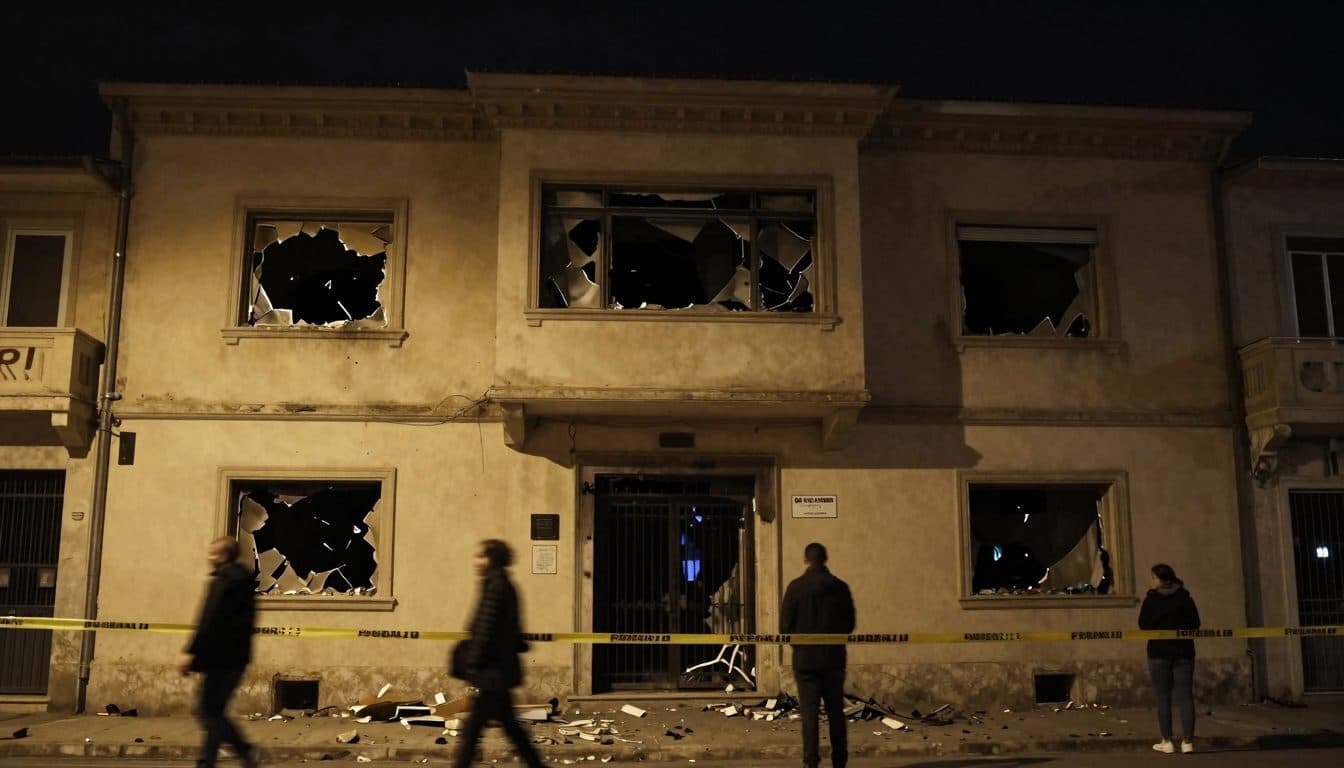
AI-generated image (z-image via Kie.ai)
Summary
A series of bomb attacks targeted the homes of three officials of the Greek conservative party New Democracy in Thessaloniki. One person was killed and four others were injured, according to the authorities.
A series of bomb attacks targeted the private homes of three officials of the Greek conservative party New Democracy in Thessaloniki on Wednesday, killing one person and injuring four others, according to the authorities.
In the port city of Thessaloniki, in northern Greece, makeshift explosive devices were placed outside the homes of three political figures of the ruling conservative party, New Democracy. According to information released by local authorities and picked up by several media outlets, one person was killed and four others were injured in these coordinated attacks.
The victim is the mother of Afroditi Nestora, a party candidate, the hospital where she was taken said on Wednesday evening. The exact circumstances of the death have not yet been detailed by investigators, but the attack on the family home was immediately linked to the series of attacks targeting New Democracy officials. Four other people were also injured, according to the same toll released by the authorities.
A coordinated attack against three officials
The events unfolded in an atmosphere of deep emotion in the country's second-largest city. Improvised explosive devices were placed in front of the homes of the three political figures during the night or in the early hours of the day. The blasts caused significant material damage to the facades and entrances of the buildings hit, and neighborhood residents reported broken windows for several meters around.
The Minister of Civil Protection, Michalis Chrysochoidis, described the perpetrators as « dumme und uneinsichtige Menschen », "stupid and narrow-minded people" who, in his view, deserve severe punishment. He promised that investigators would mobilize all available resources to quickly identify those who ordered and carried out these attacks.
The Mitsotakis government's response
Prime Minister Kyriakos Mitsotakis said he was « empört », "outraged", and spoke of a « feigen, terroristischen und mörderischen Anschlag », a "cowardly, terrorist and murderous" attack. He announced his trip to Thessaloniki to demonstrate the government's solidarity with the victims' families and the officials targeted. This visit, he stressed, was meant to « eine absolut klare und unmissverständliche Botschaft senden: null Toleranz gegenüber jeder neuen Form des Terrorismus, die in unserem Land auftreten könnte », "send an absolutely clear and unambiguous message: zero tolerance toward any new form of terrorism that might appear in our country".
After the death of one of the injured people was announced, Mitsotakis said the event « bestätigt den mörderischen und unmenschlichen Charakter der blinden Gewalt, die im öffentlichen Leben existiert », "confirms the murderous and inhuman character of the blind violence that exists in public life". The head of government also called for unity among the political forces to face what he described as a threat to democracy.
Within the New Democracy leadership, Konstantinos Kyranakis, a member of the party leadership, said « Die Täter hatten die Absicht zu töten », "the perpetrators intended to kill". He added that no intimidation would make the party back down: « Diejenigen, die seit Jahren eine Kultur der Toleranz gegenüber politischer Gewalt pflegen, sollten über ihre Verantwortung nachdenken », "those who, for years, have cultivated a culture of tolerance toward political violence should reflect on their responsibility".
A context of political tensions
These attacks come amid a context of political tensions in Greece over the issue of violence in public debate. Several government officials have called in recent months for a collective surge in response to a rise in incidents targeting elected officials or party staff, particularly in the greater Athens area and, more recently, in the north of the country. The authorities are not ruling out any lead for now, including far-left groups or organizations inspired by international terrorism.
Greek police have opened an investigation and deployed additional personnel in several neighborhoods of Thessaloniki, where checkpoints have been set up. Counter-terrorism services have been brought in, and the explosive devices recovered at the scenes are being analyzed by bomb disposal experts. The public prosecutor's office said the investigations would also look at possible links with similar incidents in other Greek cities in recent months.
Residents of the affected neighborhoods, in shock, described scenes of panic at the moment of the blasts. Several neighbors said they heard several closely spaced explosions, followed by shouts and people running through the streets. Emergency services quickly set up a security perimeter around the targeted homes and treated the wounded, some of whom were in serious condition.
The investigation and the security arrangements
Afroditi Nestora, the New Democracy candidate whose mother is among the victims, had not made any public statement at the time of writing. Those close to her said she was with her family and was cooperating with investigators. The party announced that a tribute would be organized in the coming days, once the funerals have been held.
Political reactions multiplied throughout the day. Several opposition parties condemned the attacks and expressed their solidarity with the victims' families and the officials targeted. In Parliament, in Athens, lawmakers from across the political spectrum observed a minute of silence. The Speaker of Parliament described it as a "serious attack on democratic life" and called for a common institutional response.
Mitsotakis also reiterated that his trip to Thessaloniki was precisely intended to show that the authorities would not yield to terror. "We will not allow political violence to take root in our country," he insisted, on the sidelines of an emergency meeting with the ministers of the Interior, Civil Protection and Justice. The three targeted officials agreed to briefly meet with the Prime Minister upon his arrival in the city.
International and national reactions
Greece has experienced waves of attacks in the past, particularly in the 2000s and early 2010s, attributed to groups such as "Conspiracy of Fire Cells" or "Revolutionary Struggle". Since then, pressure from counter-terrorism services had helped contain such actions, even though small groups continued to claim targeted attacks. The events in Thessaloniki have revived fears of a return of organized political violence.
Late in the day, police announced that they had recovered physical evidence at the scenes of the three attacks, including remnants of makeshift explosive devices similar to those used in past actions by anarchist-inspired groups. However, no claim of responsibility had been published by Wednesday evening, and investigators were cautious about formally identifying the perpetrators. Sweeps continued in several parts of Thessaloniki.
The government also said an expanded security council would be held in the coming days to assess the situation and, if necessary, strengthen protections for elected officials and party staff. Several measures, including reinforced video surveillance and better psychological support for victims, were being considered, according to a statement from the presidency.
At the European level, the Commission and several capitals sent messages of condolence and support to Greece. In a statement, the Commission denounced "an act of intolerable terrorism" and offered its technical assistance to Greek investigators, within the framework of existing police cooperation mechanisms. Some embassies in Athens advised their nationals to remain vigilant.
Greek authorities finally stressed that the priority remained the rapid identification of the perpetrators and those who ordered the attacks. "We will follow every lead, including those that lead abroad if necessary," a senior police official said on condition of anonymity. Investigations in the coming days are expected to focus on surveillance camera footage, intercepted communications and any eyewitnesses to the preparations.
For analysts interviewed, these attacks, whether or not claimed abroad, raise the question of the resilience of Greek political debate in the face of the temptation of violence. "When you attack private homes, you cross a red line," summed up a political scientist from the University of Macedonia in Thessaloniki, stressing that the state's response must match the shock caused in public opinion.
Questions & Answers
What happened in Thessaloniki?
During the night or in the early hours of Wednesday, makeshift explosive devices targeted the private homes of three officials of the Greek conservative party New Democracy in Thessaloniki, killing one person and injuring four others, according to the authorities.
Who is the victim who died?
The person killed is the mother of Afroditi Nestora, a New Democracy candidate, as specified on Wednesday evening by the hospital where she had been taken.
What was the reaction of the Greek Prime Minister?
Kyriakos Mitsotakis condemned a "cowardly, terrorist and murderous" attack, announced his trip to Thessaloniki and said he wanted to send a message of zero tolerance toward any new form of terrorism in Greece.
Attacks in Thessaloniki: one dead in New Democracy | allfacts360