Constitutional Court reviews messenger surveillance: Oral hearing raises fundamental rights questions
Vienna, 22 June 2026
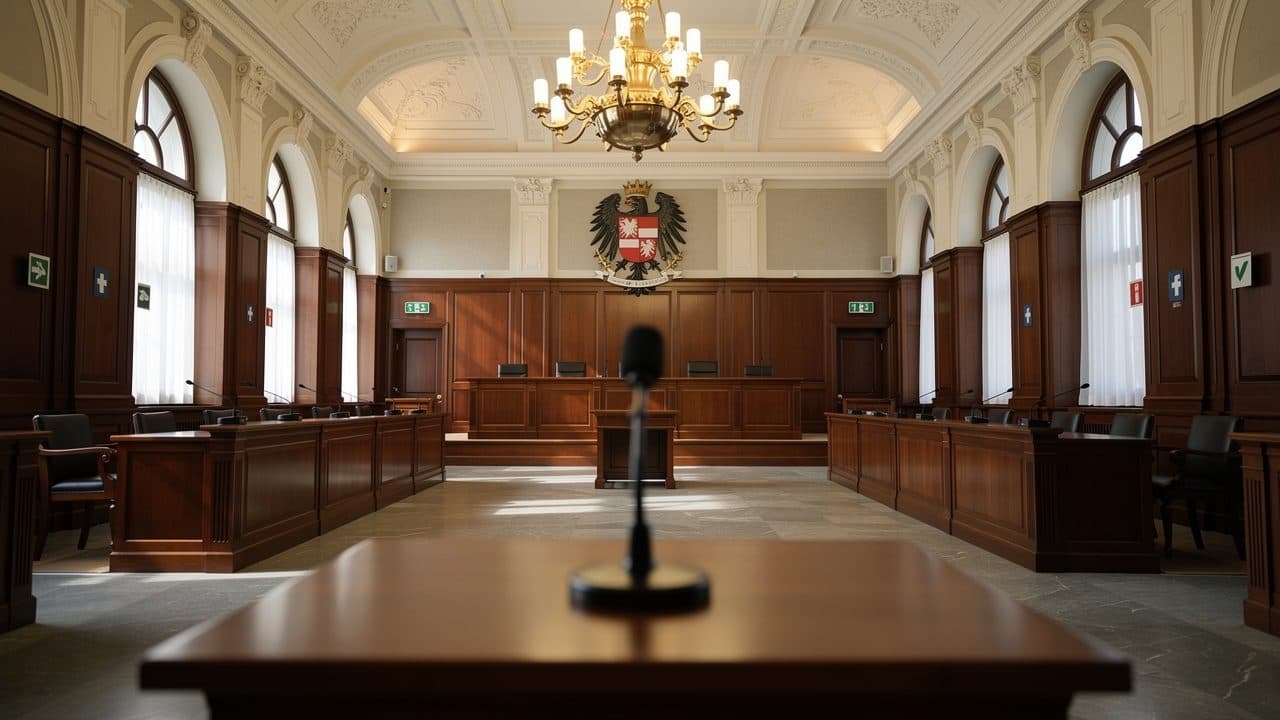
AI-generated image (flux-2/pro-text-to-image via Kie.ai)
Summary
The Constitutional Court has examined the controversial messenger surveillance of the black-red-pink coalition in a public hearing. Critics warn of massive infringements on fundamental rights, while supporters see an absolute necessity for the security authorities.
Vienna, 22 June 2026
The Constitutional Court (Verfassungsgerichtshof, VfGH) examined the controversial law on the surveillance of encrypted messenger communication in a public oral hearing on Monday, exploring fundamental rights concerns against the ÖVP's prestige project.
The hearing in Vienna is considered an important litmus test for a project that the government of ÖVP, SPÖ, and NEOS had passed with a large majority in parliament just under a year ago. At the center is the question of whether the state may in future read out encrypted chat communication on smartphones when conventional investigative steps are no longer sufficient to ward off a "constitutionally threatening attack."
To this end, software is to be installed on the affected individuals' devices that reads messages before they are encrypted. The coalition deliberately avoids the term "state trojan," but from critics' perspective it is de facto precisely such an instrument. The ÖVP itself also spoke internally of a program "that the coalition does not want to call a 'state trojan,' but de facto would be a state trojan."
Background: From the federal trojan to messenger surveillance
Lawyer Michael Rohregger, who appeared in the hearing, spoke of an "unprecedentedly invasive measure." The law comes with "massive infringements on fundamental rights" and is therefore not acceptable, he said. However, his fundamental concern was not objectionable: "The goal is not objectionable at all," Rohregger emphasized.
The head of the Directorate for State Protection and Intelligence Service (DSN), Sylvia Mayer, on the other hand defended the law as necessary. She spoke of the "unconditional necessity" of expanding investigative capabilities. From the perspective of the security authorities, one must be able to respond to changed threats.
A central point of criticism is that essentially nothing has changed compared to the 2019 predecessor provision on the "federal trojan." At that time, the VfGH had criticized that the previous law could have applied even to lesser offenses. The current regulation is more narrowly defined, but in its wording still closely follows the model.
Technical objections: Security vulnerabilities kept in reserve
The technical implementation is particularly controversial. According to a questionnaire obtained by DER STANDARD, the VfGH wants to know, among other things, whether security vulnerabilities must be exploited for messenger surveillance, how "the integrity of the evidence obtained through surveillance is ensured," and whether, for example, the commissioned software company could "read along."
In a written submission available to DER STANDARD, the FPÖ and the Greens warn of far-reaching consequences. To technically enable surveillance, vulnerabilities would have to be exploited and "kept open 'in reserve' until their use, even though this increases the vulnerability of the end devices to other actors as well." The state would "rather be obliged, in the interest of protecting its citizens, to report such vulnerabilities to the software manufacturers in order to enable them to fix them."
The parliamentarians also emphasize that the law affects the entire population: "Anyone who does not know whether their expressions are being monitored adjusts their communication accordingly." In their view, this so-called 'chilling effect' contradicts the liberal basic principle and the fundamental right to freedom of expression.
Political dimension: An ÖVP prestige project under pressure
The FPÖ and the Greens, who are jointly bringing the law before the VfGH, also harbor "considerable doubts" that the intended independent oversight is actually independent. They are thinking of possible ransomware attacks: "This can even affect critical infrastructure such as the healthcare system or energy supply."
In the parliamentarians' logical view, the authorities should therefore not be dependent on such security vulnerabilities at all. The application by the two opposition parties aims to annul the law in its entirety, as it goes beyond existing powers and is not constitutionally covered.
The ÖVP has particular political significance in the proceedings, as the law came about largely at the insistence of Federal Chancellor Christian Stocker and the People's Party. It would therefore hit the ÖVP all the harder if the Constitutional Court were to continue its strict jurisprudence on broadly defined surveillance measures – such as that on the so-called "federal trojan," which it killed off in 2019.
When the "federal trojan," later overturned by the VfGH as a "serious intrusion into privacy," was passed in 2018, then Interior Minister Herbert Kickl enthusiastically praised the surveillance instrument as part of the "largest security package." Today, FP Secretary General Christian Hafenecker is appalled by the "totalitarian surveillance madness" in the three-party coalition in view of the legally significantly more restricted messenger surveillance.
Open questions from the highest court
The political charge of the issue is also evident in a heated exchange of words. ÖVP Secretary General Nico Marchetti described the Freedom Party and the Greens in a press release, because of their application, as "police-haters" and Hafenecker in particular as a "hobby detective." This rhetoric underscores how much the coalition sees the issue as a core security policy question.
The fact that the VfGH is holding an oral hearing does not mean that it will announce its decision immediately. The 14 court members who sit on the panel want to probe critically, as emerges from the questionnaire. The decision could still take weeks or months.
Outlook: A decision with reach
In terms of content, it appears that the court will carry out a cool balancing of security interests and the protection of fundamental rights. Observers expect that the VfGH will examine in particular the question of proportionality and the depth of technical intrusion. Should the highest court follow the application, this would be a severe blow to the federal government's security policy and a signal that even modern surveillance instruments must be measured against fundamental rights.
At the same time, it is open whether the VfGH will annul the law in its entirety or only object to individual provisions. Experience with the "federal trojan" shows that the court is quite willing to make sharp corrections to security policy projects. The decision is awaited with excitement, both in political circles and among experts.
Questions & Answers
What exactly is the Constitutional Court examining in the hearing?
The VfGH is examining the law on the surveillance of encrypted messenger communication that the black-red-pink coalition passed the previous year. The FPÖ and the Greens have filed an application for its annulment, as in their view the law entails massive infringements on fundamental rights.
Who are the central actors in the hearing?
Lawyer Michael Rohregger represents, as a critic, the position that the law is not constitutionally acceptable. On the other side stands Sylvia Mayer, head of the Directorate for State Protection and Intelligence Service (DSN), who defends the law as absolutely necessary for the security authorities.
What role does the so-called federal trojan from 2019 play?
The predecessor "federal trojan" was overturned by the Constitutional Court in 2019 as a "serious intrusion into privacy" because it could have applied even to lesser offenses. Critics see the new messenger surveillance as essentially a continuation of this instrument that was struck down at the time.