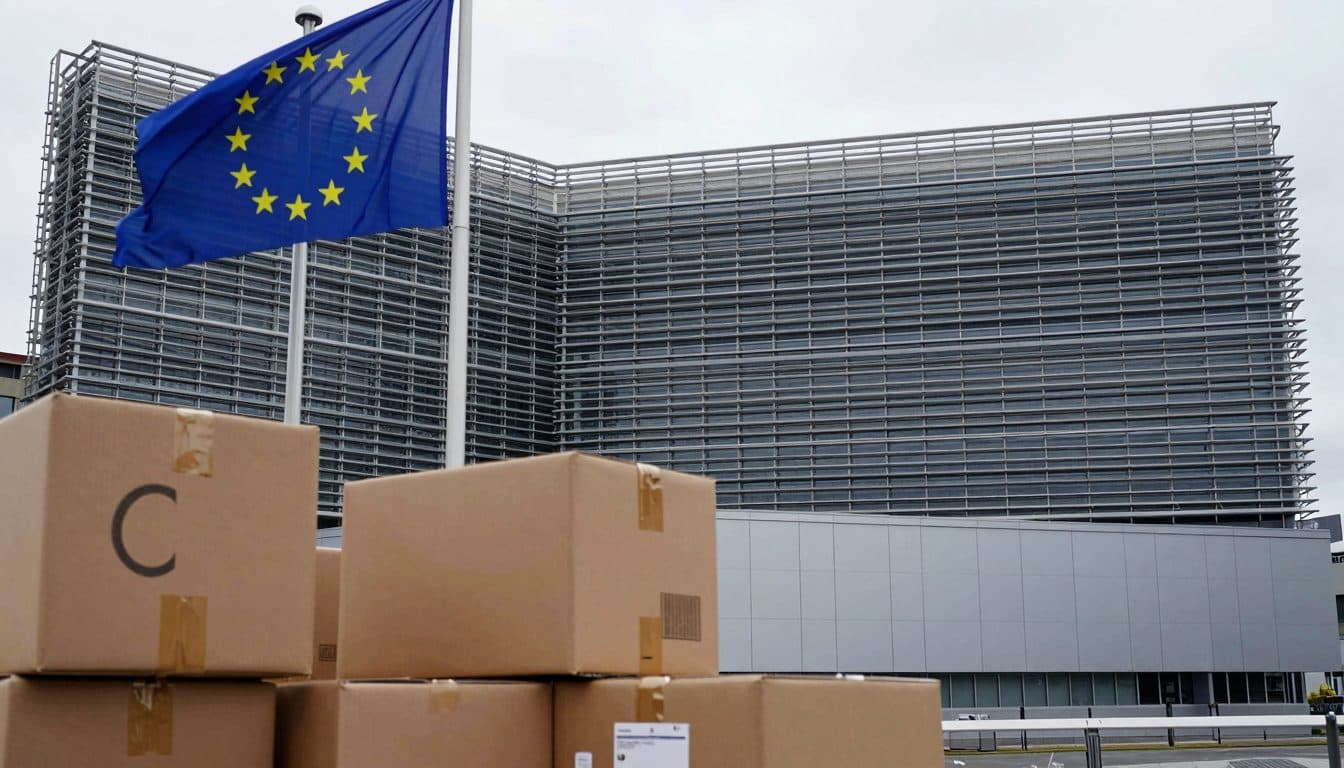
The EU Commission has imposed a record fine of €550 million on the online marketplace AliExpress because the platform failed to remove counterfeit clothing, unsafe toys, and dangerous cosmetics for weeks on end. It is the highest fine ever levied against a single company under the Digital Services Act; AliExpress announced it would appeal the decision.
Brussels, 20 July 2026
The EU Commission on Monday imposed a record fine of €550 million on the Chinese online marketplace AliExpress because illegal counterfeit clothing, unsafe toys, and dangerous cosmetics were sold via the platform.
Background of the Proceedings
The EU Commission accuses the marketplace, which belongs to the Alibaba Group, of having failed to properly enforce its sanctioning policy against sellers offering illegal products. According to Brussels, the relevant listings remained online for weeks despite complaints. In doing so, AliExpress violated obligations under the Digital Services Act (DSA), which has been in force since February 2024.
The fine now imposed is the highest ever levied against a single company under the Digital Services Act. The EU Commission opened the proceedings in March 2024; the investigation focused primarily on the years 2023 and 2024. The fine explicitly covers only the period up to June 2025.
Amount of the Fine: A Record Below the Maximum
The amount of the fine is, however, significantly lower than theoretically possible. The basis for calculation is the worldwide annual revenue of the Alibaba Group — the parent company of the marketplace accessible to EU consumers — of around €120 billion (996.347 billion renminbi yuan). With a cap of six percent of the previous year's revenue, the fine could have amounted to more than seven billion euros. As an EU representative confirmed to the dpa news agency, the actual fine therefore lies far below the possible maximum.
Henna Virkkunen, Executive Vice-President of the EU Commission for Technological Sovereignty and Security, justified the step in clear terms: "Größe ist keine Entschuldigung: Risiken müssen systematisch ermittelt und angegangen werden, um sicherzustellen, dass Verbraucher sicher online einkaufen können." At the same time, she called on AliExpress to take action: "Heute erwarten wir, dass Aliexpress diesen Standard einhält, und fordern sie auf, Maßnahmen zu ergreifen."
Reactions from Brussels and Beijing
AliExpress rejected the decision and announced it would appeal the fine. "Wir sind mit der heutigen Entscheidung und der unverhältnismäßigen Geldbuße nicht einverstanden," the company said in an initial response. It stated that the fine does not adequately reflect "die erheblichen, proaktiven Verbesserungen, die man vorgenommen habe." At the same time, it added: "Wir prüfen die Entscheidung sorgfältig und erwägen alle verfügbaren Optionen."
As early as June 2025, AliExpress had made concessions to the EU Commission and voluntarily committed itself to certain measures. The company had also argued that it was overwhelmed by the sheer volume of products when it came to monitoring them. The Commission, however, did not consider this sufficient justification.
AliExpress's Market Position in Europe
Last year, according to the EU Commission, 193 million shoppers used AliExpress's services — four times as many as in 2022. In Germany alone, the platform accounted for 5.3 percent of online retail revenues in the second quarter, as reported by the German E-Commerce and Distance Selling Trade Association (Bundesverband E-Commerce und Versandhandel Deutschland) — a record figure. By comparison, Shein had 156 million customers in the same period, and Temu had 130 million.
The EU Commission stated that AliExpress had failed to "wirksame Maßnahmen zu ergreifen, um das Risiko der Verbreitung verbotener Produkte zu verringern." The sanctioning policy had not been implemented appropriately, and shops selling illegal products had been able to remain active on the platform despite being penalized. An estimated 16 million packages per day travel from the Middle Kingdom to the EU; last year, the number of shipping packages from China with a goods value under €150 amounted to 5.9 billion units. 91 percent of these packages came from China.
Consumer advocates welcomed the move. Ramona Pop, board member of the Federation of German Consumer Organizations (Verbraucherzentrale Bundesverband), called it an important signal: "Unsichere und nicht-konforme Produkte gefährden Verbraucherinnen und Verbraucher und verzerren den Wettbewerb." It is not enough for illegal listings to be deleted as quickly as possible. The German Retail Federation (Handelsverband Deutschland) also reacted: "Wer europäische Regeln missachtet, muss mit spürbaren Konsequenzen rechnen," said Deputy Managing Director Stephan Tromp. Managing Director Rainer Will stated: "Wer Millionen Produkte in Europa verkauft, muss auch Verantwortung für deren Sicherheit übernehmen."
At the same time, Will criticized the EU-wide levy on cheap imports introduced in July 2026 as "paradox": While the EU Commission had imposed a heavy fine on AliExpress for systemic violations, precisely this platform would not be affected by the planned Austrian parcel tax because it falls below the envisaged revenue threshold of €100 million in Austria. For each parcel with a goods value of up to €150, a charge of three euros now applies.
Further Proceedings Against Online Platforms
This is not the first case of its kind. At the end of May 2026, the EU Commission had already imposed a fine of around €200 million on the Chinese online marketplace Temu, likewise for the sale of illegal products. In addition, the Commission had demanded €200 million from AliExpress almost two months ago; the €550 million fine now imposed replaces that earlier step. Proceedings under the Digital Services Act are also underway against other platforms, with which the EU Commission aims to regulate large online corporations more strictly.
EU representatives emphasized that the decision was deliberately set below the calculated maximum in order to avoid overburdening the courts while still delivering a clear sanction. The amount of €550 million represents a significant but proportionate intervention. For the Commission, the case is a litmus test for the enforcement of the DSA, which is regarded as a sharp sword against online giants.
Further developments now depend on the outcome of the announced appeal. Should the European Court of Justice confirm the fine, it is likely to set a precedent for future proceedings against other major platforms — and at the same time serve as the bill that online sellers can expect for inadequate control of illegal offerings in Europe.
Outlook: Consequences for the Industry
In conclusion, it remains to be noted that, with a view to 2025 and the following year, the Commission has announced a further tightening of its approach. Should violations occur again, additional sanctions — including possible coercive fines — cannot be ruled out.
Overall, the case shows that the EU is stepping up its regulatory rigour vis-à-vis non-European online platforms. The combination of billion-euro fines, parcel levies, and tightened product controls signals a strategic shift in consumer protection that is likely to have effects beyond the individual case.
Among experts, the fine is regarded as a political signal to all international platforms that EU rules will also be enforced against large corporations. Observers expect that other players, such as Shein, will increasingly come into the focus of Brussels's competition watchdogs in the future.
Questions & Answers
What exactly does the EU Commission accuse AliExpress of?
The EU Commission accuses AliExpress of having failed to properly enforce its sanctioning policy against sellers offering illegal products. As a result, counterfeit clothing, unsafe toys, and dangerous cosmetics remained available on the platform for weeks.
Why is the fine below the theoretical maximum?
The theoretically possible maximum fine would have been over seven billion euros — six percent of the Alibaba Group's worldwide annual revenue of around €120 billion. With €550 million, the EU Commission chose a significantly lower amount that, according to an EU representative, still constitutes a tangible sanction.
How has AliExpress reacted to the decision?
AliExpress rejected the decision as disproportionate and announced it would appeal the fine. The company pointed to its own concessions made in 2025 and said it was examining all available legal options.
EU Fine Against AliExpress: €550 Million Record Penalty | allfacts360