Federal Prosecutor's Office indicts four former leaders of the "Kingdom of Germany"
Düsseldorf, July 22, 2026
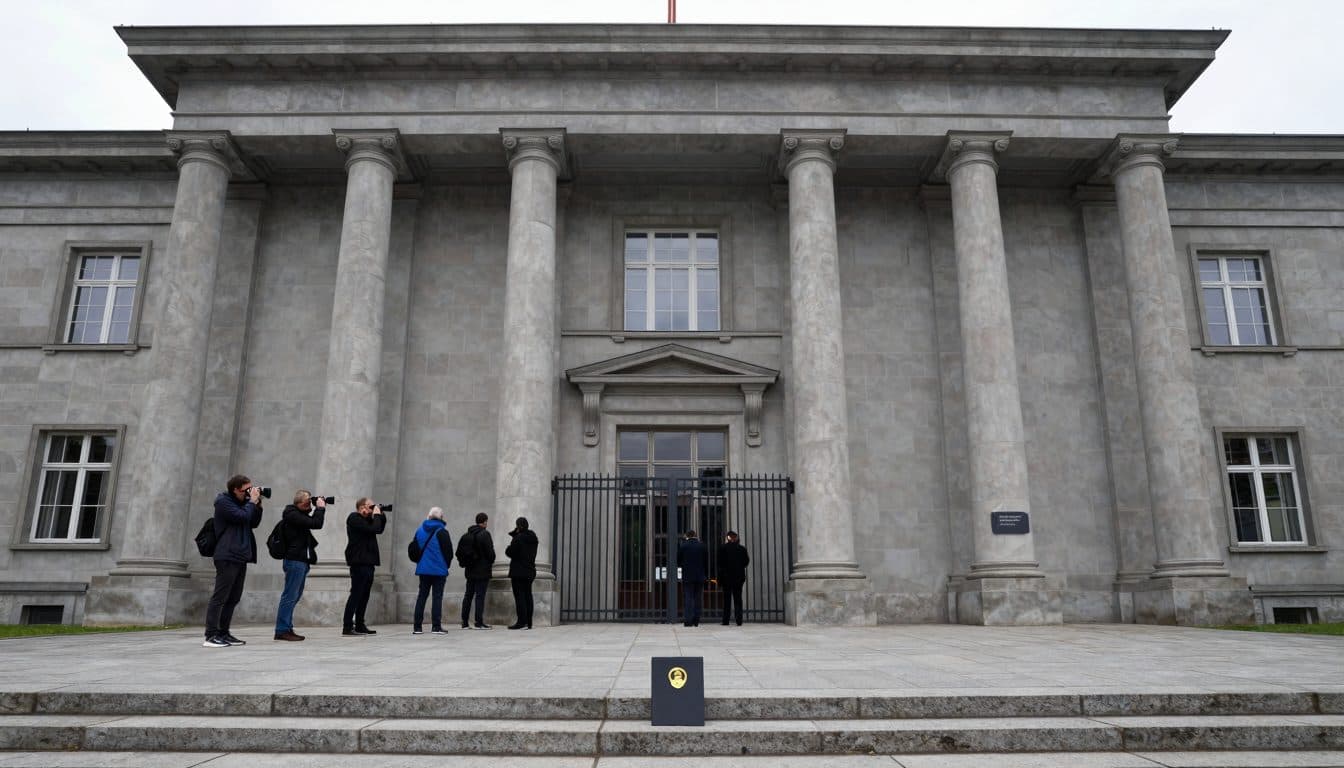
AI-generated image (z-image via Kie.ai)
Summary
The Federal Prosecutor's Office has indicted four former leaders of the now-banned Reichsbürger group "Kingdom of Germany" for membership in a criminal organization. The Higher Regional Court of Düsseldorf must now decide on the admission of the indictment and a date for the trial.
Düsseldorf, July 22, 2026
The Federal Prosecutor's Office has indicted four alleged leaders of the Reichsbürger group "Kingdom of Germany" (KRD), which has been banned since May 2025, including its founder Peter Fitzek.
Four alleged leaders of the banned Reichsbürger group "Kingdom of Germany" (KRD) have been indicted in Düsseldorf by the Federal Prosecutor's Office. Also indicted is the founder of the self-proclaimed "Kingdom of Germany," Peter Fitzek. The co-defendants include his two alleged deputies and a man said to have been responsible for finances, Mathias B., who is said to have been responsible for the finances of the whole operation since 2018. The four defendants have been in pretrial detention since their arrest on the day of the ban.
The State Protection Senate of the Higher Regional Court of Düsseldorf must now decide whether to admit the indictment and when the trial will take place. They are accused of having been active as ringleaders in a criminal organization. The founder, Peter Fitzek, is additionally charged with, among other things, operating an unauthorized insurance business and numerous cases of tax evasion.
Background: The structure of the "Kingdom"
According to the Federal Office for the Protection of the Constitution, the KRD was founded in 2012 in Wittenberg in Saxony-Anhalt. The association saw itself as an independent state with its own constitution, currency, and identity documents and was characterized by a personality cult around its "supreme sovereign," Peter Fitzek. As "supreme sovereign," Fitzek, a trained cook, had, according to the Federal Prosecutor's Office, "die Kontrolle und Entscheidungsgewalt in allen wesentlichen Bereichen" and thus determined the ideological orientation. The goal had been, "die gültige Rechtsordnung der Bundesrepublik Deutschland außer Kraft zu setzen und durch ein eigenes System zu ersetzen."
So-called Reichsbürger and self-administrators do not recognize the Federal Republic of Germany as a state. They reject democratic and constitutional structures such as parliament, laws, or courts. In line with the ideology of the so-called Reichsbürger and self-administrators, the organization had advertised for "system exit" from the Federal Republic of Germany and joining the "Kingdom of Germany."
Finances: Ten million euros and a currency of its own
Between 2020 and 2025, the organization took in funds amounting to around ten million euros, according to the Federal Prosecutor's Office. The "Kingdom" financed itself, according to the authorities, mainly through prohibited banking and deposit business as well as through donations, gifts, and income from seminars. The KRD created its own banking and insurance system with branches in Dresden, Ulm, Menden, and Wittenberg and advertised the exchange of euros for its own currency. An "E-Mark" (for digital payments) or "New German Mark" (for cash payments) corresponded to 1.10 euros. "Anhänger des KRD riskierten dabei große finanzielle Schäden, da das KRD nach eigenen Angaben keinen Rückzahlungsanspruch und keine Möglichkeit zum Rücktausch der „E-Mark" einräumte", writes the Federal Office for the Protection of the Constitution on its website. "Trotzdem erhielt das KRD von seinen Anhängern immer wieder beträchtliche Großspenden in bis zu fünfstelliger Höhe und Vermögenswerte".
Businesses were recruited with the promise that they could sell their goods and services tax- and duty-free. No taxes were paid on revenues of KRD-owned businesses, and neither income tax nor social security contributions were paid for employees. "Auf Umsätze von vereinungseigenen Betrieben wurden keine Steuern gezahlt", according to the Federal Prosecutor's Office. This resulted overall in an evasion of two million euros. More than two million euros were thus evaded. "Die Vereinigung finanzierte sich durch unerlaubte Bank- und Versicherungsgeschäfte sowie über Spenden, Geschenke und kostenpflichtige Seminare", the indictment states.
Taxes and real estate: Expansion of "state territory"
"Zudem warb das KRD Unternehmen mit dem Versprechen an, Waren und Dienstleistungen steuer- und abgabenfrei vertreiben zu können. Accordingly, the acquisition of real estate and land also played a major role, through which the "state territory" of the "Kingdom" was to be expanded. The properties were said to have been used for residential and settlement purposes as well as for business activities such as "system exit seminars." In 2022, the KRD is said to have acquired several properties in Lower Saxony, Thuringia, and Saxony. The money was apparently also used to acquire real estate and land to expand the "state territory" – in 2022, for example, in Lower Saxony, Thuringia, and Saxony.
Until the formation of a "Council of State" provided for in the KRD "constitution" and the election of a first king, the founder, Fitzek, born in Halle (Saale), was to act as trustee for all tasks. According to NDR information, the defendant Peter Fitzek has been offering walks in Hasbergen (Osnabrück district) since 2022 to win people over to the "Kingdom of Germany"; children are also said to have been present on these hikes.
Recruitment: Walks, seminars, and events
"Kingdom of Germany" ban 2025: Raids in the districts of Göttingen, Osnabrück, and Stade The Reichsbürger group was also active in Lower Saxony in Bad Lauterberg (Göttingen district). There, the "Kingdom of Germany" had acquired an empty spa hotel on the Wiesenbeker Teich in the Harz mountains and wanted to operate a kiosk. However, the Göttingen district banned this in 2023 due to missing building permits. An event of the "Kingdom of Germany" is said to have taken place in June 2022 at Kloster Malgarten in Bramsche.
On May 13, 2025, then-Federal Interior Minister Alexander Dobrindt (CSU) banned the at-that-time largest grouping of so-called Reichsbürger and self-administrators. On the same day, the Federal Prosecutor's Office had buildings searched nationwide and the four alleged ringleaders arrested in Rhineland-Palatinate, Saxony, and Brandenburg. A man from the Oder-Spree district in Grünheide was also arrested.
Ban and arrests in May 2025
According to its own statements, the KRD had 6,000 followers at the time, although the security authorities assumed rather around 1,000 followers. The scene comprised about 26,000 people in 2025, according to them. The Office for the Protection of the Constitution assumes around 30 such groups active across state borders. The "Kingdom of Germany" was for a long time the largest group of so-called Reichsbürger in Germany and has been banned since May 2025.
Now the Federal Prosecutor's Office has brought charges against four alleged leaders – including the so-called "supreme sovereign," Peter Fitzek. Four alleged members of the banned Reichsbürger group "Kingdom of Germany" have been indicted by the Federal Prosecutor's Office.
Outlook: Trial before the OLG Düsseldorf
Ten million euros in mostly illegal revenue. Purchase of "state territory" in Germany The Federal Prosecutor's Office has indicted four alleged leaders of the banned "Kingdom of Germany" (KRD) for their activity in a criminal organization. Between 2020 and 2025, the organization took in around ten million euros in this way. The KRD financed itself, according to the authorities, mainly through prohibited banking and investment business, donations, gifts, and fees for "system exit seminars."
Peter Fitzek, who had swapped his job as a cook for the role of self-proclaimed king, built up the KRD over more than a decade into what it claimed to be the largest Reichsbürger structure in Germany. Until the formation of a "Council of State" provided for in the KRD "constitution" and the election of a first king, the founder, Fitzek, born in Halle (Saale), was to act as trustee for all tasks. With the indictment, jurisdiction now lies with the State Protection Senate of the Higher Regional Court of Düsseldorf, which must decide on the admission of the indictment and a possible trial date.
For the around 26,000 people who, according to the Office for the Protection of the Constitution, are attributed to the Reichsbürger scene nationwide, and the approximately 30 groups active across state borders that the authorities are monitoring, the outcome of the proceedings in Düsseldorf is of considerable significance. For the first time, a court will have to deal in detail with the structure, finances, and ideology of the largest banned Reichsbürger group in Germany since the ban in May 2025.
Questions & Answers
Who is Peter Fitzek and what role did he play in the "Kingdom of Germany"?
Peter Fitzek is the founder of the "Kingdom of Germany" group, which was founded in 2012 in Wittenberg in Saxony-Anhalt, according to the Federal Office for the Protection of the Constitution. As "
Indictment "Kingdom of Germany": Proceedings against Fitzek | allfacts360