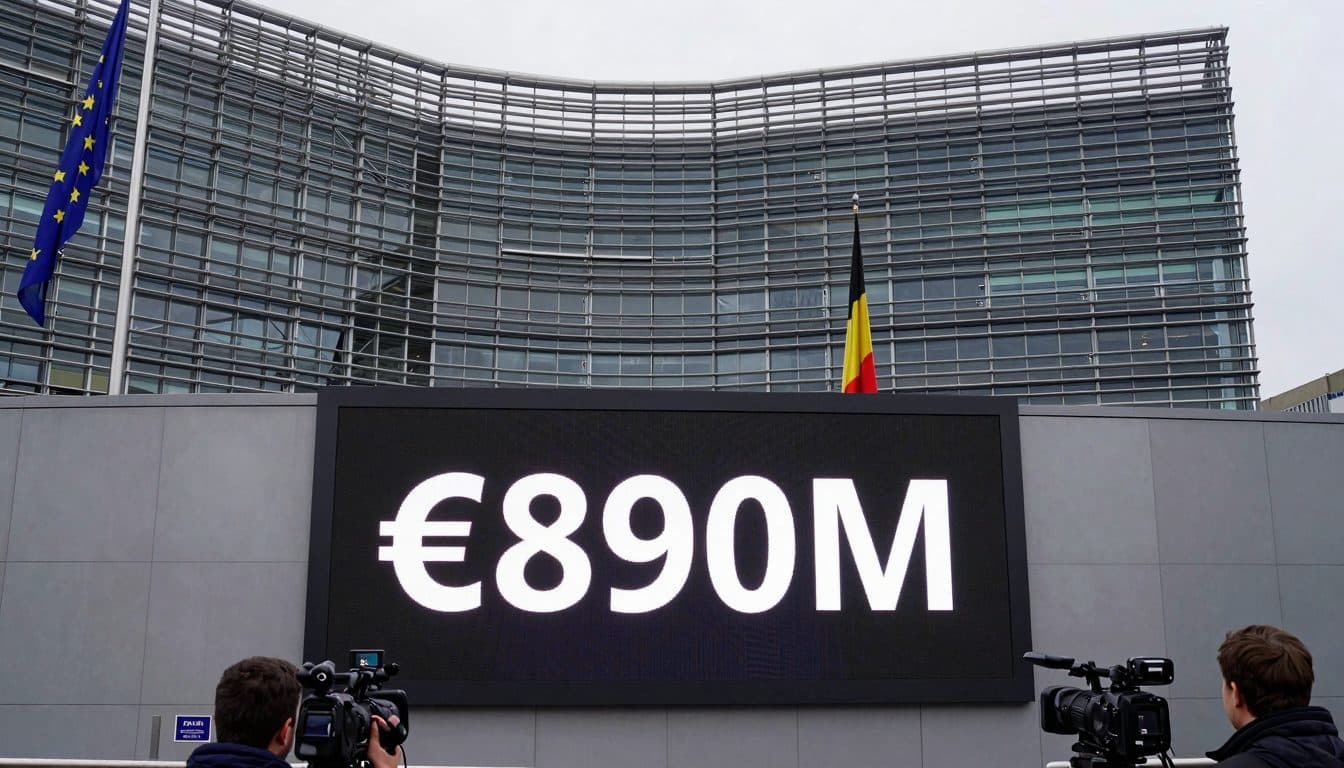
Google Fine EU: €890 Million Penalty Under the DMA
Brussels, 23 July 2026
AI-generated image (z-image via Kie.ai)
Summary
The European Commission has imposed a fine of €890 million on Google. It is the first sanction under the Digital Markets Act and concerns self-preferencing in Google Search as well as rules in the Google Play app store.
Brussels, 23 July 2026
The European Commission imposed a total fine of €890 million on Google in Brussels on Thursday because the US group had, in the view of the competition authorities, infringed the Digital Markets Act with its search engine and the app marketplace Google Play.
Two Proceedings, 60-Day Deadline
The fine is split across two separate proceedings for abuse of market power: €460 million relates to Google Search, €430 million to the app marketplace Google Play. As the European Commission announced, Google now has 60 days to comply with the decisions. Otherwise, penalty payments of up to five percent of average daily global turnover are threatened.
It is the first fine against the US group under the Digital Markets Act (DMA) and at the same time the highest sanction Brussels has issued to date under the regulatory framework that entered into force in 2022. The DMA classifies Google's parent company Alphabet as a so-called gatekeeper because its offerings represent an important gateway for consumers. Article 6(5) of the DMA prohibits precisely the kind of self-preferencing that the Commission is now accusing Google of.
Self-Preferencing in Google Search
In the first proceeding, the Commission accuses Google of ranking its own vertical search services such as Google Shopping, Google Flights, and hotel search more prominently in results than comparable offerings from third-party providers. Search engines must apply "transparent, fair, and non-discriminatory conditions" for ranking, according to Brussels. The preferential treatment of its own services in "shopping, hotels, transport, and sports results" constitutes a violation of the DMA's non-discrimination requirement.
Restrictions in the Google Play Store
The second proceeding concerns the rules for app developers. Google prevents them from informing users "free of charge about alternative, often cheaper offers and directing them to these offers," for example on websites or in alternative app stores. The group instead obliges developers to "communicate offers, promote offers, and conclude contracts with users not only within but also outside the Google Play App Store—technically as well as contractually—freely through the Google Play Store."
EU Competition Commissioner Teresa Ribera justified the decision on Thursday in clear terms. "The best products should succeed because they are better, not because they belong to the company that operates the search engine," said the Commission's Executive Vice-President. She added in French: "Google n'a pas respecté de manière effective le Digital Markets Act, et nous avons pris aujourd'hui des mesures coercitives décisives mais équilibrées pour sanctionner ces infractions."
Reactions from Brussels
EU Digital Commissioner Henna Virkkunen stressed the competition-policy purpose of the fine: "With this decision, we want to ensure competition." The Commission wants "to ensure that there is more competition and that other companies also have the opportunity to drive innovation." The dialogue with Google, which Brussels described as "constructive," has already begun to test corresponding changes.
Google rejected the accusations and criticized above all the practical consequences of the requirements. Company spokesperson Kent Walker said: "Regulierung sollte Produkte verbessern, nicht verschlechtern." The company argues that, to comply with the DMA requirements, it would have to remove real-time search features "that Europeans value, such as instant price quotes and direct availability of hotels, flights, and restaurants." Similar adjustments would be required in the Google Play Store, "to the company's incomprehension." Security features would even have to be dismantled there, according to the company.
Amount of the Fine: Too Low?
The fine is, in the EU Commission's view, appropriate with regard to the duration and impact of the infringements. The theoretical upper limit under the DMA is ten percent of global annual turnover, and twenty percent in the case of repeated infringements. Alphabet posted record revenue of around $402.8 billion in 2025, which would have meant a maximum penalty framework of around $40 billion. A fine of ten percent of global annual turnover, equivalent to approximately €40 billion, would also have been possible.
Competitors nevertheless consider the fine to be significantly too low. "€890 million in fines for a company with $400 billion in annual revenue is not a deterrent," said Wolfgang Oels, managing director of the European search engine Ecosia. The sum is "surprisingly low." Christian Kroll also stressed: "Since 2017, the Commission has imposed fines of more than eleven billion euros—fines that the company has always appealed and only paid in part after years." They are "a calculated part of a business model."
Google's Market Power
Criticism of the amount goes hand in hand with a fundamental debate about DMA enforcement. Katharina Nocun of LobbyControl accused the EU in Der Spiegel of an "implementation problem." Concerns that the proceedings are progressing too slowly are also widespread in the European Parliament. The Commission launched the proceedings in March 2024 but only communicated the preliminary findings in March 2025. Critics complained of a "significant delay."
Google's market-dominating status is undisputed: around 90 percent of all search queries worldwide go through Google Search; competing products such as Microsoft's Bing account for a market share of four to five percent. The managing director of a smaller search platform summed up the dynamic: "More users generate more data, which delivers better results, which attracts more users—a cycle from which one cannot exit without external intervention." Google possesses with its search index "a gigantic map of the entire internet." "No other company in the world possesses this data treasure," said the representative of the smaller search platform.
A Long List of Proceedings
With the fine, the EU is taking another step in a long series of competition proceedings against Google. In 2017, Brussels imposed €2.42 billion for the preferential treatment of its own price-comparison service. In 2018, around €4.34 billion followed for Android—in early July 2026, the European Court of Justice confirmed this record fine at a slightly reduced amount of €4.1 billion. In September 2025, €2.95 billion was added for adtech practices. A fine of €1.49 billion imposed in 2019 for the advertising solution AdSense, by contrast, was overturned by the ECJ. In addition, there are proceedings against other tech groups: in 2025, Brussels imposed €200 million on Meta and €500 million on Apple.
Internationally, the decision is causing political tensions. Just on Wednesday, Google's parent company Alphabet had reported quarterly revenue of around $112 billion; the fine corresponds to approximately US$1.02 billion. Already following the adtech fine in September 2025, US President Donald Trump had publicly described the decision as unfair and criticized it as the "next blow against a great American company." He even threatened tariffs at the time. On Friday, the 150-day timeframe for the US-imposed import tariffs expires; on Thursday, 12.5 percent tariffs were to come into force, directed against around 60 trading partners.
Tensions with Washington
US Trade Representative Jamieson Greer criticized on Thursday: "Diese Maßnahmen schaffen jedoch massive Unsicherheit für US-Exporte von Waren und Dienstleistungen nach Europa." A senior EU representative, by contrast, stressed that the EU has the "sovereign right" to regulate US tech companies within its own jurisdiction; the timing of the fine has no connection to the tariffs. The NEOS EU delegate, Anna Stürgkh, welcomed the action: "Es ist gut, dass die Europäische Kommission nun gegen diese Verstöße vorgeht." The SPÖ member of the European Parliament, Elisabeth Grossmann, cautioned: "Auch wenn von US-Seite Druck aufgebaut wird, darf Europa hier nicht einknicken."
The Commission is also receiving political support from the European Parliament. The Green Party's digital policy spokesperson, Süleyman Zorba, called on the EU Commission to continue enforcing European law: "Die Schonfrist für BigTech muss vorbei sein." Another proceeding, opened in November 2025, concerns the alleged downranking of news publishers in search results. Regulatory pressure on Google therefore remains high—and with it, the concern about an escalation in transatlantic relations.
ZDF correspondent Ulf Röller assessed, before the amount of the fine was announced, that the impact on EU–US relations "could be very, very great." Even after the decision, observers expect a reaction from Trump. Karen Grass, a colleague at ZDF, described the possible scenarios. One thing is certain: with the first DMA fine, the EU is sending a signal to the major tech platforms that self-preferencing of their own services in Europe will no longer be tolerated—even at the cost of new tensions with Washington.
Questions & Answers
What exactly did the EU Commission find Google guilty of?
The EU Commission accused Google of infringements of the Digital Markets Act in two separate proceedings: in Google Search, the company had favored its own services such as Google Shopping, Google Flights, and hotel search over competing offerings. In the Google Play app store, Google had prevented app developers from directing users to cheaper offers outside the Play Store.
How much money does Google have to pay and how much time does the company have?
In total, Google must pay €890 million, split into €460 million for the search engine and €430 million for Google Play. Google has 60 days to comply with the Commission's requirements, otherwise penalty payments of up to five percent of average daily global turnover are threatened.
Why do competitors such as Ecosia consider the fine too low?
Competitors argue that €890 million is not
Google Fine EU: €890 Million Penalty Under the DMA | allfacts360