Largest IPO in History: SpaceX Launches on Nasdaq with $75 Billion – Musk Becomes First Trillionaire
New York, June 12, 2026
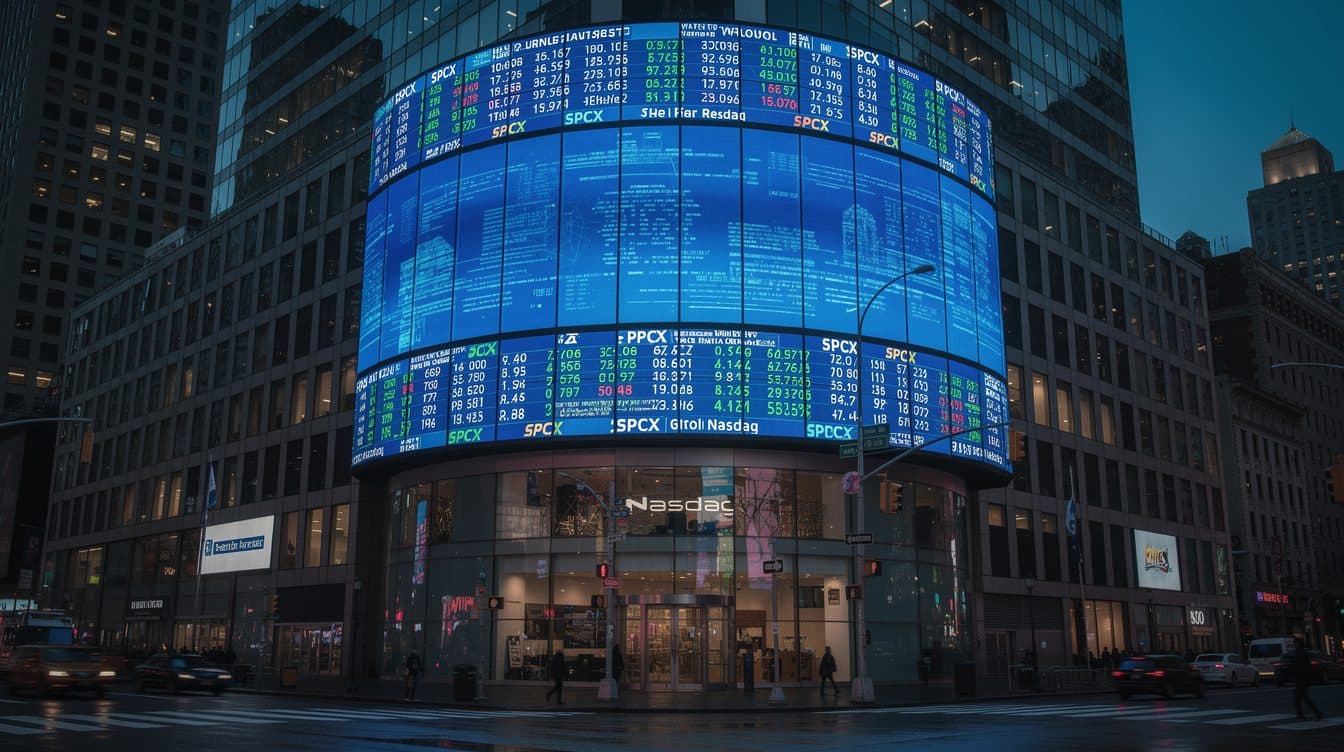
AI-generated image (flux-2/pro-text-to-image via Kie.ai)
Summary
The space company SpaceX on Friday completed what it says is the largest IPO in history, raising $75 billion. The jump to a $1.77 trillion valuation made founder Elon Musk the world's first trillionaire, according to Forbes.
New York, June 12, 2026
The U.S. space company SpaceX on Friday completed the largest IPO in the world by its own account, with a volume of $75 billion. Founder Elon Musk became the first person with a fortune of more than a trillion dollars through the surge in share price.
At the Nasdaq technology exchange in New York, the bells rang for the SpaceX share at 9:30 a.m. local time (3:30 p.m. CEST) on Friday, debuting under the ticker symbol SPCX. The company sold around 555.6 million shares at an issue price of $135, raising $75 billion ($64.8 billion euros). That puts the volume well above the previous record: Saudi oil company Aramco had raised around $29 billion in its 2019 IPO.
Record Volume and Heavy Demand
Even at the issue price, SpaceX reached a total valuation of $1.77 trillion – making it worth more than Facebook parent Meta out of the gate. On its first trading day, the SpaceX share climbed at one point to more than $170, closed at $161, and was thus around eleven percent above the issue price. In later trading, the price gain at times widened to around 30 percent, with the market capitalization surpassing the $2 trillion mark.
Unlike many other IPOs, SpaceX set the $135 issue price itself in advance. Companies typically first name a range – and then determine the price based on investor interest. In the SpaceX IPO, around a fifth of the nearly 555.6 million shares was apparently reserved for them, as the "Wall Street Journal" reported – far more than the usual five to seven percent that retail investors are normally allotted in IPOs.
Business Model: Starlink as Profit Driver
Demand far exceeded supply. According to financial service Bloomberg, retail investors placed orders worth more than $100 billion, with total demand said to have exceeded $250 billion. At a valuation of $1.8 trillion – and still no shortage of demand: today's SpaceX IPO is multiple times oversubscribed. The free float after the IPO is only around four percent, which observers consider unusually low.
The proceeds flow entirely into the company's coffers, including for the development of new rockets and the expansion of the AI business. SpaceX consists of three divisions with very different profiles: spaceflight, satellite internet, and AI. The Starlink satellite network, with more than 10,000 satellites in orbit, is used for internet provision, mobile telephony, and military communications. The satellite internet business around Starlink is the economic heart of SpaceX, generating around 60 percent of company-wide revenue in 2025 and an operating profit of around $4.4 billion – it is the only profitable unit.
Billions in Losses and High Investments
The group as a whole is deep in the red. Last year, there were losses of around $4.94 billion on revenue of $18.67 billion (just over 16 billion euros). One reason for the losses is the high cost of developing the large Starship rocket, into which SpaceX has so far invested more than $15 billion. In the IPO prospectus, the company reported revenue of just under $19 billion and a loss of $4.3 billion for the past year.
Data centers in space are also planned. "You could produce electricity very cheaply up there, and cooling in space is free as well," says digital expert Robert Fiege. Skeptics, however, point to problems such as the substantial construction costs, cooling that remains difficult despite the low temperatures in space, and the radiation that can damage circuits. Musk is planning, among other things, data centers in orbit – though whether this will technically work remains unclear.
Musk's Power After the IPO
In AI, SpaceX is broadly positioned through the acquisition of xAI, which also includes the chatbot Grok and the online platform X. The AI chatbot Grok lags behind the competition and is considered unreliable. The AI business, including the planned data centers in space, is valued at hundreds of billions of dollars, but little of that is visible so far. In the IPO prospectus, SpaceX estimated the future total market for artificial intelligence, including infrastructure, at more than $26 trillion – and cited this as a justification for the high valuation. New York economics professor Aswath Damodaran sharply criticized that.
Musk holds the control: "Musk, who thanks to his supervoting shares has sole say at SpaceX" and after the IPO holds more than 80 percent of the voting rights. That means no one can push him out of the company. Index providers Nasdaq and FTSE Russell changed their rules at short notice for this purpose, while MSCI referred in May to rules introduced in 2007 for large IPOs so that the SpaceX share could be quickly included in its indices. S&P Dow Jones, on the other hand, is holding firm and sticking to the rule that the share can only enter the S&P 500 select index after twelve months on the market.
From Start-up to Trillion-Dollar Company
Through the IPO and the associated appreciation of his SpaceX stake, Elon Musk became – according to Forbes – the first person with a fortune of more than a trillion dollars. At Friday's prices, the SpaceX stake of more than $800 billion now makes up the bulk of his wealth. Shares and options in the also Musk-led electric car maker Tesla push him past the trillion-dollar mark. However, all of this is stock wealth, dependent on price swings and not easily converted into cash.
At the trading debut, Musk said, among other things, that he had given SpaceX a ten percent chance of success when founding it. Musk is founder and CEO of SpaceX and holds a stake of around 40 percent. Founded in 2002, the company was originally designed to drastically reduce the cost of rocket launches and eventually build a colony on Mars. Musk's plans to colonize Mars are dismissed by experts as "Wahnbild" (delusion).
In the days before the trading debut, Musk found time to once again interfere in British politics. Through his online platform X, he amplified voices of extreme critics of Britain's immigration policy ahead of racially motivated riots. His life consists of «grossen Höhen, schrecklichen Tiefen und unerbittlichem Stress», as he himself once put it. Musk is often too optimistic in his announcements, which are sometimes fulfilled only years after the deadlines he names.
Warnings of a Speculative Bubble
Financial experts view the valuation critically. The chief investment strategist at BNP Paribas Wealth Management considers SpaceX's high valuation "sehr ambitioniert" (very ambitious). "An unprofitable company with the hope of sharply rising future profits is pulling off a record IPO – that naturally evokes memories of the tech bubble of the late 1990s." Morningstar analysts, with a calculated valuation of $780 billion, did not even reach half that amount.
Risk Warnings for Retail Investors
The Interessenverband für Anleger (IVA) urges potential shareholders to exercise caution in view of the U.S. space company's record IPO. The IVA therefore advises investors not to make purchase decisions based solely on media reports or social media euphoria, to examine fundamentals and assess them realistically, and to invest only if a financial loss would be bearable. "Inexperienced investors in particular run the risk here of buying in near a market high and subsequently suffering significant losses," warns association board member Florian Beckermann. Moreover, spaceflight remains a "Hochrisikogeschäft" (high-risk business), dependent on technology, regulation, accidents, geopolitics, or fewer government contracts.
In Austria, the stock was not offered in the run-up to the IPO. Those who wanted the share had to turn to brokers in third countries. As a rule, however, these charge corresponding surcharges on the issue price, meaning that "Abzocke" (rip-offs) cannot be ruled out, it was said further. Around 4,400 employees could become millionaires through the IPO, the New York Times calculated. A wave of selling could already come at the end of August, when the lock-up periods for SpaceX managers and employees gradually expire.
Questions & Answers
Who is Elon Musk and what role does he play at SpaceX?
Elon Musk founded the space company SpaceX in 2002 and is its CEO. After the IPO, he holds around 40 percent of the shares and controls more than 80 percent of the voting rights through supervoting shares.
Why is the SpaceX IPO considered historic?
With a volume of $75 billion, the IPO surpassed the previous record holder, Saudi Aramco from 2019, which had raised around $29 billion. At the issue price, SpaceX was valued at $1.77 trillion.
What risks do experts see in the SpaceX share?
Investor advocates such as the Austrian IVA warn of overvaluation and point to high losses, dependence on future profits, and Elon Musk himself as a risk factor due to controversial statements and political controversies.
SpaceX IPO: Largest IPO in History at $75 Billion | allfacts360