Merz announces special session of the Union parliamentary group on July 29 on Spahn's succession
Berlin, July 20, 2026
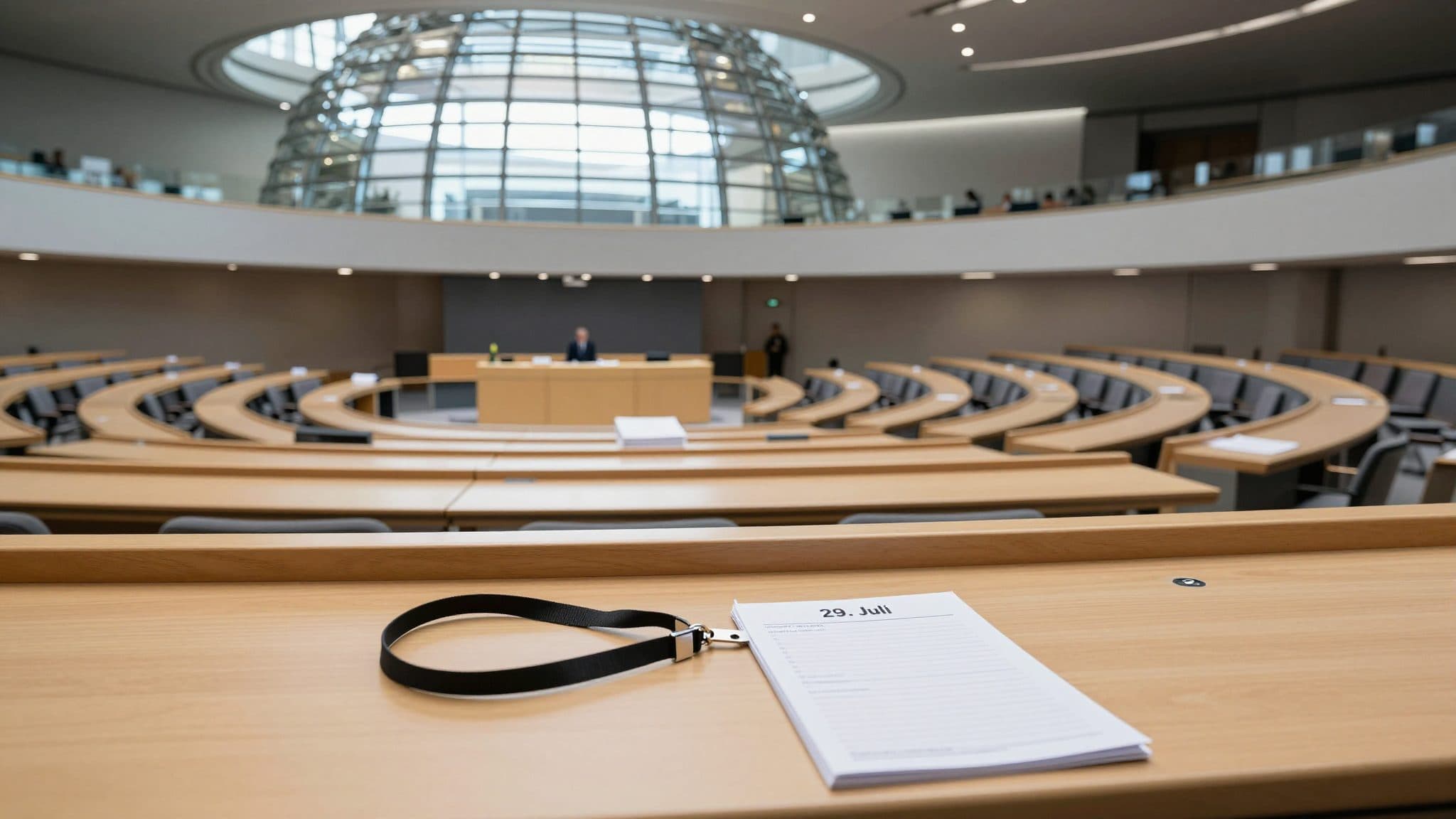
AI-generated image (z-image via Kie.ai)
Summary
Federal Chancellor Friedrich Merz, together with CSU leader Markus Söder, has convened a special session of the CDU/CSU Bundestag parliamentary group for July 29 to arrange the succession of the resigned group chairman Jens Spahn. Both party leaders are currently drafting a joint personnel proposal; Head of the Chancellery Thorsten Frei is considered the favorite.
Berlin, July 20, 2026
Federal Chancellor Friedrich Merz (CDU) and CSU leader Markus Söder have convened a special session of the CDU/CSU Bundestag parliamentary group for July 29 to determine the succession of the group chairman Jens Spahn, who resigned last Saturday.
Special session and procedure
The special session is planned for 2 p.m. in person at the Berlin Reichstag building, the Deutsche Presse-Agentur reported, citing sources from the CDU Presidium. According to this, the 208 members of the parliamentary group were informed of the extraordinary meeting on Monday by SMS from the acting group chairman Alexander Hoffmann (CSU) and the parliamentary managing director Steffen Bilger (CDU). "Liebe Kolleginnen und Kollegen, unsere Parteivorsitzenden von CDU und CSU sind derzeit damit befasst, einen Personalvorschlag für den Fraktionsvorsitz zu erarbeiten. In diesem Prozess wird die Einbindung der Fraktion sichergestellt", the message, which is available to the Tagesspiegel, reads. With the note "Die Abgeordneten der Fraktion werden dafür aus der parlamentarischen Sommerpause geholt" and the request "Wir bitten daher, Eure Anreise nach Berlin zu organisieren", "Alexander und Steffen" signed the invitation.
The background to the resignation is the publicly revealed use of surrogacy in the USA by Spahn and his husband Daniel Funke. A surrogate mother in the United States carried their shared son Georg; Funke is the biological father. Surrogacy is prohibited in Germany, the CDU expressly rejects it, and Spahn himself had spoken out against surrogacy in the past. In his letter of resignation, Spahn stated: „Denn der Spagat zwischen meiner privaten Entscheidung zu einem Kind durch Leihmutterschaft und der nachvollziehbaren Erwartung an mich als Vorsitzenden unserer Fraktion ist größer geworden, als ich es erwartet hatte." He had also "die Parteivorsitzenden von CDU und CSU, Friedrich Merz und Markus Söder, darüber informiert, dass ich mit diesem Schreiben an unsere Fraktion von meinem Amt als Vorsitzender der CDU/CSU-Bundestagsfraktion zurücktrete."
Background: Spahn's resignation
Merz had previously called on Spahn to resign. „Glaubwürdigkeit ist das höchste Gut in der Politik", the Chancellor said, describing Spahn's resignation in a statement as "richtig" and "unvermeidlich". At the same time, Merz criticized that Spahn had "die Partei und die Fraktion sehr, sehr spät über das alles informiert". Already on Saturday, Merz had announced that he would, in coordination with Markus Söder, make a proposal for the new appointment to the group leadership. Both party leaders now declared in the CDU Presidium, which met on Monday morning at the Adenauer House in Berlin, that the special session would take place on July 29.
Merz personally attended the Presidium meeting, as did Parliamentary Managing Director Bilger, Saxony-Anhalt's Minister President Sven Schulze, Brandenburg's Deputy Minister President Jan Redmann, and Deputy CDU Secretary General Christina Stumpp. A large part of the Presidium members were connected via video. Spahn himself did not attend – at the time the meeting began, it was 5 a.m. local time in New York, where Spahn was staying with his husband and son, according to sources from the parliamentary group. After his resignation, Spahn is no longer a Presidium member and no longer holds any office that would allow him to attend.
Pressure from the states: Saxony-Anhalt and Mecklenburg-Western Pomerania
The debate over Spahn's succession comes at a politically tense phase: state elections are due in the autumn in Saxony-Anhalt (September 6), Mecklenburg-Western Pomerania, and Berlin. In Saxony-Anhalt, the AfD is significantly ahead of the ruling CDU of Minister President Sven Schulze in current polls. Before the Presidium meeting, Schulze told MDR Aktuell that the debate over Jens Spahn was "nicht hilfreich, sondern schade dem Wahlkampf", and added: „Es ist gut, dass das Thema jetzt gelöst wird." Schulze hopes "dass wir Wahlkampf machen können, ohne dass wir permanent an den Wahlkampfständen auf Berliner Themen angesprochen werden". Until now, these Berlin issues had "überlagerten" his campaign, as well as those in Mecklenburg-Western Pomerania and Berlin.
The CDU state chairman in Mecklenburg-Western Pomerania, Daniel Peters, who is also the CDU's top candidate for the state election there in September, reiterated the demand for a swift resolution in Deutschlandfunk. „Die Union könne den Sommer nicht mit Personalfragen verbringen", Peters said. „Die Entscheidung dürfe sich nicht über mehrere Tage oder Wochen ziehen." In a Politico podcast, he stated: „Es hat nur dann Auswirkungen, wenn wir uns mit dieser Personaldebatte Zeit lassen, wenn wir uns in eine wochenlange Diskussion über mögliche Nachfolger begeben." Peters also criticized that it was not acceptable "wenn ein Politiker selbstgeschaffenes, selbstverantwortetes Recht so umgeht".
Possible successors
According to consistent media reports, Head of the Chancellery Thorsten Frei (CDU), who already served as Parliamentary Managing Director under Merz in the last legislative period, is currently considered the favorite for Spahn's succession. Asked about Frei as "Top-Kandidat für den Fraktionsvorsitz" in the ZDF summer interview, Merz said he did not know, "wer Frei zum Top-Kandidaten gemacht habe. Er höre das zum ersten Mal". In addition, CDU Secretary General Carsten Linnemann, Deputy Group Chairman Günter Krings, Federal Interior Minister Alexander Dobrindt (CSU), and Federal Health Minister Nina Warken are being discussed as possible candidates. Linnemann (48) is given only outsider chances, Dobrindt (56) is considered unlikely to move to the group leadership, Warken (47) is the only woman among those mentioned. Krings (56) has been a member of the Bundestag for 24 years and leads the influential North Rhine-Westphalian state group.
Should Head of the Chancellery Frei move to the group leadership, a cabinet reshuffle would also be necessary, according to observers. The personnel matters would thus be directly linked. Asked about conceivable scenarios, the SPD-led side initially did not rule out a comment; SPD group chairman Matthias Miersch merely stated that he and Spahn had worked together in the coalition "sehr eng und vertrauensvoll".
Merz himself had already hinted on Sunday evening in the ZDF summer interview at the scope for possible government changes. „Es könnte eine Gelegenheit sein, noch einmal über die Aufstellung der Bundesregierung nachzudenken", the Chancellor said – expressly in the subjunctive. He repeatedly emphasized that he was speaking not in firm intentions, but in possibilities. On the sidelines, he also pointed in the interview to women in leadership positions such as Bundestag President Julia Klöckner and said: „Ich tue alles, um das noch besser zu machen."
Voices from political Berlin
Greens co-chair Franziska Brantner called on Merz directly in the ARD summer interview with regard to the cabinet formation: „Das wäre doch jetzt der Moment für Herrn Merz, wirklich zu sagen: Jetzt Tabula rasa, wir gehen jetzt nochmal neu los." She added that Merz now has the chance to free himself "im Kabinett von allen, die da handwerkliche Schwächen haben, und von jenen, die ideologisch verbohrt sind". Left Party leader Luigi Pantisano and Brantner called Spahn's resignation in the Rheinische Post "längst überfällig" and pointed to earlier mistakes by Spahn such as the overpriced mask purchase. FDP leader Wolfgang Kubicki called Spahn's behavior a "weiteren moralischen Tiefpunkt der CDU". AfD leader Alice Weidel expressed herself similarly on the platform X.
From the ranks of the Union came partly sharp criticism of Spahn, but also partly approval of his withdrawal. Sebastian Steineke, chairman of the Brandenburg CDU state group in the Bundestag, said: „Ich sehe keinen Schaden für die Fraktion. Der Rückzug von Jens Spahn bietet jetzt die Möglichkeit für eine Neuaufstellung. Diese Chance sollten wir nutzen." Thuringia's CDU Secretary General Niklas Waßmann announced that Spahn had drawn the "richtige Konsequenz". The CDU leadership and the group leadership are thus striving to carry out the personnel upheaval swiftly and in unity.
Observers expect that the actual decision will only be made in the special session on July 29. With regard to the timing, persons familiar with the matter explained that no decisions were to be expected on the day of the Presidium meeting itself. Merz' schedule-free time begins at the end of July; by then, the personnel matter should be settled, it was said. The executive committee of the Bundestag parliamentary group still wanted to meet on
Merz: Special session of the Union parliamentary group on | allfacts360