Pashinyan's ruling party wins parliamentary election in Armenia – EU accession remains open
Yerevan, June 8, 2026
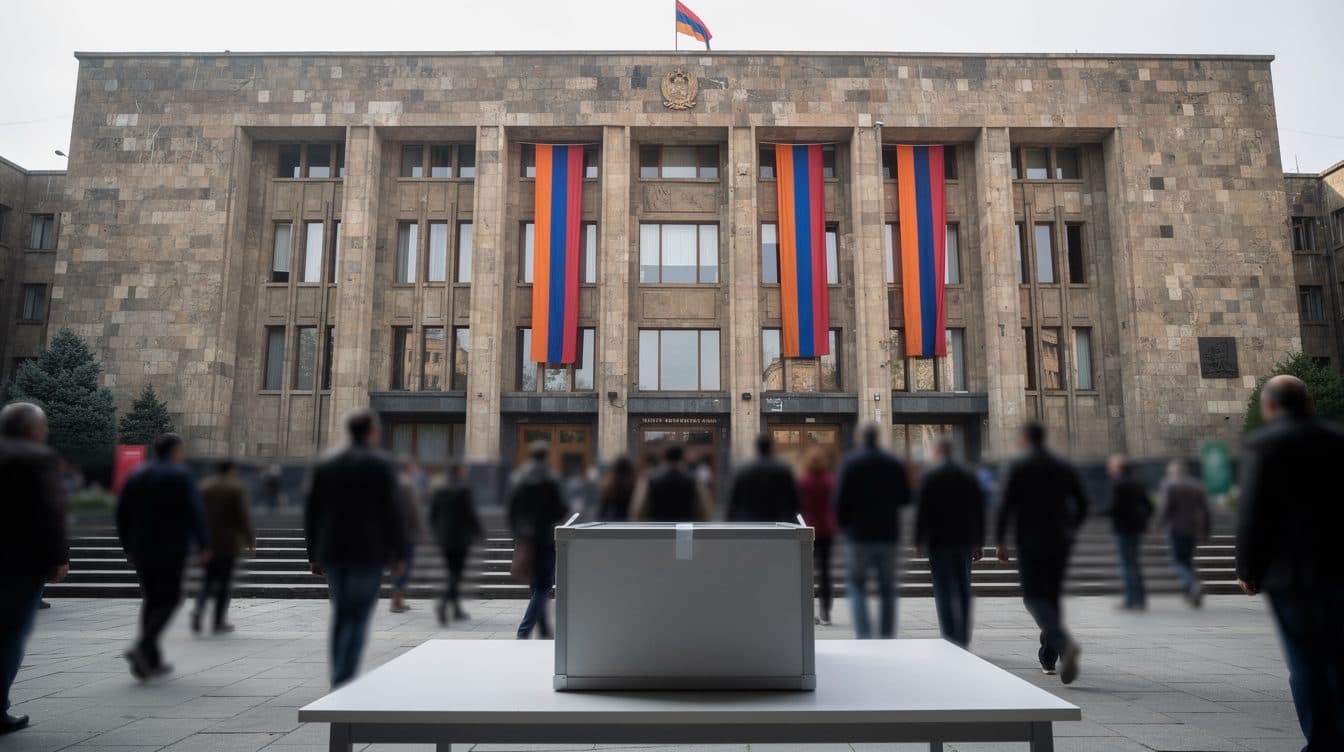
AI-generated image (flux-2/pro-text-to-image via Kie.ai)
Summary
In the parliamentary election in Armenia, the pro-Western ruling party of Prime Minister Nikol Pashinyan received the most votes but missed an absolute majority. The EU offered praise after the election victory, but the country's accession remains up in the air.
Yerevan, June 8, 2026
In the parliamentary election in Armenia, the pro-Western ruling party of Prime Minister Nikol Pashinyan won the vote but narrowly missed an absolute majority.
Foreign policy tug-of-war between East and West
The election on Sunday in the South Caucasus was dominated by a foreign policy tug-of-war. After the victory of his "Civil Contract" party, Pashinyan spoke of a "historic victory" and announced that he wanted to "secure Armenia's survival and development." As reported from the polling station, election day had already begun in the morning with arrests.
Within the country, the vote is seen as a directional decision between stronger ties with the West and a continued orientation toward Russia. Observers also interpret the outcome as a personal vote of confidence for the 51-year-old, who has led the country as prime minister since 2018.
His political career had humble beginnings. Pashinyan was born in 1975, when Armenia was still part of the Soviet Union. In Yerevan, he studied journalism – until he was expelled from university for regime-critical texts. In the 1990s, Pashinyan worked for various opposition newspapers before eventually going into politics. As early as 2007, he made his first attempt to enter parliament – and failed. It was only in 2012 that he entered parliament as a deputy, founded his "Civil Contract" party, and led it to power.
Political biography: From the opposition to the highest office
Domestically, the head of government is confronted with the consequences of the Nagorno-Karabakh conflict. In 2020, Armenia lost the major war with Azerbaijan over Nagorno-Karabakh. Pashinyan resigned, ran again in 2021 – and won with an absolute majority. In 2023, Azerbaijan then likely conquered Nagorno-Karabakh for good. Alexander Iskandaryan, director of the renowned Caucasus Institute, assessed the prime minister's strategy as follows: "He considers the fulfillment of Azerbaijan's demands to eliminate threats as the most important instrument of his policy."
Congratulations came from the West. US President Donald Trump sees Pashinyan as a "great friend and leader" and declared before the election that he shares his vision of peace and prosperity for Armenia and the entire South Caucasus region. Praise also came from the EU: After the election victory, much praise is now coming from the EU, but accession remains up in the air. There is no official accession perspective attached to it.
Reactions from Washington and Brussels
At the same time, the relationship with Russia remains a factor that Pashinyan cannot openly break. Armenia is a member of the Moscow-led Collective Security Treaty Organization, while Yerevan has repeatedly held Western military exercises in recent years. This dual structure makes every foreign policy course setting delicate, because it affects the security policy balance in the South Caucasus.
Observers see two signals in the election outcome. First: The pro-Western ruling party remains in the lead in elections, but has lost support. It is no longer enough for an absolute majority in 2026. Second: A significant portion of voters appears to want a more decisive departure from Moscow and a faster EU course, without an alternative political force being able to implement this in the foreseeable future.
Weaker majority, more difficult government formation
For government formation, the result means considerably more effort. Pashinyan must seek coalition partners to build a viable majority in parliament. Commentators in Yerevan assume that this will limit the premier's room for maneuver, especially on sensitive issues such as normalization with Azerbaijan and the question of Western military presence in the country.
In private, the head of government tends to be rather reserved. Pashinyan is married to a journalist, and the two have three daughters and a son. Little is known about the family environment; reports on the family's daily life are rare, and the prime minister himself speaks only sporadically about his private life.
It remains unclear how the election result will affect the peace process with Azerbaijan. In recent months, Pashinyan had repeatedly emphasized that a reconciliation with Baku was in the interest of Armenia's security. Critics at home accuse him of making too many concessions in the process. Whether the weakened majority will continue to carry this line forward will become clear in the coming weeks.
The EU is likely to continue its pragmatic course for the time being. In recent years, Brussels has increased aid programs and prepared visa liberalizations, without, however, launching formal accession negotiations. The restraint also has internal European reasons: several member states are skeptical of further enlargement.
Outlook on the peace process with Azerbaijan
In the region itself, the election is being closely observed. Georgia is pursuing a significantly more conservative domestic political course, and Turkey maintains close relations with Azerbaijan. For Armenia, this means: every step toward the West is noted in the neighborhood, every rapprochement with Moscow is noted in Brussels.
Overall, the election shows that the government's pro-Western orientation has majority support in Armenian society, but is not a given. The outcome gives Pashinyan backing for his course, but at the same time forces him into compromises that could dilute his foreign policy signature.
The article was written by Jo Angerer and published on June 8, 2026. It classifies the vote as a tug-of-war between East and West – an image that has gained in sharpness after the election, even if the basic direction of Armenian politics remains stable for the time being.
Questions & Answers
Who is Nikol Pashinyan?
Nikol Pashinyan has been prime minister of Armenia since 2018 and is the founder of the "Civil Contract" party. The 51-year-old studied journalism in Yerevan and worked for various opposition newspapers before his political career.
Why is the election in Armenia described as a tug-of-war?
The election was classified as a tug-of-war between East and West because Armenia stands between stronger ties with the EU and a continued orientation toward Russia. Both directions have security policy consequences for the South Caucasus.
How did the EU and the USA react to the election victory?
After the election victory, praise came from the EU, but according to the report, accession remains up in the air. Before the election, US President Donald Trump described Pashinyan as a "great friend and leader" and shared his vision of peace and prosperity for the region.
Pashinyan election victory Armenia 2026: Government without | allfacts360