Pius Brotherhood consecrates four bishops against the Pope's will – Rome prepares excommunication
Écône, 02 July 2026
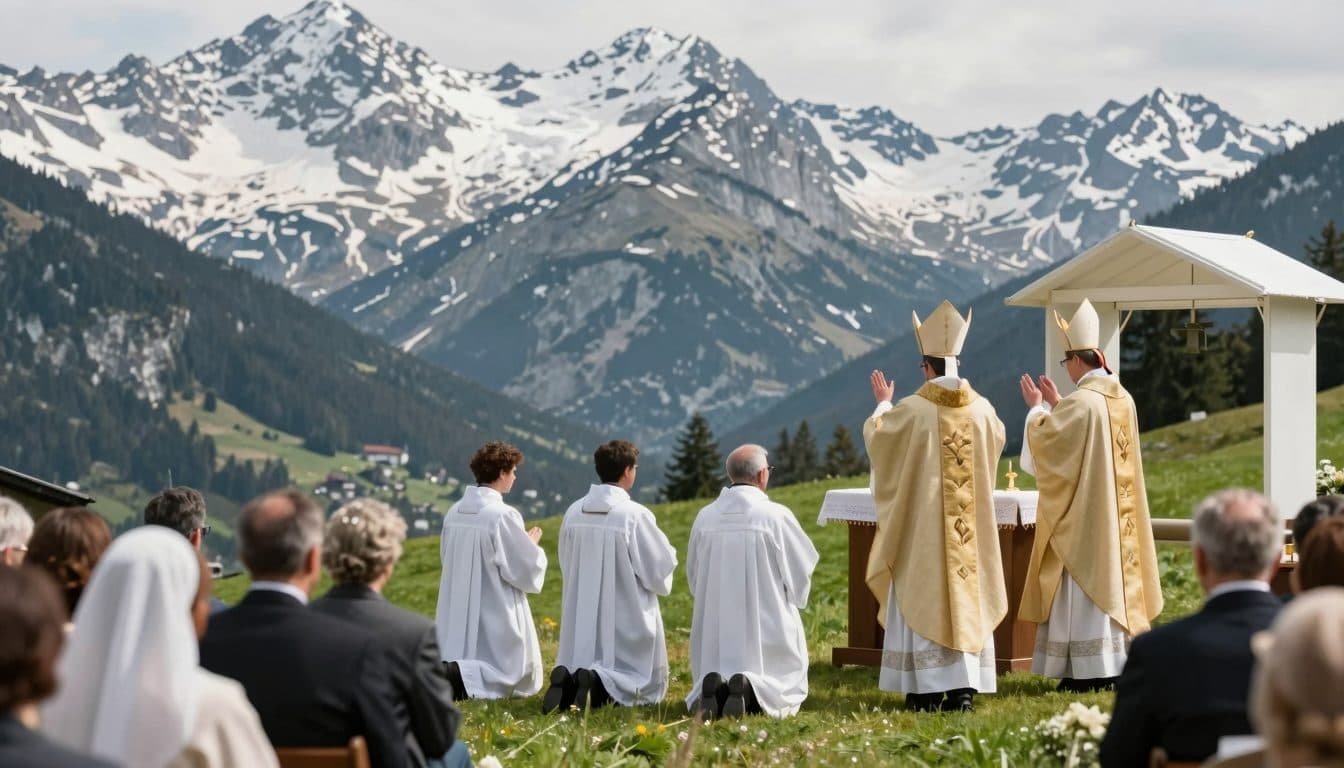
AI-generated image (z-image via Kie.ai)
Summary
The traditionalist Pius Brotherhood unilaterally consecrated four priests as bishops in Switzerland – in defiance of an explicit ban by Pope Leo XIV. Canon lawyers expect the Vatican to formally confirm the automatically incurred excommunication.
Écône, 02 July 2026
The traditionalist Priestly Brotherhood of St. Pius X consecrated four of its own priests as bishops on Wednesday morning in Écône in the Swiss canton of Valais, even though Pope Leo XIV had explicitly forbidden the ceremony beforehand; under Catholic canon law, all those involved are thereby automatically excommunicated.
The priests Pascal Schreiber (left, Switzerland), Michael Goldade (United States), Michel Poinsinet de Sivry (France), and Marc Hanappier (France) are being consecrated as bishops. The ceremony took place against the alpine backdrop of Valais and before thousands of attendees. They were consecrated by the brotherhood's two remaining bishops, Alfonso de Galarreta and Bernard Fellay.
The Consecration in Écône
According to the traditionalists' own statements, the consecration was intended to secure the succession of priests for the community. Before the ceremony, the brotherhood had only two bishops left, who in turn could not ordain new priests without first ordaining bishops themselves. According to Kathpress, the Pius Brotherhood is a conservative traditionalist community based in Switzerland, with approximately 720 priests, 250 religious sisters, and around half a million supporters.
Pope Leo XIV had urged the brotherhood in a letter on Tuesday to cancel the consecrations. The Pope had urgently entreated the brotherhood once more on Tuesday to call off the consecrations. What the Pius brothers were planning was a sin of the gravest kind. Excommunication – expulsion from the Church – threatened. On the eve of the consecration, Superior General Pagliarani thanked the Pope «in kindlicher Ergebenheit» for his «väterliche Fürsorge» and asked him to take the necessary time for the «Unterscheidung der Geister».
The Brotherhood's Position
The Pius Brotherhood justifies its decision with a rupture in the Roman institutions since the Second Vatican Council (1962-1965). Since the Roman institutions since the Second Vatican Council had been imbued with a spirit contrary to the «wahren Tradition der Kirche», it saw itself duty-bound to consecrate bishops «in der wahren Gesinnung», Superior General Davide Pagliarani declared on Wednesday in Écône. The brotherhood rejects central reforms of the Council, including religious freedom, ecumenism, and the celebration of Mass in vernacular languages.
At the beginning of the episcopal consecration, the brotherhood refrained from reading out the papal mandate that is normally part of the rite. In doing so, it effectively called into question the ecclesiastical authority of the Pope. In the Roman Catholic Church, it is not possible – and indeed forbidden – to consecrate anyone as a bishop without the Vatican's permission. Under Catholic canon law, such a consecration entails automatic excommunication for all involved – both the two consecrating bishops and the four newly consecrated.
Reactions from Austria and Rome
Archbishop Franz Lackner, President of the Austrian Bishops' Conference, stated: «Durch diesen Akt des Ungehorsams haben sich sowohl die Spender als auch die Empfänger der Weihe selbst exkommuniziert und einen schismatischen Akt gesetzt». Every schism was painful for the Pope, who bears responsibility for the unity of the Church, and for the Church worldwide; at the same time, «nun ein Schlusspunkt hinter eine jahrzehntelange Konfliktgeschichte zwischen Rom und der Piusbruderschaft gesetzt worden». The Austrian Bishops' Conference supports the position of Pope Leo XIV.
Canon lawyers expect the Vatican to publish a decree in the coming days formally confirming the automatically incurred excommunication. Back in 1988, the day after the episcopal consecration, the Vatican had issued its decree confirming the excommunication automatically incurred by the act. At that time, the French founder of the brotherhood, Archbishop Marcel Lefebvre (1905–1991), had consecrated four bishops without Vatican permission and was subsequently excommunicated.
Background since 1988
Pope Benedict XVI (2005–2013) lifted this penal measure in 2009; however, no theological reconciliation has been achieved since then. Benedict lifted the excommunication against the bishops consecrated in 1989, without a full reconciliation being reached. Pope Leo XIV nevertheless emphasized a willingness to engage in dialogue: the Church was «offen für einen Weg des Dialogs und der Verständigung». He explicitly acknowledged the brotherhood's strong attachment to the liturgy, its commitment to priestly formation, and its «Wunsch nach Treue zur Tradition».
From the Vatican's perspective, the consecration constitutes a schismatic act – that is, a break with Rome. Norbert Bischofberger, religion editor of Swiss television SRF, said: «In der römisch-katholischen Kirche ist es klar geregelt: Die beiden bisherigen Bischöfe der Piusbruderschaft und die vier neuen Bischöfe sind laut Kirchenrecht als Beteiligte direkt exkommuniziert.» He expected the community to «eher am Rand oder ausserhalb der römisch-katholischen Kirche weiter bestehen wird».
Superior General Pagliarani immediately rejected the ecclesiastical penalties. All penalties and censures pronounced against the consecrations possess, in the Superior General's explicit view, «keinerlei Gültigkeit». The brotherhood continues to see itself as part of the Roman Catholic Church, but rejects the Church's opening since the 1960s.
The Priestly Brotherhood of St. Pius X was founded in 1970 as a counter-movement to the reforms of the Second Vatican Council. The Priestly Fraternity of St. Peter, founded in 1988 at the initiative of Pope John Paul II (1978–2005), was created at that time as a bridge for traditionalists who wished to celebrate the old liturgy in agreement with Rome. Marcel Lefebvre had already in 1976 ordained priests against a papal prohibition, thereby isolating the Priestly Brotherhood of St. Pius X within the Church.
Traditionalist Currents Worldwide
Within the traditionalist current there are also the so-called Sedevacantists, who regard all popes after Pius XII (1939–1958) as modernist heretics and therefore consider the Chair of Peter to have been vacant (sedis vacans) since 1958. Other representatives of this current include the Una Voce movement and the Abbey of Le Barroux in southern France.
The Austrian section of the Priestly Brotherhood comprises, according to the website fsspx.at, 20 priests, three brothers, and three oblates. The priests of the Austrian district are active in Austria and in six other Central European countries as well as in South Tyrol. Worldwide, the brotherhood has more than 700 priests, most of them in North America and France. By comparison, the Catholic Church counts around 1.4 billion faithful worldwide.
Outlook: What Could Happen Now
Pope Leo XIV regards the Church's opening through the Second Vatican Council as a guiding star. Before the consecration, he had urged the brotherhood with the words «Kehrt um!» and pointed them to concern for the spiritual welfare of the faithful. Through the unauthorized consecration, which causes a schism, the brotherhood was depriving its faithful of the reception of the sacraments.
ZDFheute Xpress reported on this topic on 01/07/2026 at 14:57 in the report «Verbotene Bischofsweihen bei den Piusbrüdern». Deutschlandfunk also broadcast a report on 01/07/2026 on the events in Écône. With this, the open confrontation between Rome and the traditionalist brotherhood, after decades of wrangling, has entered a new, canonically clear phase.
Questions & Answers
Who are the four bishops consecrated in Écône?
The priests Pascal Schreiber from Switzerland, Michael Goldade from the United States, as well as Michel Poinsinet de Sivry and Marc Hanappier from France were consecrated.
What consequences does the consecration have under Catholic canon law?
Under Catholic canon law, an episcopal consecration carried out without papal permission entails automatic excommunication for all involved – including the two consecrating bishops Alfonso de Galarreta and Bernard Fellay.
Why did the Pius Brotherhood defy the Pope's prohibition?
Superior General Davide Pagliarani justified the step by stating that the Roman institutions since the Second Vatican Council had been imbued with a spirit contrary to the «wahren Tradition der Kirche»; in addition, the move was intended to secure the succession of priests for the community.
Pius Brothers bishop consecration: Rome threatens | allfacts360