Salzburg Festival 2026 opened: Kolesnikova's keynote speech | allfacts360
Salzburg Festival officially opened – Kolesnikova delivers keynote speech on democracy and listening
Salzburg, July 26, 2026
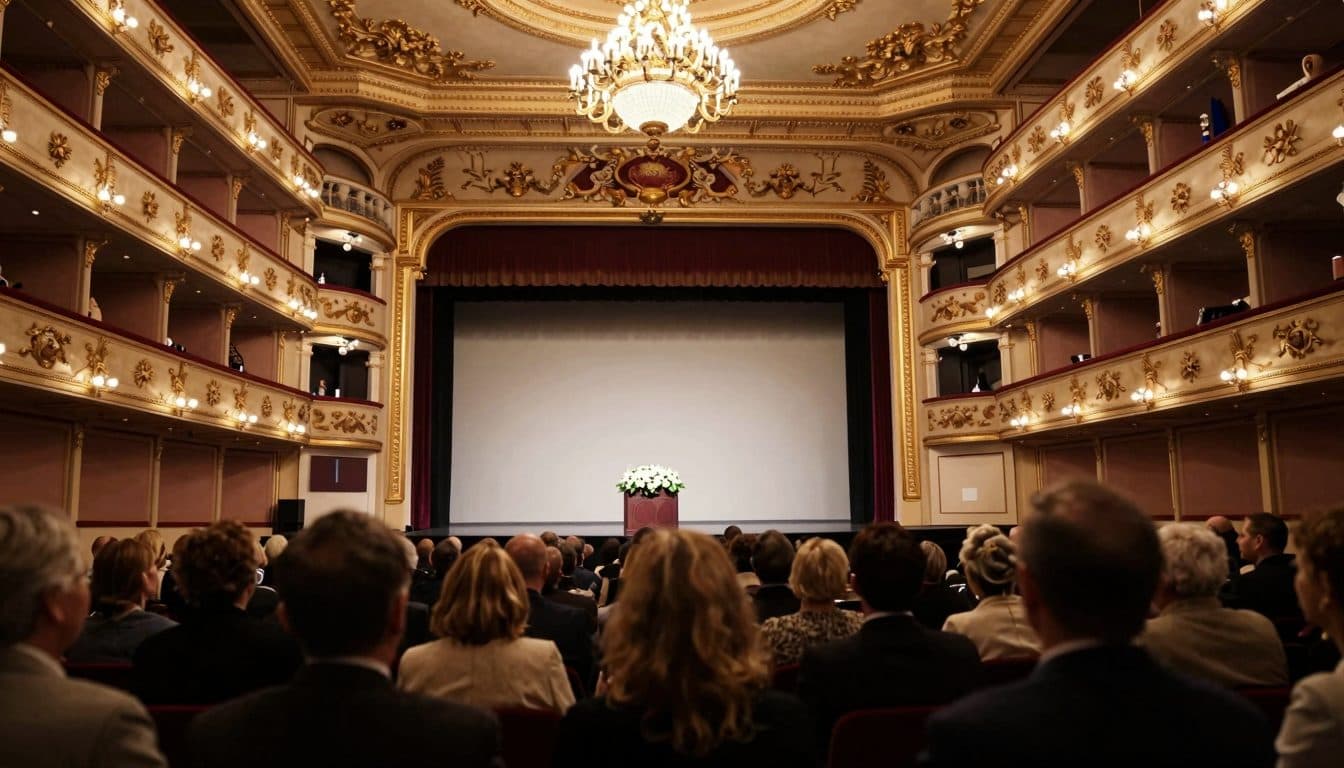
AI-generated image (z-image via Kie.ai)
Summary
The Salzburg Festival was officially opened on Friday evening. The roughly two-hour ceremony centered on the keynote speech by Belarusian musician Maria Kolesnikova, who was released from years of imprisonment 226 days ago.
Salzburg, July 26, 2026
The Salzburg Festival was officially opened on Friday evening with a roughly two-hour ceremony at whose center stood the keynote speech by the Belarusian musician and civil rights activist Maria Kolesnikova.
A keynote speech on listening and humanity
In the Great Festival Hall, Federal President Alexander Van der Bellen declared the traditional cultural event open with the words "Die Salzburger Festspiele sind eröffnet." The event, which took place in rainy, cool summer weather, combined musical performances by the Mozarteum Orchestra Salzburg under the direction of the Belarusian conductor Vitali Alekseenok with speeches by Federal President Van der Bellen, Salzburg's Governor Karoline Edtstadler (ÖVP), Vice Chancellor and Minister of Culture Andreas Babler (SPÖ), and keynote speaker Maria Kolesnikova.
Kolesnikova, the 44-year-old flutist, conductor, and cultural manager, was one of the leaders of the mass protests in 2020 against the presidential election in Belarus, which was overshadowed by allegations of manipulation. Because of her engagement against the regime of Alexander Lukashenko, she spent five years in prison in her homeland – and had been released only 226 days earlier together with roughly 120 other political prisoners. A few months earlier, she had also accepted the International Charlemagne Prize, which had been awarded to her back in 2022.
Kolesnikova's path after five years of imprisonment
In her keynote speech, which was met with repeated bursts of applause and celebrated at the end with a standing ovation, Kolesnikova painted a picture of a free society as an orchestra in which mutual listening is essential. Directly and without bitterness, she looked back on the imprisonment she had endured: "Mein größter Sieg war, dass ich nicht zuließ, dass Hass in meinem Herzen Wurzeln schlug – und dass ich trotz allem Mensch blieb." The past 226 days since her release, the artist continued, had been the most precious of her life.
With an eye to the present, Kolesnikova formulated a clear appeal: "Sprechen ist ein Recht. Zuhören ist Verantwortung. Genau dort beginnt Demokratie." She warned that it is not only the expression of opinions, but above all listening to one another, that keeps democracy alive. Alongside her political engagement, Kolesnikova also addressed technological change and artificial intelligence: "Die Zukunft entscheidet sich nicht daran, wie intelligent unsere Maschinen werden, sondern daran, wie menschlich wir bleiben."
Van der Bellen: Humorous words on homeland and compromises
Kolesnikova also expressed concern regarding the attack at Berlin's Christopher Street Day, which had taken place the day before. She asked the audience whether freedom, democracy, human rights, and the rule of law were as self-evident as the stars in the sky. She expressed surprise at how "Gereiztheit, Misstrauen und wachsende gegenseitige Entfremdung" now shape political and social life. Her appeal: there will always be people "die nach Lösungen suchen, nicht nach neuen Feinden".
Federal President Van der Bellen spoke in his customary humorous tone, drawing on his own biography to talk about migration and homeland, and offered samples of his "Kaunertaler Zweitsprache." Considering the concept of homeland, he recalled that "viel gefährlicher Blödsinn" was often done with it, before drawing an arc to democracy: "Das Innenleben jeder funktionierenden freien, liberalen Demokratie, besteht nolens volens auf Kompromissen, insbesondere in Koalitionsregierungen." Particularly moving was the moment when Van der Bellen, from the lectern, asked the keynote speaker which stress was used to pronounce her first name – and as the only speaker stressed the first syllable, in order to show special respect. With a view to the achievements of democracy and international law, the Federal President emphasized: "Wer das kleinredet und geringschätzt, missachtet den Kern des Aufblühens unserer Heimat."
Edtstadler recalls Stefan Zweig
Salzburg's Governor Karoline Edtstadler opened the evening with a welcoming address in which she recalled Stefan Zweig's "The World of Yesterday" and warned of the time "vor den großen Katastrophen Europas" described by Zweig. "Wenn sich heute der Vorhang der Salzburger Festspiele hebt, dann schärft sich nicht nur unsere Wahrnehmung für die Kunst, sondern wir sind – ganz im Sinne Zweigs – auch aufgefordert, den Zustand unserer eigenen Welt zu reflektieren," Edtstadler said. She knows that freedom and peace are not immovable and is reminded of that every day. It is only uncomfortable to deal with it, "deshalb haben wir es uns gemütlich gemacht unseren Luxusproblemen."
Babler argues for reason with heart
Vice Chancellor and Minister of Culture Andreas Babler, who spoke without the announced incident, devoted his address to the topic of reason in times of climate crisis and the division of society. "Das heurige Festspielprogramm stellt der kalten Vernunft die Macht des Herzens gegenüber," Babler underlined. He asked: "Es fragt, was uns in schwierigen Zeiten Orientierung gibt." In clear words, the SPÖ politician warned: "Als vermeintlich vernünftige Wesen akzeptieren wir gerade Entwicklungen, deren gefährliche Folgen wir aus der Geschichte längst kennen." In this context, he quoted Ingeborg Bachmann ("Die Geschichte lehrt, aber sie hat keine Schüler") and expressed the wish that she should not prove right.
Babler formulated the motto of the evening in a triad: "Wir brauchen die Vernunft, um die Welt zu verstehen, wir brauchen die Kunst, um uns eine andere Welt vorstellen zu können, aber wir brauchen das Herz, um diese andere Welt möglich zu machen." With reference to "Jedermann," the Minister of Culture also formulated a preview of the world premiere of Elfriede Jelinek's "Unter Tieren": "Sie macht deutlich, was geschieht, wenn Jedermanns Lebensweise zur Funktionsweise einer ganzen Gesellschaft wird." Art can help because it opens a space for thought "in dem alles ganz anders sein könne."
Musical framework and Reinhardt text
Between the speeches, musical contributions by the Mozarteum Orchestra under Alekseenok were heard, which, in addition to the obligatory anthems – with the participation of the Theater Children's Choir – included works by Édouard Lalo, Olivier Messiaen, and Lili Boulanger. The actress Senta Berger passionately recited a text written in 1943 by Max Reinhardt, one of the founding fathers of the Festival: "Heutzutage ernsthaft Theater zu spielen ist im Grunde genommen eine Donquichoterie. Das heißt mit künstlerischen Idealen ankämpfen zu wollen gegen die ungeheuren Windmühlen, die im Sturm unserer Zeit klappern" – a text that in large parts could have been written today.
Outlook on the Festival summer of 2026
After the opening, audiences can look forward to an extensive program: until August 30, more than 170 performances in 45 days at 19 venues are on the schedule, plus 37 performances in the youth program "jung & jede*r." Already on Sunday evening, Georges Bizet's "Carmen" under the direction of Teodor Currentzis premiered at the Great Festival Hall, followed on Monday evening by the world premiere of Peter Handke's "Schnee von gestern, Schnee von morgen," directed by Jossi Wieler. As the festival continues, numerous opera productions follow one another: on August 1, the premiere of Messiaen's "Saint François d'Assise" is on the program, on August 2 Mozart's "Così fan tutte" follows. On August 16, star conductor Riccardo Muti conducts a ceremonial event, on August 17 and 18, "Ariadne auf Naxos" and "Il Viaggio a Reims" offer two further operatic highlights. The emotional finale on August 30 is the final performance of "Jedermann."
The opening ceremony lasted roughly two hours. After Van der Bellen's words, the audience released a rainy, cool summer day into a Festival summer that programmatically aims to explore the tension between reason and heart, between political vigilance and aesthetic experience – and that began with the keynote speech of a woman who had spent five years behind bars for her commitment to democracy and freedom.
The choice of Kolesnikova as keynote speaker set a political signal right at the beginning. The speakers' references to Stefan Zweig, Ingeborg Bachmann, and Max Reinhardt anchored the program in a tradition of European intellectual history that is meant to sharpen the view of the present – of a present in which, as Babler put it, comfort and convenience toward the "Luxusprobleme" of the free society threaten historical vigilance.
This year's Festival program thus expressly sees itself as an artistic examination of the political situation. The speakers were united by the conviction that art is not merely entertainment, but a space for thought in which fundamental questions of a free society can be negotiated – an attitude that Kolesnikova exemplified with her keynote speech on listening, humanity, and the value of