Settler Violence in the West Bank: Mosques Set Ablaze, Four Palestinians and Two Israelis Killed
Haifa, July 26, 2026
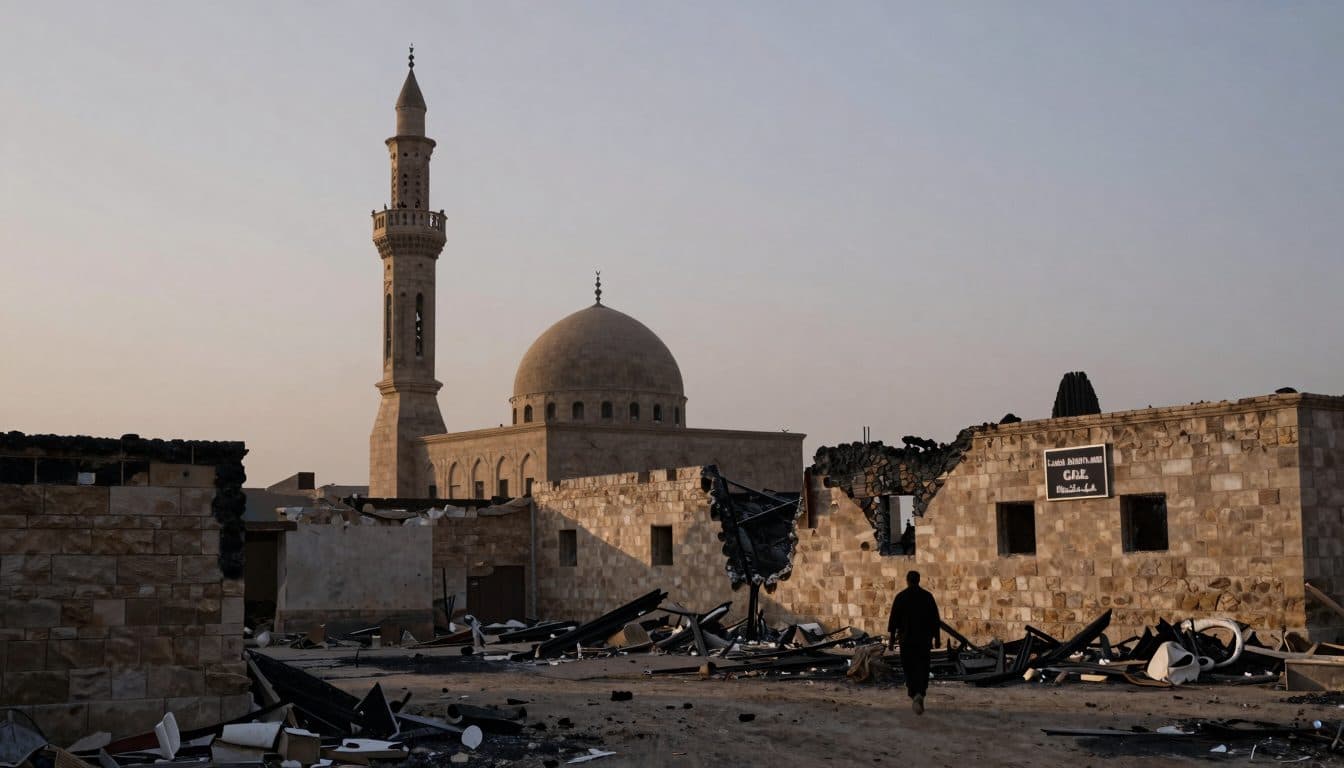
AI-generated image (z-image via Kie.ai)
Summary
Following a shootout that left four Palestinians and two Israeli soldiers dead, armed settlers set fire to mosques, houses, and vehicles in the West Bank. Israeli Prime Minister Benjamin Netanyahu announced a troop reinforcement and new settlements.
Haifa, July 26, 2026
Armed Israeli settlers on Friday set fire to two mosques, a house, and vehicles in the northern West Bank, defacing them with Hebrew graffiti, while a shootout near the village of Tal left four Palestinians and two Israeli soldiers dead.
Situation on the Ground: Arson and Shootout
According to Palestinian and Israeli sources, the incidents that took place on Friday in the Nablus and Tulkarm areas constitute a coordinated wave of retribution by radical settlers. According to Palestinian media, radical settlers also set fire to two mosques, a house, and vehicles in the West Bank. In the village of Kusra, southeast of Nablus, attackers reduced a newly built mosque to rubble and ashes, according to village council head Abdel Asim Wadi. In the village of Kur, southeast of Tulkarm, three settlers attempted to set fire to a mosque at dawn, as council member Farid Dschijusi reported.
The perpetrators sprayed Hebrew slogans on the walls of the destroyed or damaged houses of worship, including the inscription "Jewish blood is not free," the word "Anarchy," and the lettering "Benayahu's revenge." The latter refers to Benayahu Mellet, one of the two Israeli victims of Friday's shootout in the village of Tal. Hebrew graffiti was also placed in both mosques, documented by Palestinian residents.
Background of the Violence
The shootout itself occurred on Friday when, according to eyewitness accounts, around 20 armed Israeli settlers entered the area of the Palestinian village of Tel southwest of Nablus. In the ensuing battle, four Palestinians and two Israeli soldiers were killed. The Israeli military initially stated that the settler group had been hikers who had been shot at; it later acknowledged that some of the Israelis had been armed.
Israeli Prime Minister Benjamin Netanyahu then ordered a reinforcement of troops in the West Bank. "The military also deployed additional soldiers into the occupied Palestinian territory," the military said. According to eyewitness accounts, the army sealed off all access points to the city of Nablus, severely hampering medical care for the population.
Response of the Israeli Government
The Israeli human rights organization Yesh Din accuses the army of not intervening decisively enough in such attacks. Spokeswoman Hagit Ofran said: "Das ermutige die gewaltbereiten Banden nur, sich zu weiteren Übergriffen zu verabreden". The organization also documents that perpetrators face almost no criminal consequences. "Es gibt kaum Berichte darüber, dass Siedler nach Attacken zur Rechenschaft gezogen werden", Yesh Din criticized.
Former Israeli Major General Giora Eiland described the situation in the West Bank as "Anarchie". Within the army as well, complaints are growing that the units stationed in the West Bank are overwhelmed by the sheer number of violent incidents. The army is repeatedly accused of not acting decisively enough against radical settlers who attack Palestinians and their property.
Accusations Against the Army
Netanyahu, who is seeking a parliamentary election in October, announced alongside the troop reinforcement the approval of further Israeli settlements in the West Bank to increase security. New agricultural outposts were also to be created and existing ones swiftly legalized, the head of government declared. Israeli Finance Minister Bezalel Smotrich is regarded as a hardliner demanding an accelerated annexation of the West Bank by Israel.
The army announced it wanted to speak with witnesses and secure evidence for investigations. "Israels Sicherheitskräfte wollen den Angaben zufolge mit Zeugen sprechen und Beweismittel für Ermittlungen sichern", the military reported. A statement read: "Die Sicherheitskräfte verurteilen Vorfälle dieser Art, einschließlich der Beschädigung religiöser Stätten, aufs Schärfste und werden weiterhin entschlossen handeln, um die Sicherheit und die öffentliche Ordnung in dem Gebiet aufrechtzuerhalten".
According to its own statements, the army searched for fugitive suspects in several locations who had set fire to a mosque and vehicles. "Das Militär habe zudem mit Verzögerung eine Meldung über eine weitere in Brand gesetzte Moschee erhalten." Israel's army condemns "solche Vorfälle, einschließlich der Beschädigung religiöser Stätten, aufs Schärfste".
Arrests and Consequences
According to its own statements, Israel's army subsequently arrested dozens of "wanted suspects." Among them are reportedly members of Hamas. According to the army, those detained are suspects from radical Palestinian groups held responsible for attacks. The Israeli army said on request that no injuries had been reported in the incidents — a statement that contradicts reports of casualties.
The consequences of the violence are not limited to the direct attacks. The organization Physicians for Human Rights (PHRI) stated that the rescue service in the Nablus district had practically come to a standstill due to the closures. "Two women had to give birth in ambulances because they were stuck at military checkpoints", PHRI reported. Dialysis patients had been stuck at checkpoints on their way to treatment.
Medical Care and Humanitarian Consequences
The Palestinian news agency WAFA reported today several injured Palestinian workers following an attack by radical Israeli settlers near the city of Ramallah at night. In the village of Kur, the worshippers themselves said they had been able to extinguish the flames before they reached the main hall — a rare example of successful self-help.
International Context
The background of the violence reaches far back. The West Bank was occupied by Israel in 1967 during the Six-Day War. The majority of UN member states share the assessment that the Israeli settlements violate international law. The United Nations also considers the settlements illegal — a position shared by the vast majority of states worldwide. Israeli settlements in the West Bank are not internationally recognized. Such outposts are illegal under Israeli law.
Attacks by settlers on Palestinians have markedly intensified since the start of the war against Hamas in the Gaza Strip in October 2023. According to the report, 21 Palestinians have been killed in such settler attacks since the beginning of the year. According to the UN and the Palestinian Authority, dozens of Palestinians have been killed and hundreds injured in settler clashes this year. In the conflict in the Gaza Strip, which according to Israeli figures was preceded by a Hamas attack on targets in Israel with 1,200 dead, more than 73,000 people have been killed by Israeli strikes according to Palestinian figures.
Residents of the affected villages describe an increase in attacks. Village council head Wadi said: "Das Dorf ist seit 2011 wiederholt angegriffen worden" and added: "Diese Angriffe haben seit dem Krieg zugenommen". Farid Dschijusi from Kur emphasized: "Dies ist der erste Angriff, den unser Dorf erlebt hat". Palestinians seek an independent state in the Gaza Strip, the West Bank, and East Jerusalem — a goal pushed further out of reach by the recent violence. The report was broadcast on July 26, 2026 on Deutschlandfunk and written by Maria Sterkl from Haifa.
Questions & Answers
What happened in Kusra and Kur in the West Bank?
In Kusra, southeast of Nablus, settlers set fire to a newly built mosque, according to village council head Abdel Asim Wadi. In the village of Kur, southeast of Tulkarm, three settlers attempted to set fire to another mosque at dawn; worshippers, however, were able to extinguish the flames.
How is the Israeli government responding to the attacks?
Prime Minister Benjamin Netanyahu ordered a troop reinforcement in the West Bank and announced the approval of further settlements as well as new agricultural outposts. The army also sealed off all access points to the city of Nablus.
What role does Finance Minister Bezalel Smotrich play in the conflict?
Bezalel Smotrich is described as a hardliner who demands an accelerated annexation of the West Bank by Israel. He is among the voices within the government pushing for an expansion of Israeli control over the territory.
Settler Violence West Bank: Mosques Burning, Dead | allfacts360