Venice closes 2026 day-tripper fee season with record revenue and questions about the next phase
Venice, 27 July 2026
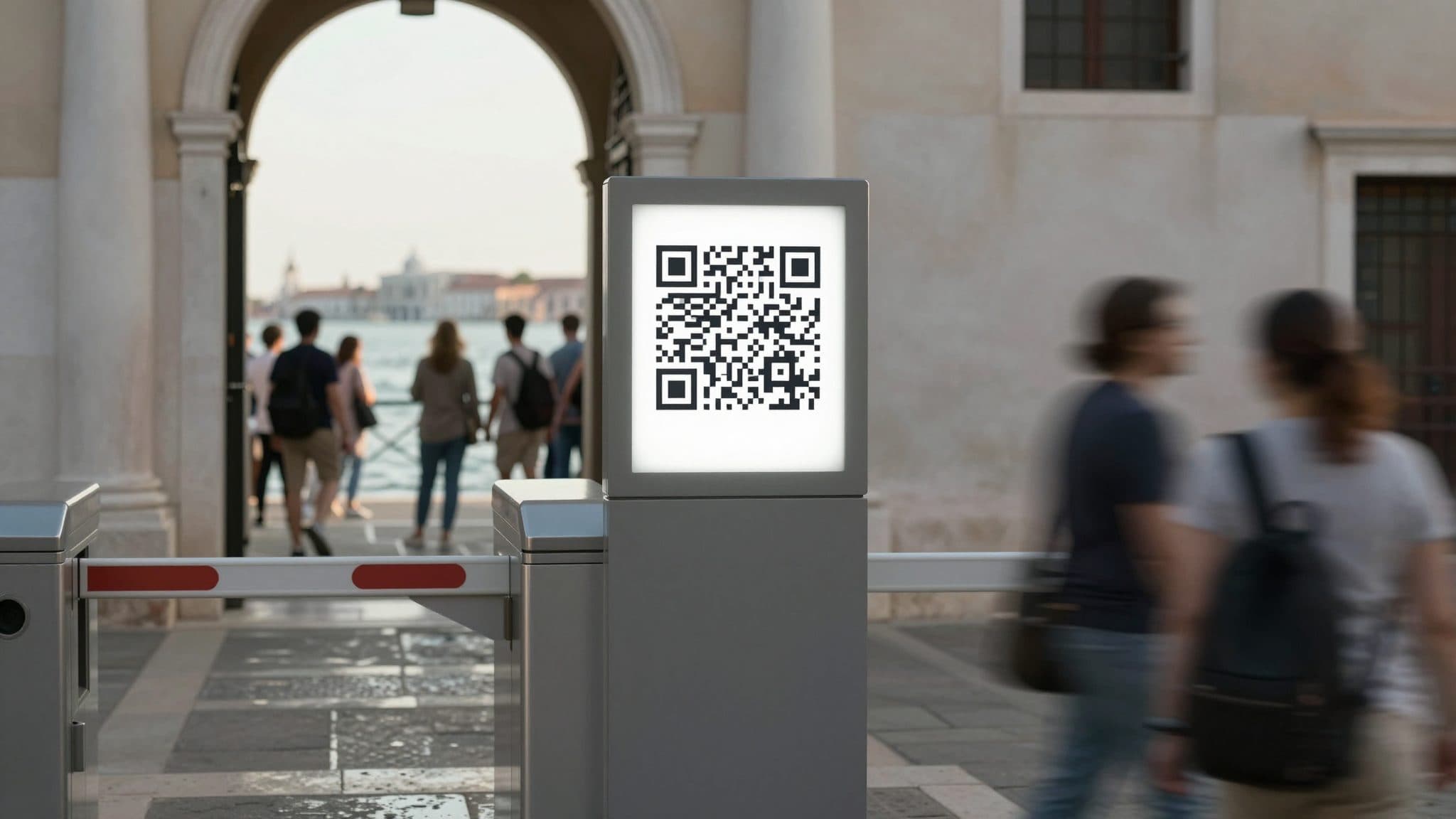
AI-generated image (z-image via Kie.ai)
Summary
Venice reported more than 650,000 paying day visitors after this year's paid day-tripper season ended on the weekend, with the lagoon city collecting more than…
Venice, 27 July 2026
Venice reported more than 650,000 paying day visitors after this year's paid day-tripper season ended on the weekend, with the lagoon city collecting more than five million euros in entrance fees — a record amount that has prompted Mayor Simone Venturini to float the idea of significantly higher charges next year.
The municipality of Venice announced on Sunday that 650,000 people paid the special fee charged to day visitors who enter the lagoon city between 08:30 and 16:00, during a 60-day window that began in April. The standard price was ten euros, while those who booked at least three days in advance paid only five euros. The fee applied regardless of how long visitors stayed in the city, which is crossed by more than 150 canals.
A 60-day paid season and a record haul
At five million euros, revenue this year is the highest the city has ever taken in from the day-tripper levy. The previous year brought in 5.4 million euros, while two years earlier the figure stood at 2.2 million euros. Officials describe the charge as still being in a test phase, but they have framed this year's result as evidence that the instrument works as both a revenue tool and a soft crowd-management measure.
Mayor Simone Venturini, a centre-right politician, has already indicated that the entry fee could become significantly more expensive in the future. He proposed charging between 30 and 50 euros on certain days, a level that would mark a sharp departure from the current five-to-ten-euro range and would push Venice closer to the pricing of a ticketed museum visit rather than a tourist tax.
Any change to the fee does not rest with Venice alone. The government of Prime Minister Giorgia Meloni in Rome would also have to approve a higher charge, leaving the city dependent on national political backing for the more ambitious version of the scheme. Critics argue that even the current fee deters hardly anyone from visiting St. Mark's Square, the Rialto Bridge and other major sights, and they are likely to question whether a steep price hike would meaningfully change visitor behaviour.
The fee so far has not reduced visitor numbers
So far, visitor numbers have not declined, according to figures cited by the municipality. That point is being made both by supporters of the fee, who argue it generates income without shrinking the flow of tourists, and by critics, who say it demonstrates that the levy fails to redistribute visitors away from the most crowded days and sites. The 60 paid dates in 2026 marked an expansion from 54 days in 2025 and just 29 days in 2024, reflecting how the experiment has been widened year by year.
The fee is officially aimed at day-trippers. Visitors staying overnight are exempt from the day-visitor entrance fee but must pay an overnight tourist tax, which has long been part of the city's tourism finances. The structure is designed to target the highest-pressure segment of tourism — large numbers of visitors who arrive by train or bus, spend limited time in the centre and leave little money behind.
Venice became the first city in the world to charge an entrance fee for a visit in 2014, when the measure was introduced as a way to manage the flow of tourists into the fragile lagoon ecosystem. Over the following decade, the scheme has been repeatedly adjusted and expanded, with this year's 60 paid dates the longest run since the programme began. Officials say the cumulative experience now provides data to argue for a more permanent or more expensive system.
Venice's tourism paradox: revenue and pressure
The economic backdrop for the debate is stark. Fewer than 50,000 people live in Venice's historic centre today, while the city welcomes millions of tourists from around the world each year and now has significantly more hotel beds than residents. Venice is widely cited as a European example of a city that earns substantial money from tourism while also suffering heavily from its impact, with pressure on housing, infrastructure and the lagoon environment all linked to visitor numbers.
Against that backdrop, experts have raised constitutional questions about a significantly higher fee. From their perspective, a charge of 50 euros could be interpreted as a restriction of freedom of movement, putting the proposal on a collision course with Italian constitutional law. The concern is likely to sharpen the political debate in Rome, where any agreement would need to balance tourism management with citizens' rights of movement.
For the remainder of this year, day visitors can enter Venice without paying. The paid dates are expected to resume next year, probably starting from the Easter weekend, which traditionally marks the beginning of the lagoon city's busiest tourism period. Whether the fee structure returns unchanged, is raised sharply or is modified in some other way will depend on negotiations between the municipality and the national government.
Constitutional concerns over a much higher fee
City officials are also framing the 2026 result as a model for other destinations. With more than five million euros collected over 60 paid days, the average revenue per day was higher than in any previous year of the experiment, suggesting that the combination of a longer season and a slightly higher headline price has pushed the programme past its earlier limits. The data is being used internally to argue both for continuity and for a bolder next step.
Mayor Venturini's proposal of 30 to 50 euros on certain days would amount to a six-to-ten-fold increase over the current ten-euro rate and would put Venice in uncharted territory globally. No other city has charged tourists an entrance fee at that level for a single day visit, and the proposal is likely to attract international attention if it advances. For now, the existing fee remains the operative policy and continues to be formally described as a pilot.
What happens before next Easter
Supporters argue that the revenue can be reinvested in preserving the lagoon, maintaining infrastructure and supporting the dwindling resident population. Critics counter that the measure has done little to curb demand, that it places an additional administrative burden on visitors and transport operators, and that any substantially higher charge would need a clear legal and political justification before being introduced.
The next decision point will come in the months ahead of the 2027 Easter weekend, when Venice and Rome will need to agree on the parameters of the next phase of the scheme. Until then, the city enters an unpaid window in which day visitors can once again arrive in Venice without a special levy, while the debate over whether to charge more — and whether doing so would actually change behaviour — continues to unfold.
Venice closes 2026 day-tripper fee season with record… | allfacts360