Vienna Responds to Asbestos Finds in Asphalt: Suspect Areas to Be Sealed
Vienna, July 24, 2026
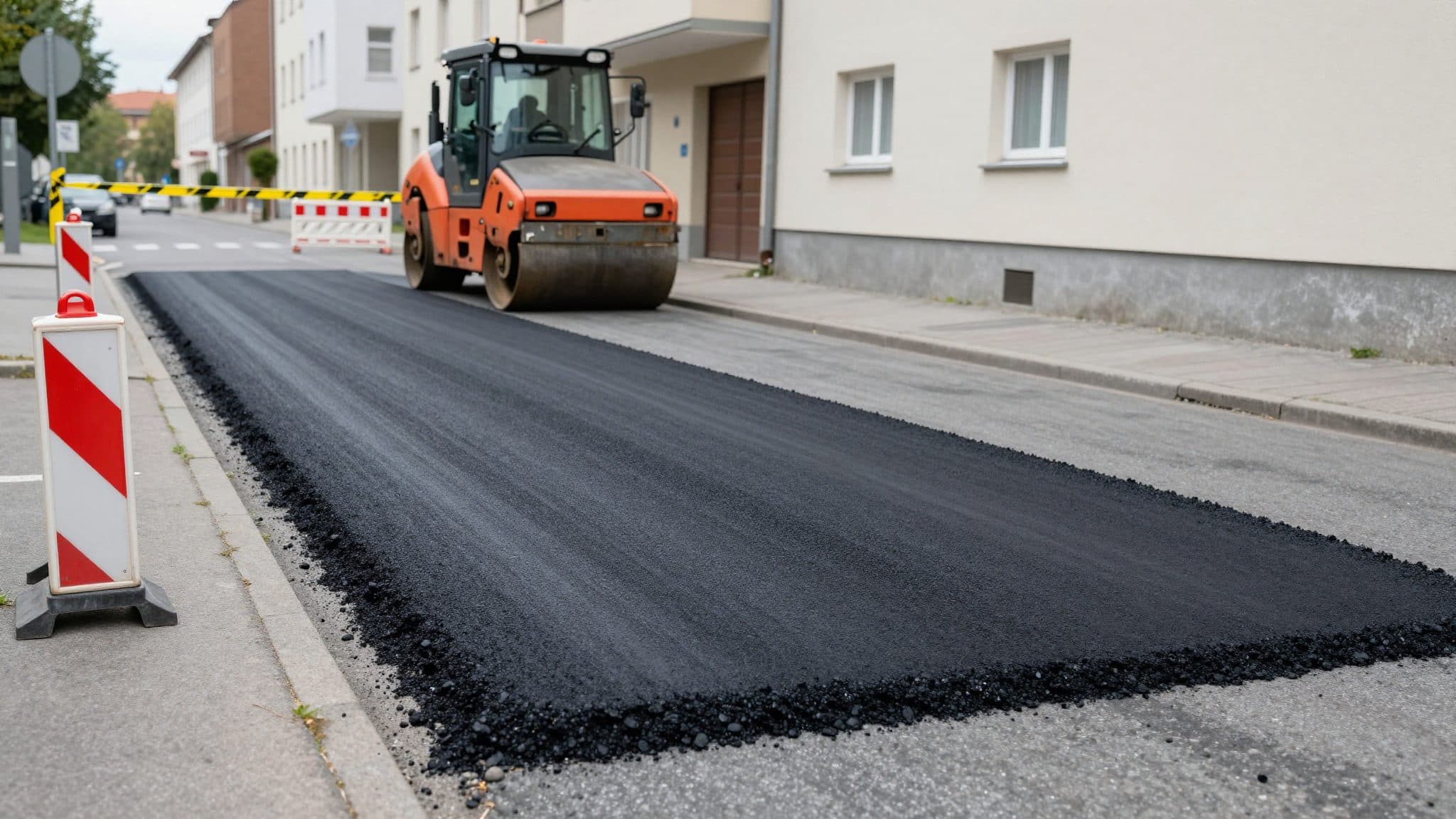
AI-generated image (z-image via Kie.ai)
Summary
The information came from Greenpeace: in early July, the environmental organization had detected asbestos inclusions in the asphalt surface of several Vienna…
Vienna, July 24, 2026
Greenpeace Sounds the Alarm
The information came from Greenpeace: in early July, the environmental organization had detected asbestos inclusions in the asphalt surface of several Vienna streets and passed this information to the City of Vienna. In total, Greenpeace had reported 40 suspect areas in eleven Vienna districts to the authorities, as the organization announced in a statement. This brought a topic onto the political agenda that repeatedly sparks debate in Austria.
The City of Vienna's reaction followed promptly. Notwithstanding the fundamental assessment that the presence of asbestos-containing rock in a road surface is not automatically equivalent to a health hazard, MA 28 – the Municipal Department for Road Construction and Road Administration – immediately intensified its inspection measures in the area of material testing and construction supervision. As the city announced on Thursday, the affected areas are now being sealed with an asphalt overlay or a surface layer.
Sealing as a Response
For the sealing, the city cites both technical and logistical reasons. Wolfgang Ablinger, deputy head of department at MA 28, was quoted in the statement with the words: "Das ist die schnellste, sicherste und wirksamste Methode, um rasch einen effektiven Schutz zu gewährleisten." The measure covers the asbestos-containing material and encapsulates it; a release of asbestos fibers is "wirksam unterbunden". Ablinger emphasized: "Der Schutz wirkt sofort. Sie verhindert unmittelbar einen möglichen Kontakt mit Asbestfasern."
At the same time, the City of Vienna ordered that, for every MA 28 road construction project involving road excavation, the existing road body must now be specifically examined for the presence of asbestos as part of the preparation of the tender documents. In addition, employees of MA 28 continuously monitor the road space for conspicuous road sections, the city further announced.
Expert Assessment from MedUni Vienna
An important nuance is provided by environmental medicine. MA 28 fundamentally obtains the rock material required for construction projects from quarries in Lower Austria and the greater Vienna area. In current MA 28 construction projects, no asbestos-containing rock material is used; the installation of such materials can be excluded, it was stated. What is decisive is whether and to what extent asbestos fibers can actually be released.
This assessment is shared by Hans-Peter Hutter, head of the Department of Environmental Hygiene and Environmental Medicine at MedUni Vienna. He said: "Aus umweltmedizinischer Sicht ist entscheidend, ob Asbestfasern tatsächlich freigesetzt und eingeatmet werden können." If asbestos-containing material is firmly bound within an asphalt surface, the risk of fiber release is essentially very small. Hutter added: "Das Vorhandensein von asbesthaltigem Gestein in einem Straßenbelag ist daher nicht automatisch mit einer Gesundheitsgefährdung gleichzusetzen."
Demands on Federal Policymakers
Nevertheless, sealing with a new surface layer is, for precautionary reasons, a sensible measure to minimize even small risks. The city emphasizes that all indications of asbestos are being investigated and, according to its own statements, is in close exchange with Greenpeace. For additional reported conspicuous areas, sampling and laboratory analyses have already been initiated.
Greenpeace itself is satisfied with the authorities' actions. The City of Vienna is acting in an exemplary manner, the organization said. Stefan Stadler of the investigative team said: "Jede Verdachtsfläche wird geprüft und es werden sofort Maßnahmen ergriffen." At the same time, however, Greenpeace directed demands at federal policymakers: from Federal Chancellor Christian Stocker (ÖVP), the organization demanded the creation of an affordable disposal option for asbestos and the provision of aid funds for municipalities, companies, and private individuals affected by the "Asbest-Skandal."
The background to the debate is the role of asbestos fibers: if they are released and inhaled, they can cause long-term health damage. However, if asbestos-containing material is firmly bound within an asphalt surface – for instance, as a component of the rock – experts classify the risk of fiber release as fundamentally very low. This technical differentiation is the basis for the Viennese authorities sealing the surface rather than removing it.
For residents and for daily road use, the sealing initially changes little: traffic can continue to flow, and according to the city, the measure is carried out in a short time. MA 28 also announced that ongoing inspections of the road space would continue and that material testing in future construction projects would be consistently focused on asbestos. This is intended to prevent new asbestos-containing rock from entering road surfaces.
Outlook on Further Sampling
Overall, the procedure illustrates the interface between civil society research and municipal action: the information from Greenpeace led to concrete construction measures, a tightening of tendering practice, and a public debate about disposal options. How many of the 40 reported suspect areas actually contain asbestos will be shown by the ongoing laboratory analyses.
The City of Vienna stated that it will inform about the results of further sampling and expand protective measures if necessary. Greenpeace announced that it will continue to monitor the issue and address the disposal question with the federal government.
For the people of Vienna this means: should asbestos be found in further streets, a comparable approach – sealing rather than excavation – is to be expected. This keeps the intervention in the road space minimal while simultaneously minimizing the possibility of fiber release.
The approach could also be relevant for other Austrian cities in which older road surfaces containing asbestos-bearing rock exist. The Viennese practice – material testing in tenders, sealing in cases of suspicion, expert assessment by environmental physicians – offers a template for dealing with suspected cases.
Both Ablinger and Hutter emphasize that protecting the population is the top priority. The sealing takes effect immediately and prevents any possible contact with asbestos fibers, according to the city. At the same time, the investigation into the cause – that is, the question of where the asbestos-containing material was originally installed – will continue.
Questions & Answers
Who is Wolfgang Ablinger and what role does he play in the asbestos debate?
Wolfgang Ablinger is the deputy head of department at MA 28, Vienna's Municipal Department for Road Construction. He explained the sealing of the suspect areas as the fastest and most effective protective measure.
How many suspect areas has Greenpeace reported to the City of Vienna?
Greenpeace has reported a total of 40 suspect areas in eleven Vienna districts to the City of Vienna, where asbestos inclusions in the asphalt are suspected.
Why is the asbestos-containing asphalt being sealed rather than broken up?
According to experts, the risk of fiber release from firmly bound material is very low. A new surface layer covers the material and effectively prevents the release of asbestos fibers, without the need to fully remove the road surface.
Vienna Responds to Asbestos Finds in Asphalt: Suspect… | allfacts360