Warning strike Czech Republic: media protest against Babis | allfacts360
Warning strike by Czech public-service media against planned abolition of broadcasting fees
Prague, June 22, 2026
AI-generated image (flux-2/pro-text-to-image via Kie.ai)
Summary
Thousands of employees of Czech public-service broadcasters went on strike on Monday against the planned abolition of broadcasting fees and the future financing from the state budget. The day before, several thousand people had gathered in front of the Czech Television headquarters in Prague to demonstrate against the reform.
Prague, June 22, 2026
Thousands of employees of Czech Television (ČT) and Czech Radio (ČRo) protested on June 22, 2026 with a one-day warning strike against the planned abolition of broadcasting fees and the planned direct financing from the state budget.
Trigger: Planned abolition of broadcasting fees
The action was directed against a decision by the right-wing populist government under Prime Minister Andrej Babiš to abolish radio and television fees. In the future, the broadcasters are to be financed directly from the state budget, as stated in the draft of the Ministry of Culture. The public-service radio and television broadcasters are to be financed from the state budget in the future.
The draft originates from Culture Minister Oto Klempíř of the right-wing populist Motorists party, which forms a three-party coalition together with Babiš's ANO movement and the far-right SPD. The coalition has governed the country since the end of 2025. The cabinet had made the decision about a week before the warning strike.
Monday's warning strike was deliberately made highly visible: Numerous television programs began with a one-minute delay. The offering on online pages, on social media, and on teletext was of a smaller scope than usual. Many presenters appeared in black mourning attire to underscore their protest stance. In the news, the strike itself was not addressed, with coverage delayed.
Street protest: Thousands in Prague
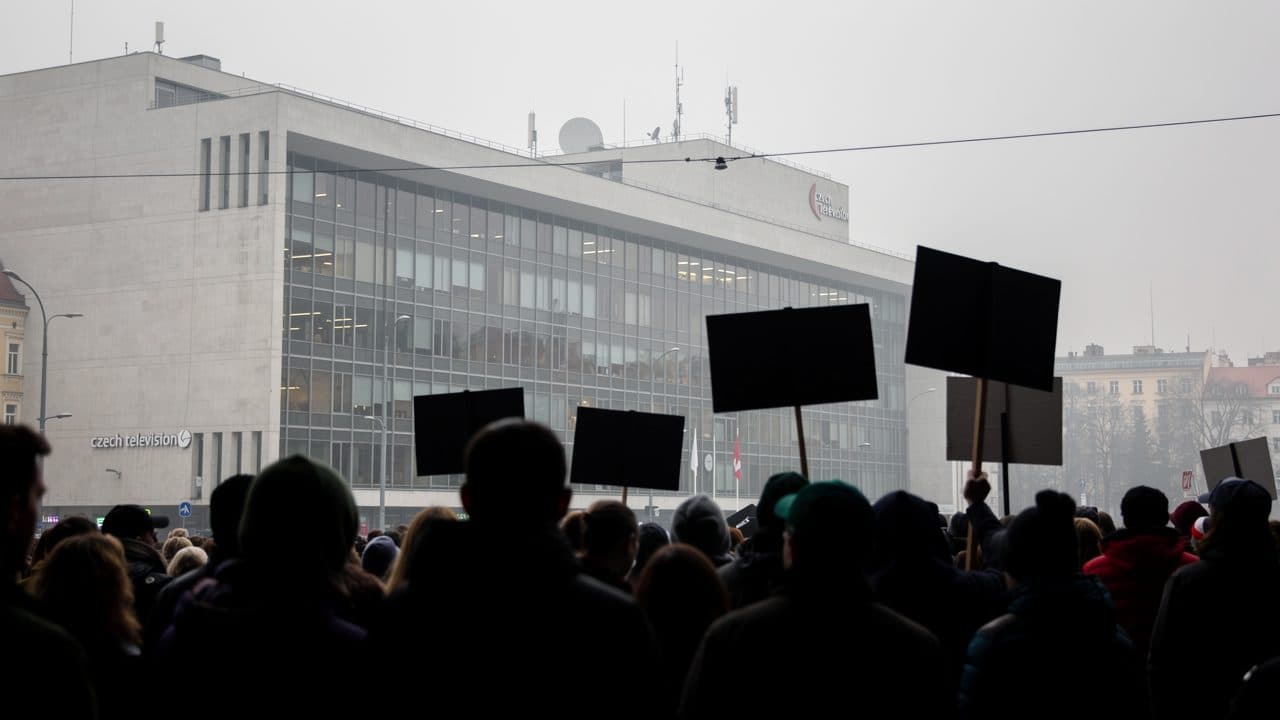
On the day before the strike, on Sunday, according to the ČTK news agency and other Czech media, several thousand people gathered in front of the Czech Television headquarters in Prague to demonstrate against the plans. Employees of the broadcaster lowered banners from the building reading "We thank you!" The rally had been organized by the movement "One Million Moments for Democracy," which had already staged similar protests in all major Czech cities in May.
On banners and in chants, it read: "A free society needs free media." Signs with inscriptions such as "Free media = free society" and "We don't want a government program" were also displayed. Speakers on stage warned that the broadcasters could be turned into mouthpieces of the government. Demonstrators called on Culture Minister Klempíř to withdraw the reform plans and to resign himself.
Financial consequences and criticism
Until now, every Czech household paid 55 crowns (about 2.3 euros) per month for radio and 150 crowns (about 6.2 euros) per month for television. In the future, the broadcasters are to be financed from the state budget but would, according to calculations, lose around 15 percent of their previous revenue. Critics see the move as an attack on the independence of the media.
President Pavel is also critical of the reform. President Petr Pavel described the previous system as functional and spoke of a serious risk of political dependence should the broadcasters, in the future, depend on the goodwill of the parties for every budget decision. In addition, Pavel declared the journalists' strike to be legitimate.
Political reactions: President, coalition, and opposition
Prime Minister Babiš rejected the accusations. There would be no political influence, he promised. At the same time, the billionaire had previously stated that there was sufficient savings potential at the broadcasters. The coalition justified the step with economic necessity and the avoidance of the waste of taxpayers' money.
Culture Minister Klempíř accused the striking employees of being concerned about money and not about values and social ideals. The culture minister had authored the bill and is regarded as determined to implement the plans. The law is to take effect at the turn of the year but still has to be passed by parliament.
Parliamentary path and European context
The draft will now be debated in the Czech parliament. The opposition majority in the Senate, the second chamber of parliament, has already announced fierce resistance to the reform. In the Czech Chamber of Deputies, the debate is therefore likely to be significantly prolonged. Parliament is now dealing with the government project.
The government reshuffle in Prague follows a pattern that can also be observed in other European countries with right-wing populist parties. In France, Germany, and Austria, there are similar efforts to restructure the financing of public-service media. The FPÖ, for example, which sits together with Babiš's ANO in the Patriots for Europe group in the EU Parliament, is also calling for direct budget financing.
In domestic political terms, the controversy is also an echo of earlier conflicts surrounding Babiš. The head of government was formerly the owner of the media group MAFRA, which publishes several daily newspapers. During election campaigns, he used his own media for his campaigns. In 2021, Babiš also surfaced in the Pandora Papers, a major leak on tax havens, and in the so-called Stork Nest affair, which involved allegedly unjustly received EU subsidies worth millions for a wellness complex near Prague. He has consistently and vehemently rejected the accusations and spoken of political witch hunts. The EU funds were, according to information at the time, intended only for small and medium-sized enterprises, while Babiš, as one of the richest citizens of the Czech Republic, was the owner of the Agrofert group with more than 200 companies. He had repaid the subsidies. In addition, the Czech Chamber of Deputies recently refused to lift Babiš's immunity, which protects him from further prosecution. Under pressure from President Pavel, who cited a serious conflict of interest, Babiš had agreed to transfer the Agrofert group into a foundation.
Background: Babiš, MAFRA, and the Stork Nest affair
The events show how deeply the dispute over media financing in the Czech Republic is embedded in broader political tensions. While the government side presents the reform as economically necessary, critics see it as an attack on the independence of the media, since the broadcasters would, in the future, depend on the goodwill of the parties for every budget decision. President Pavel also expressed criticism in this sense.
The employees of ČT and ČRo explicitly announced the warning strike for Monday as a warning. During the strike day, further protest actions and rallies were planned throughout the day. With a view to the upcoming parliamentary procedure, the unions and the protest movement intend to keep the pressure on the coalition.
Observers assess the warning strike as an unprecedented act of resistance by Czech public-service media. The parallel demonstrations and expressions of solidarity from abroad give the protest additional weight. Whether the reform can ultimately survive in parliament remains open in view of the opposition majority in the Senate and the heated public debate.
An intense parliamentary battle is to be expected in the coming weeks. Should the reform fail, this would be a political setback for Babiš. Should it be adopted despite the protest, the public-service broadcasters face a period of uncertainty over their future financing and independence.
The events in Prague also throw a spotlight on a fundamental question of European democracy: How can public-service media be protected from political influence when their financing depends precisely on the goodwill of the respective government? With its debate, the Czech Republic could become a litmus test for other member states where similar reforms are under discussion.
In any case, the one-day warning strike has made the fault lines of Czech domestic politics visible. Between the right-wing populist governing coalition, the president, the opposition, and the employees of the public-service broadcasters, a conflict over media freedom has escalated that is attracting attention beyond Prague. The upcoming parliamentary debates will show whether the protest takes effect or whether the reform is implemented despite all resistance.
The solidarity rally on Sunday and the one-day warning strike on Monday are only the opening of a dispute that is likely to occupy the Czech Republic for months to come.
The CTK news agency and other Czech media reported consistently on the events. This news item was broadcast on June 22, 2026 on the Deutschlandfunk program.
Questions & Answers
What is the warning strike in the Czech Republic about?
Employees of Czech Television (ČT) and Czech Radio (ČRo) went on strike on June 22, 2026 against the planned abolition of broadcasting fees and the direct financing of the broadcasters from the state budget.
Who decided on the reform?
The right-wing populist government under Prime Minister Andrej Babiš had decided on the abolition of broadcasting fees about a week before the warning strike; the draft was authored by Culture Minister Oto Klempíř of the Motorists party.
What role does President Petr Pavel play in the conflict?
President Pavel has criticized the reform, described the previous system as functional, and expressly recognized the employees' strike as legitimate.