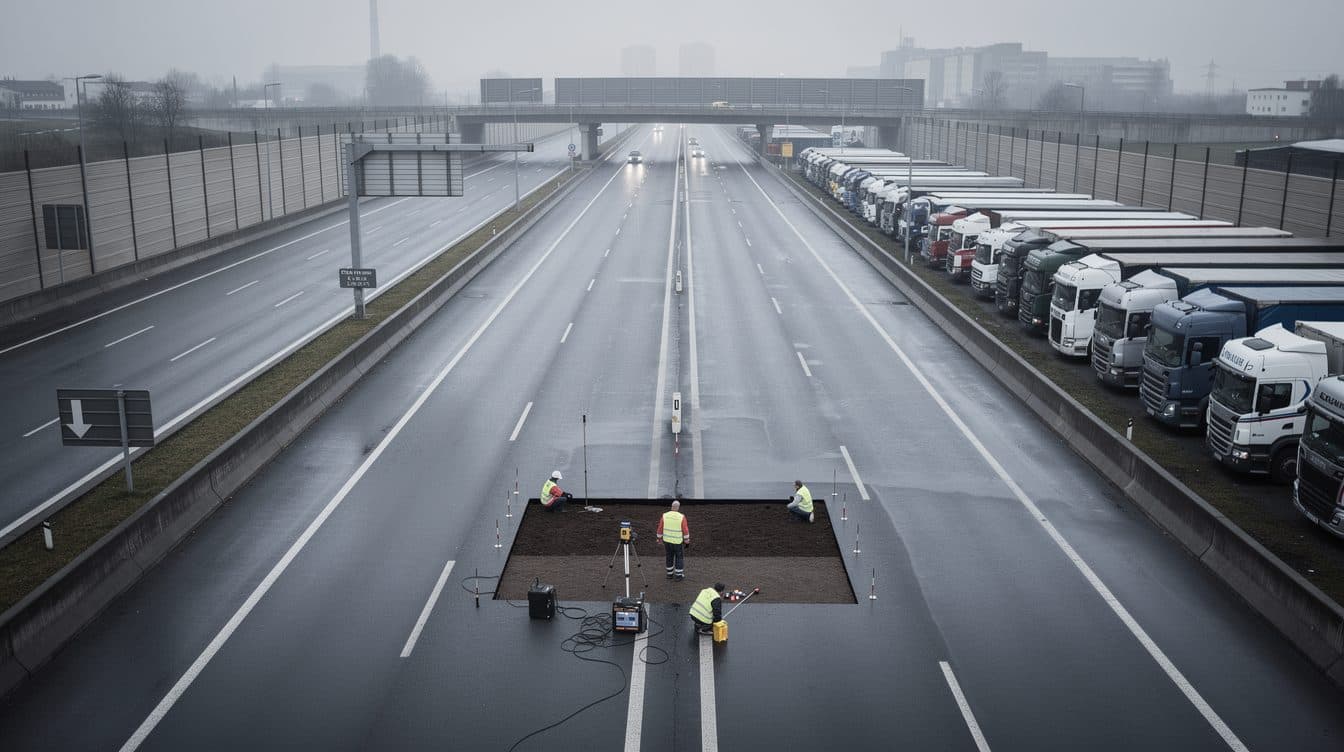
A40 near Mülheim closed for ten days as crews search for World War II ordnance
●Updated · 40 new developments since 06/12/2026
Mülheim an der Ruhr, 12 June 2026
AI-generated image (flux-2/pro-text-to-image via Kie.ai)
Summary
A heavily used stretch of the A40 near Mülheim an der Ruhr has been closed in both directions for ten days so specialists can search for unexploded World War II ordnance before planned construction work. Drivers and truckers between Duisburg and Essen are being diverted on a wide detour that nearly doubles the route, and residents and businesses along the corridor say they expect delays, lost customers and longer working days.
Mülheim an der Ruhr, 12 June 2026
A frequently used section of the A40 between Duisburg and Essen was closed in both directions on Friday evening at 9:00 PM for ten days so specialists can search for unexploded World War II ordnance ahead of planned construction works near Mülheim an der Ruhr.
Update 12 June 2026: The A40 closure between the Mülheim-Heißen and Mülheim-Winkhausen junctions has begun, and reporters on the ground have started documenting the impact on residents, commuters and small businesses in the corridor. Authorities had previously announced the timing; what is new is the on-the-ground reaction from people who live, drive and work alongside one of the busiest motorway sections in western Germany.
What's new since 12 June 2026
The section affected runs between the Mülheim-Heißen and Mülheim-Winkhausen junctions, the Autobahn GmbH said. Although only about 20 metres of roadway need to be cleared, the search for bombs and munitions remnants requires the surface to be removed and then rebuilt, which is why both directions of the carriageway are shut for an extended period. According to the Autobahn GmbH, between 80,000 and 90,000 vehicles use this stretch of the A40 every day.
Where the closure bites
For most of those drivers, the closure means a significant detour. Traffic heading from Duisburg towards Essen is being diverted at the Kreuz Duisburg, along the A59 to Kreuz Duisburg-Süd, then via the A524 to Kreuz Breitscheid and finally along the A52 to the Autobahndreieck Essen-Ost, where vehicles rejoin the A40. The detour extends the journey from roughly 20 kilometres to almost 40 kilometres.
The reason for the work is the planned expansion of the A40 between Duisburg and Essen. The section, long regarded as a congestion hotspot in the western Ruhr area, is to be widened to six lanes in the coming years, a project that will also require 16 bridges in the densely populated region to be rebuilt. Before that work can begin, specialists have to check the ground for unexploded bombs dropped during the Second World War.
Why the autobahn is being dug up
On the ground, the mood among residents and businesses is a mixture of resignation, frustration and dark humour. A WDR team spoke to people in Winkhausen, a city district of Mülheim that sits directly next to the affected motorway section, and reported the conversations on 12 June 2026.
Residents and businesses react
Birgit Westphal from Duisburg, who was loading her shopping into a small car on a car park right by the A40 in Winkhausen, said there was nothing to be done about the closure: "Hilft ja nichts." Asked about possible alternatives, she shook her head: "Ich müsste über die Altendorfer Straße, da kann man nicht mal eben schnell ausweichen." The Altendorfer Straße, a known congestion point of its own, offers little relief.
A few metres away, Ümit Yilmaz stood by his chicken-rotisserie van. He said he expected to feel the financial impact, noting that during the previous A40 closure his business had seen roughly twenty per cent fewer customers. "Irgendwann muss das gemacht werden und über ne Fliegerbombe will ja auch keiner drüber fahren," he added, before shrugging: "Aber was sollen wir machen, wir können es nicht ändern."
For tradespeople who depend on the A40 to reach their customers, the closure is more than an inconvenience. David Richter, a craftsman from Duisburg who travels the route daily, called it catastrophic: "Die Sperrung ist für uns katastrophal." He said he expected to be on the road 40 minutes earlier because of the detour: "Jetzt müssen wir noch früher los, ich rechne mit 40 Minuten durch die Umwege." "Die Autobahn gehört mit zu meinem Beruf," he added.
David Fischer, who runs a roof and façade renovation firm, was caught off guard by the closure. His company sets off at 7:00 AM with its vans to reach customers. "Jetzt werde ich wohl noch früher aufstehen müssen und mein Wecker geht schon um 6 Uhr," he said. He said he had not been aware of the closure beforehand: "Da wusste ich nichts von."
Retiree Hans Kirchberg took the news with humour. "Aber bei unserem Glück finden se bestimmt was," he laughed, suggesting that with their luck the search teams would be sure to find something. His wife joined the conversation to defend their generation: "Wir sind Rentner und hätten ja Zeit, aber die sind ja eigentlich immer am ungeduldigsten."
Several residents questioned where all the diverted traffic was supposed to go. "Wo sollen wir denn herfahren, es sind doch überall nur noch Baustellen?" one person asked, pointing to the dense overlap of construction sites across the Ruhr area. The wider Ruhr region is in the middle of a sustained programme of motorway renewal, and the A40 closure is happening against a backdrop of numerous other works.
The Autobahn GmbH has urged drivers and truckers travelling between Duisburg and Essen to allow extra time, and the police have been pointing to the signed diversion route as the recommended alternative. Local authorities have also asked employers, where possible, to allow staff to work from home or shift hours to ease pressure on the diversion roads.
What officials are saying
Officials stress that the ordnance search is non-negotiable. Unexploded bombs from Allied air raids on the industrial Ruhr area are still discovered regularly, and the German authorities' standard procedure is to clear the ground before any major construction project begins. The 20-metre section near Mülheim is being treated the same way as hundreds of other sites across North Rhine-Westphalia.
Looking ahead: the six-lane expansion
Beyond the immediate ten-day closure, the long-term plans for the A40 are ambitious. The motorway is to be widened to six lanes and 16 bridges rebuilt, a project expected to take several years and to cause further traffic disruption in stages. For now, the priority is the ordnance search; only once the ground has been declared clear can the expansion works begin.
Drivers are being advised to check traffic bulletins before setting out, to allow significantly more time for journeys between Duisburg and Essen, and to consider public transport where possible. Local police have warned that, especially in the first days of the closure, congestion is likely to spread beyond the official diversion route onto secondary roads in Mülheim, Essen and Duisburg.
Questions & Answers
Why is the A40 near Mülheim closed for ten days?
Specialists are searching a roughly 20-metre section between the Mülheim-Heißen and Mülheim-Winkhausen junctions for unexploded World War II ordnance before planned construction work. The road surface has to be removed and then restored, which is why the closure lasts ten days.
How long will the detour between Duisburg and Essen take?
According to the Autobahn GmbH, the diversion roughly doubles the normal distance, extending the route from about 20 kilometres to almost 40 kilometres. Drivers and truckers have been told to allow around 40 minutes of extra time.
What is the long-term plan for the A40 between Duisburg and Essen?
The autobahn, which carries 80,000 to 90,000 vehicles a day, is to be widened to six lanes in the coming years. The project will also require 16 bridges in the densely populated region to be rebuilt.