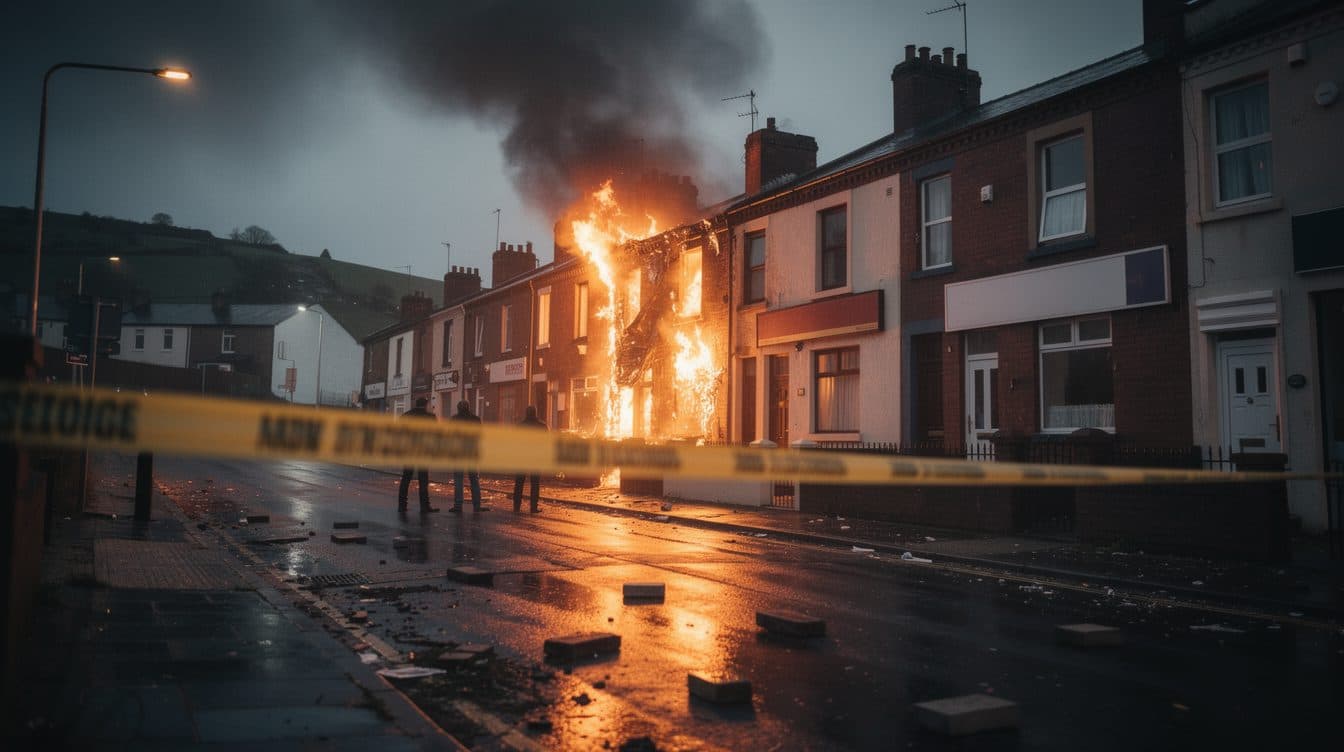
AI-generated image (flux-2/pro-text-to-image via Kie.ai)
Summary
In Belfast, days of partly racially motivated unrest have erupted following a stabbing. Prime Minister Keir Starmer promised the full force of the law; Northern Ireland's First Minister Michelle O'Neill sharply condemned the violence.
Belfast, 11 June 2026
In the Northern Irish capital Belfast, severe, partly racially motivated riots have been raging since Tuesday evening, after a Sudanese asylum seeker stabbed a 44-year-old man with a knife on Monday evening, leaving him critically injured.
Trigger: Monday evening stabbing
According to police, the attacker is a 30-year-old Sudanese man who entered Northern Ireland in 2023 via Paris and Dublin and applied for asylum there. A few months later he was granted the right to stay. The 44-year-old victim, who was on the ground during the attack and was stabbed repeatedly, is in life-threatening condition, authorities said. The alleged perpetrator, Hadi A., is in pre-trial detention; the victim is in intensive care with severe head injuries.
Violence on the streets: burning houses and masked attackers
By Tuesday evening Belfast had descended into chaos. Hooded, mostly young men marched through working-class neighborhoods, hurling cobblestones, bricks and Molotov cocktails at police and setting homes and vehicles on fire. In several cases, masked groups specifically targeted houses in the city's poor eastern districts where Black and Asian people live. Several houses and shops fell victim to arson attacks, 27 people had to be evacuated. Twelve officers were injured, 16 protesters were temporarily arrested.
Labour MP Claire Hanna spoke of a racist pogrom. She said she had seen men "going from house to house looking for foreigners" — many of them masked, several had set fires — including in houses where migrant families with children lived. Pastor Mervyn Gibson, who belongs to the Orange Order, told the Financial Times: "Die Proteste werden von Faschisten und Rassisten angezettelt." He observed "pure racism along the lines of 'all foreigners out'."
Situation on Wednesday and outlook
On Wednesday evening a massive deployment of security forces prevented a repeat in Belfast. Police used water cannon, but the scale of violence was lower than the previous night. Unlike the night before, this time the rioters did not specifically hunt down migrants identifiable by their skin color. A solidarity rally under the motto "Together Against Hate" is planned for Saturday in Belfast.
Protests and riots also broke out in other UK cities. According to the Scottish Daily Express, people were also specifically targeted because of their skin color during those events. The unrest has now spread beyond some Scottish regions to places including the English city of Southampton — a city in which 18 wards are among the poorest ten percent of the entire country. After the Southport murders of 2024, the worst riots had broken out in Sunderland, Middlesbrough and Hull — all former industrial cities in northern England now in decline.
Role of social media
In the days before the riots, numerous posts on X and Telegram stoked the mood. Stephen Yaxley-Lennon, a far-right extremist convicted multiple times in Britain who calls himself "Tommy Robinson," had called on people to hold mass protests across Great Britain. X chief Elon Musk had retweeted his post. Apparently, known criminals had openly advertised the possibility of entry via Dublin. Attention in London is now focused on combating online perpetrators of violence and agitators such as X chief Elon Musk, who likes to talk about "civil war" in Britain.
Labour Prime Minister Keir Starmer promised the rioters "the full force of the law." Northern Ireland's First Minister Michelle O'Neill and Prime Minister Keir Starmer sharply condemned the violence and announced a tough response against those responsible. To cope with the flood of arrests, the Ministry of Justice has hastily freed up over 500 new prison places so that offenders can be jailed in fast-track proceedings.
Political reactions from London and Belfast
Northern Ireland's police chief Jon Boutcher did not rule out the involvement of paramilitary groups. He said: "ich scheue nicht vor der Wahrheit über eine mögliche Beteiligung paramilitärischer Gruppen zurück. Lassen Sie uns erst die Ermittlungen in Gang bringen, um herauszufinden, wer das online und vor Ort orchestriert hat." The responsible regulator Ofcom urged the affected companies to comply with an online safety law that recently came into force, which criminalizes incitement to violence.
Historian and peace researcher Corinna Hauswedell said: "Es sind Erinnerungen an ‹The Troubles›, die bürgerkriegsähnlichen Zustände, die Nordirland 30 Jahre lang gebeutelt haben". She warned: "Wir müssen aufpassen, dass Wut und Hass nicht genutzt werden, um alte Familienemotionen wieder zu mobilisieren und auf einem fast ausgetrockneten, aber noch fruchtbaren Boden wieder neue Gewalt wächst". Although the Northern Ireland conflict is considered politically settled since the negotiation of the Good Friday Agreement, so-called "Peace Walls" still divide parts of Belfast to this day.
Northern Ireland Secretary Hilary Benn announced: "Wir werden nächste Woche neue Vorschläge vorlegen, um Social-Media-Unternehmen in Krisenzeiten - die dann definiert werden - zu bewegen, solche Inhalte zu entfernen." There are people "who live far, far away from Northern Ireland and know nothing about Northern Ireland, but who would still try to ignite and fuel these riots." Technology Secretary Liz Kendall, ironically on X, signalled a tightening of legal regulations.
Historian warns of a new old conflict
Criminologist Johanne Devlin Trew of Ulster University described the attackers as "Männer, die maskiert und größtenteils wahrscheinlich relativ jung sind". Online radicalization expert Julia Ebner said in an ARD interview: "Es hat sich in den letzten Jahren und vor allem auch letzten Wochen immer mehr abgezeichnet, dass es einzelne Trigger-Ereignisse gibt, die von rechten Akteuren und rechtsextremen Influencern ausgenutzt und instrumentalisiert werden." The Belfast riots were thus also amplified by social media algorithms.
Among those who helped was Twasul Mohammed, originally from Sudan, who, according to BBC Radio, assisted frightened residents on the night of the violence. "Es seien Menschen, die erst kürzlich vor dem Krieg im Sudan geflohen sind. Sie würden dieselben Szenen erneut erleben und wieder dasselbe durchleben", she reported. Belfast is currently pursuing the initiative of becoming a "City of Sanctuary" — a safe haven for asylum seekers. Hauswedell spoke in this context of a "besonderen Ironie der Geschichte". (Sebastian Borger from London, 11.6.2026)
Questions & Answers
What triggered the riots in Belfast?
The trigger was a brutal stabbing on Monday evening, in which a 30-year-old Sudanese asylum seeker critically injured a 44-year-old passerby; the victim is in intensive care with severe head injuries.
Who is Tommy Robinson and what role did he play in the unrest?
Tommy Robinson, whose real name is Stephen Yaxley-Lennon, is a far-right extremist convicted multiple times in Britain, who had called for mass protests across Great Britain; his call was retweeted by X chief Elon Musk.
What measures have the authorities taken against the violence?
Prime Minister Keir Starmer promised the full force of the law, the Ministry of Justice created over 500 new prison places for fast-track proceedings, and Northern Ireland's police chief Jon Boutcher did not rule out the involvement of paramilitary groups.