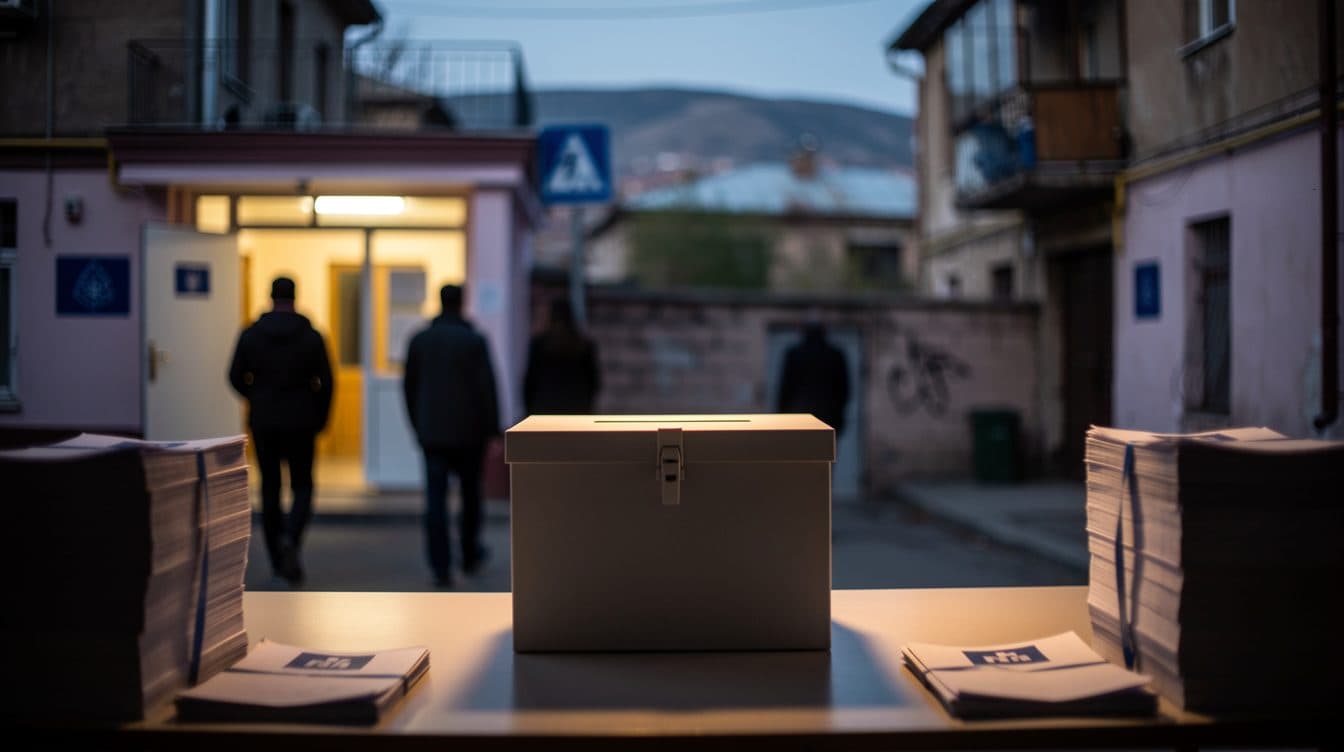
AI-generated image (flux-2/pro-text-to-image via Kie.ai)
Summary
In the Armenian parliamentary election, the pro-Western camp of Prime Minister Nikol Pashinyan has clearly won according to initial projections. His Civil Contract party received 51 to 57 percent of the vote in a partial count, while the pro-Russian opposition Strong Armenia received 21 to 23 percent. Voter turnout at 59 percent was significantly higher than in 2021.
Yerevan, June 8, 2026
In the Armenian parliamentary election, considered a directional vote, the pro-Western camp of Prime Minister Nikol Pashinyan has achieved a clear victory according to a partial count, while the pro-Russian opposition trails significantly behind.
According to the Central Election Commission, after counting 553 of approximately 2,000 polling stations, 51 percent of Armenians voted for Pashinyan's Civil Contract party. In an earlier partial count of 110 polling stations, 57 percent had voted for Civil Contract. The strongest opposition force became the pro-Russian party Strong Armenia with 23 percent, led by the oligarch Samvel Karapetyan, who is under house arrest.
Voter turnout was 59 percent, significantly higher than in the previous parliamentary election in 2021. The Election Commission had already reported brisk participation in the first hours: within the first three hours, nearly 15 percent of voters had cast their ballots.
High Turnout and Historic Victory
Prime Minister Pashinyan spoke of a "historic victory" in the night to Monday and reaffirmed his goal of a third term. His Civil Contract party, which has been in power since 2018, had at times been polled significantly weaker but had recently regained ground during the campaign.
In the vote, which was considered a directional election between West and East, two issues were at the forefront: relations with Russia and the peace agreement with the long-time archenemy Azerbaijan. Armenia had signed the agreement last year after its defeat in the latest war over Nagorno-Karabakh, thereby relinquishing its claim to the region, which had been contested for decades.
In September 2023, Azerbaijan had fully taken the Nagorno-Karabakh region after only 24 hours of fighting; around 100,000 ethnic Armenians had to flee from there to the mainland. Many of the approximately three million Armenians do not agree with the renunciation of Nagorno-Karabakh, and the opposition therefore accuses Pashinyan of high treason. The government, in turn, accuses parts of the opposition of serving the Kremlin.
Nagorno-Karabakh and Azerbaijan: The Other Major Challenge
Russia had exerted massive pressure on Yerevan in the run-up to the election. Russian President Vladimir Putin had warned the country the previous week of economic consequences of a possible rapprochement with the European Union. Moscow had imposed import bans on Armenian products over Yerevan's pursuit of EU rapprochement, including flowers and various food items, justifying this with alleged hygiene deficiencies.
At the same time, the Russian Ministry of Energy threatened to terminate a gas supply contract favorable to Armenia. Estimates of Armenia's economic dependence on Russia range from 40 to over 60 percent, including discounted prices for oil and gas deliveries.
Putin received Pashinyan in Moscow in April and told him that the pursuit of EU membership was incompatible with simultaneous membership in the Moscow-dominated Eurasian Economic Union. That is incompatible with membership in the Moscow-dominated economic alliance EAEU, Putin let his guest know. At an EAEU summit in late May in Astana, he repeated the warning: the crisis in Ukraine had begun with the EU accession efforts.
Pressure from Moscow, Rapprochement with Brussels
Pashinyan rejected the criticism and declared that Armenia is a democracy without restrictions. "Our social networks, for example, are one hundred percent free," he said, and there are no political prisoners in his country either. At the same time, he described relations with Russia as "in a transformation phase, which he assesses positively" and added: "Our relations with Russia are transparent and sincere, and we have nothing to hide."
The EU responded to the Russian pressure tactics with its own signal of support. European Commission President Ursula von der Leyen announced an aid package of 50 million euros and criticized Moscow's attempt to use economic relations as a political lever as "economic coercion." She also encouraged European companies to invest in Armenia.
In early May, an EU-Armenia summit of the European Political Community had taken place in Yerevan, attended also by French President Emmanuel Macron. At the summit, a partnership agreement was signed, aimed at modernizing Armenian transport infrastructure, diversifying energy supply, and expanding digital infrastructure. During the visit, Macron and Pashinyan sat together at a piano in Yerevan and tried their hand at "La Bohème," a chanson by the Armenian-French artist Charles Aznavour.
USA, EU, and a Piano with Macron
Shortly before the election, US Secretary of State Marco Rubio had also stopped in the Armenian capital and signed a bilateral cooperation agreement. Jakob Wöllenstein, head of the South Caucasus office of the Konrad-Adenauer-Stiftung, said on Deutschlandfunk that the USA and the EU had an interest in the country with a view to a possible trade corridor in the Caucasus. At the same time, Armenia is a democratic pioneer in the region, and as the oldest Christian country, it belongs to European civilization in the view of many people.
Wöllenstein added that in surveys, a majority of the Armenian population say they want to join the EU in the long term, while pursuing a balanced foreign policy that seeks to enter into many partnerships. "The mood in the country has turned," he told the Deutsche Presse-Agentur; the government's work is now rated more positively, especially on the issues of peace and security and on the creation of new jobs. "Even if many do not like Pashinyan, there is no alternative." The parts of the opposition perceived as Kremlin-loyal are certainly not.
Election day itself was partly turbulent. The authorities justified their actions against supporters of Strong Armenia around billionaire Samvel Karapetyan with suspicion of attempted vote-buying. The Armenian Anti-Corruption Committee spoke of "electoral manipulation" and accused Karapetyan's party of having provided "gratuitously financial support to various residents" who are eligible to vote in the parliamentary elections. Police searched the party's office in the city of Gyumri, and more than ten people were arrested on suspicion of vote-buying. Three members of a local election commission were also arrested during the night.
The pro-Russian opposition complained about the arrest of more than 100 of its supporters on election day. The Armenian government, in turn, accused Moscow of attempted election manipulation: reportedly, Armenians living in Russia had been flown to Armenia specifically to vote there for payment for pro-Russian parties. A Flyone plane from Moscow that landed in Yerevan on Thursday before the election was reportedly nearly fully booked, with a festive family atmosphere on board. In Russia itself, there was no polling station at the Armenian embassy for Armenians wishing to vote.
Turbulent Election Day and Vote-Buying Allegations
Observers assessed the vote as evidence of a shift in mood in the country. The freight forwarder Gevork from the small town of Jermuk said: "We won't sell off our future for two truckloads of flowers." He said he is not a big Pashinyan fan, but he likes the pro-Russian parties of billionaire Karapetyan and former President Robert Kocharyan even less: "I don't want to go back to the Soviet Union."
The oligarch Karapetyan, whose fortune, amassed in the Russian gas and real estate business, is estimated at just under 4.5 billion US dollars, has been under house arrest for around a year. He is accused of planning a coup in Armenia; Pashinyan spoke of an "attempted coup" by the party. Karapetyan is constitutionally excluded from the office of prime minister, as he holds Russian citizenship in addition to Armenian citizenship. If his alliance were to win the election, he would presumably pursue a constitutional amendment and amnesty for himself.
Karapetyan Under House Arrest, Opposition Fragmented
Putin had complained in Moscow that pro-Russian forces were in custody even though they held a Russian passport, and had wished for their participation in the election. Russian Foreign Ministry spokeswoman Maria Zakharova warned that Armenia would be drawn into an "anti-Russian orbit" of the EU, "Such a course will inevitably lead to negative political and economic consequences for Armenia."
It remains unclear how many parties or alliances will ultimately enter parliament, as poll results fluctuated significantly. If no political force can form a government majority, Armenians would have to vote again in four weeks. According to the official OSCE election observation mission, the campaign was marked by accusations, threats, and disinformation. Mission leader Farah Karimi spoke of a worrying polarization; the campaign had been marked by mutual accusations and insults.
Pashinyan officially pursues a strategy called "diversification," in which ties to both Russia and the West are to be maintained. He also wants to normalize relations with Turkey, the important ally of Azerbaijan. Asked about a possible EU accession referendum, Pashinyan said in a video message: "The question of when this referendum will take place is very important. But until Armenia has submitted an official application for membership or approached the status of an EU candidate country, it is illogical to hold a referendum." Yerevan has not yet submitted an accession application.
Questions & Answers
Who is Nikol Pashinyan?
Nikol Pashinyan is the incumbent Prime Minister of Armenia and chairman of the Civil Contract party; he is seeking a third term with the parliamentary election of June 8, 2026.