Armenia Election 2026: Pashinyan Ahead, Conflict with Russia | allfacts360
Armenian Parliamentary Election: Pashinyan's Camp Leads According to Partial Results, Tensions with Russia High
Yerevan, June 7, 2026
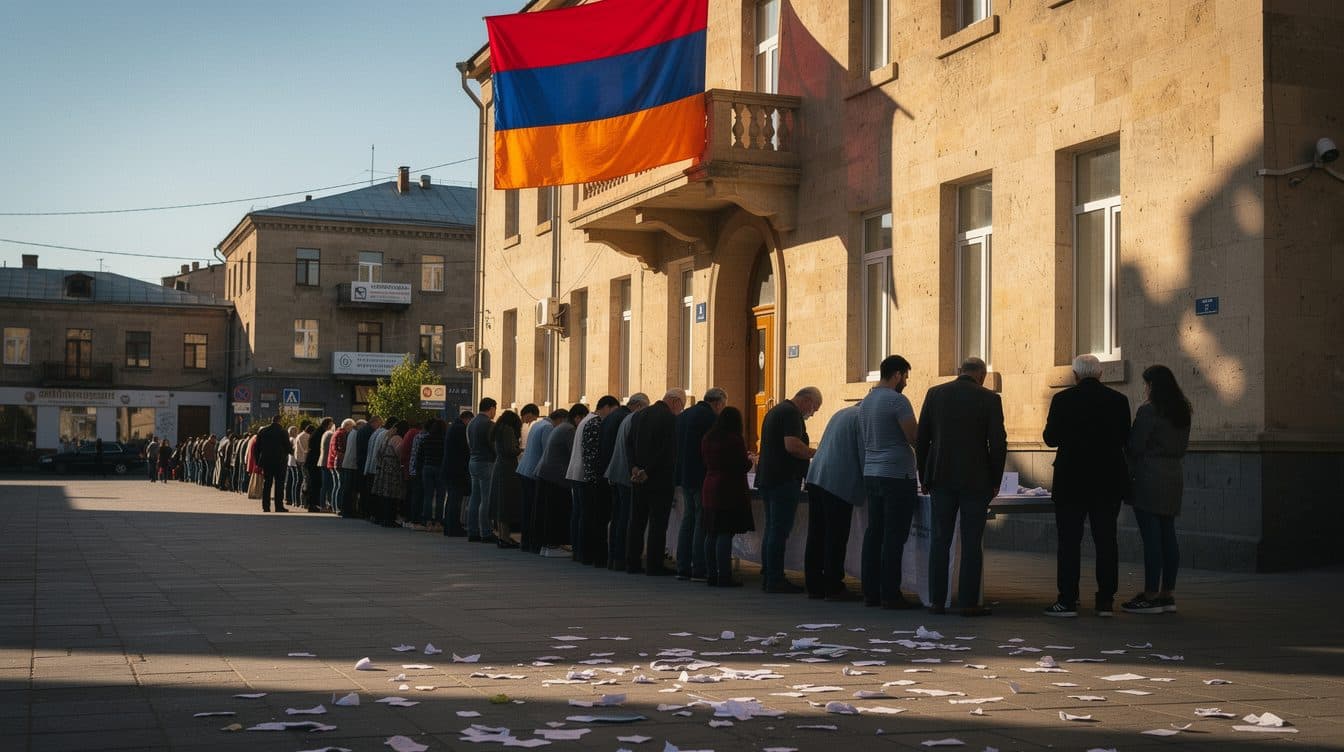
AI-generated image (flux-2/pro-text-to-image via Kie.ai)
Summary
In the Armenian parliamentary election, Prime Minister Nikol Pashinyan's camp took the lead according to partial counts. The vote was marked by massive tensions with Russia and raids against the pro-Russian opposition.
Yerevan, June 7, 2026
In the Armenian parliamentary election, the pro-Western camp of Prime Minister Nikol Pashinyan took the lead according to initial partial results, while the vote on June 7, 2026 was accompanied by severe tensions with Russia as well as raids against the pro-Russian opposition.
Polling stations in Armenia opened on Sunday morning at 6:00 a.m. local time; around 2.5 million Armenians were called upon to elect a new parliament. Turnout was brisk, according to observations by a reporter for the dpa news agency. According to the Central Election Commission, within the first three hours nearly 15 percent of voters had cast their ballots. Prime Minister Pashinyan is seeking a third term with his party "Civil Contract" and had already cast his vote in the morning.
Initial Partial Results: Clear Lead for "Civil Contract"
After the first counts, covering 110 of a total of around 2,000 polling stations, a clear lead emerged for Pashinyan's "Civil Contract." According to the Central Election Commission, the initial figures showed 57 percent of Armenians voting for Prime Minister Pashinyan's Civil Contract party. The strongest opposition force became the pro-Russian party Strong Armenia with 21 percent. Voter turnout at 59 percent was significantly higher than in the previous parliamentary election in 2021. However, "Civil Contract" is expected to need coalition partners in order to form a government.
The vote was marked by major tensions with Russia. Because of Yerevan's pursuit of closer ties with the EU, Moscow had imposed import bans on Armenian products ahead of the election and threatened to terminate a favorable gas supply contract. The Russian consumer protection authority had placed Armenian flowers and an entire list of food products on its index — allegedly due to quality defects. Armenia's economic dependence on Russia is estimated at between 40 and over 60 percent, including discounted prices for oil and gas deliveries.
Pressure from Moscow: Economic Threats Ahead of the Election
Back in April, Kremlin chief Vladimir Putin had received the Armenian head of government, Nikol Pashinyan, in Moscow. There were strong pro-Russian forces in Armenia, and he wished for them to also take part in the election, Putin said. However, some of them were in custody, even though they held a Russian passport, the Kremlin chief complained. At the end of May, Putin had also warned at the EAEU summit in Astana of the economic consequences of a possible rapprochement between Armenia and the European Union. Finally, Putin publicly reminded Yerevan that the conflict with Ukraine had also once begun with that country's aspiration to join the EU.
Election day itself was at times turbulent. The pro-Russian opposition complained about the arrest of more than 100 of its supporters. In the office of the opposition party "Strong Armenia" of the house-arrested oligarch Samvel Karapetyan in the city of Gyumri, police searched the premises on suspicion of vote buying. More than ten people were arrested. Three members of a local election commission were also arrested on the night before the election. The authorities justified their actions against supporters of Strong Armenia around billionaire Samvel Karapetyan with the suspicion of attempted vote buying.
Turbulent Election Day: Raids and Arrests
The opposition is fragmented. Among its most influential figures are the house-arrested oligarch Karapetyan with his party "Strong Armenia" and former President Kocharyan, who leads the electoral alliance "Armenia." Both are considered pro-Russian. Karapetyan has been under house arrest for about a year on charges of having planned a coup in Armenia. His fortune is estimated at nearly 4.5 billion US dollars, roughly half of the Armenian state budget. The Armenian constitution prohibits Karapetyan from running for prime minister, as he holds Russian citizenship in addition to Armenian. Officially, his nephew Narek Karapetyan therefore leads the alliance's election campaign.
Pashinyan responded to the accusations from Moscow in strong words. "Our social networks, for example, are one hundred percent free," and there are also no political prisoners in his country, he said. At the same time, he described relations with Russia as being in a phase of transformation, which he assessed positively because his relations with Russia were transparent and sincere and he had nothing to hide. On his country's European goals, he declared: "Democracy always works in favor of regional and international cooperation and is an instrument for peace in the region."
Response from Yerevan: Pashinyan Rejects Accusations
The EU had signed a partnership agreement at the EU-Armenia Summit in Yerevan at the beginning of May, covering, among other things, the modernization of Armenian transport infrastructure, the diversification of energy supply, and the expansion of digital infrastructure. European Commission President Ursula von der Leyen announced an aid package of 50 million euros for Armenia and criticized Russia for using economic relations as a political lever of pressure — an unacceptable case of economic coercion. Shortly before the election, US Secretary of State Marco Rubio also stopped in the Armenian capital and signed a bilateral cooperation agreement. The US government under President Trump supports the policy pursued by Pashinyan of rapprochement with Azerbaijan and its patron Turkey. Critics decried the Western approach as election campaign assistance for the ruling party.
Western Support: EU Summit and US Agreement
Another campaign issue was the peace agreement with the long-standing archenemy Azerbaijan. Armenia had signed it last year after its defeat in the most recent war, declaring its renunciation of the Nagorno-Karabakh region, contested for decades. Azerbaijan is traditionally supported by Turkey. Around three years ago, Azerbaijan had fully taken the disputed Nagorno-Karabakh region after brief heavy fighting. Around 100,000 ethnic Armenians had to flee from there to the mainland. However, Moscow largely remained passive during the latest armed conflict over Nagorno-Karabakh — presumably also because of the challenges of its war of aggression against Ukraine — which has triggered resentment among many in Armenia. Many of the three million Armenians disagree with the renunciation of Nagorno-Karabakh. The opposition accuses the prime minister of treason in connection with the Nagorno-Karabakh question.
Peace with Azerbaijan: A Burdened Campaign Issue
Farah Karimi, head of the OSCE election observation mission, spoke to the Deutsche Presse-Agentur of an alarming polarization of the election campaign. The campaign had been marked by accusations and insults. Jakob Wöllenstein, head of the Konrad-Adenauer-Stiftung's South Caucasus office, also observed a shift in mood on Deutschlandfunk: "The mood in the country has turned," Wöllenstein said. The government's work is now being assessed more positively, especially on the question of peace and security, which matters to many people. Armenia is also a democratic frontrunner in the region, Wöllenstein said.
Wöllenstein also pointed to the strategic interest of the US and the EU in the country with a view to a possible trade corridor in the Caucasus. Many Armenians believe that the country, as the oldest Christian nation, belongs to the broad sphere of European civilization. Wöllenstein added that surveys show a majority of the Armenian population indicating that they want EU membership in the long term, and at the same time a balanced foreign policy that seeks to enter into many partnerships. "Even if many don't like Pashinyan, there is no alternative. The parts of the opposition perceived as Kremlin-loyal are certainly not," Wöllenstein told the Deutsche Presse-Agentur.
Observers' View: Polarization and a Shift in Mood
The mood among the population was striking. A freight forwarder named Gework from the small town of Jermuk said: "We won't sell off our future over two truckloads of flowers." He is no big fan of Pashinyan, but he likes the pro-Russian parties around billionaire Samvel Karapetyan or former President Robert Kocharyan, who is considered a friend of Putin, even less. "I don't want to go back to the Soviet Union," Gework said. A representative of the Armenian government also accused Moscow of attempted vote buying: Armenians in Russia had reportedly been flown to Armenia specifically in return for payment in order to vote for pro-Russian parties.
Should none of the political forces ultimately be able to form a majority government, Armenians would have to vote again in four weeks. The Caucasus republic has traditionally maintained close relations with Moscow. The government has, however, recently signaled increased interest in ties with the European Union. The Caucasus republic has officially committed itself to the goal of EU accession. Pashinyan stated that he had long-term EU membership in mind for Armenia. However, until Armenia has submitted an official application for membership or moved closer to the status of an EU accession candidate, it would be illogical to hold a referendum.
France's President Emmanuel Macron had tried to play "La Bohème" by Charles Aznavour together with Pashinyan at the piano in Yerevan at the beginning of May. Macron and other European heads of state and government had taken part in the EU-Armenia Summit of the European Political Community in Yerevan. Russia has been waging its large-scale war of aggression against neighboring Ukraine for more than four years. The situation in the region remains fragile, but the provisional result suggests that voters in Armenia are largely backing the course taken so far.
Questions & Answers
Who is Nikol Pashinyan and which party does he lead?
Nikol Pashinyan is the incumbent Prime Minister of Armenia. He is running in