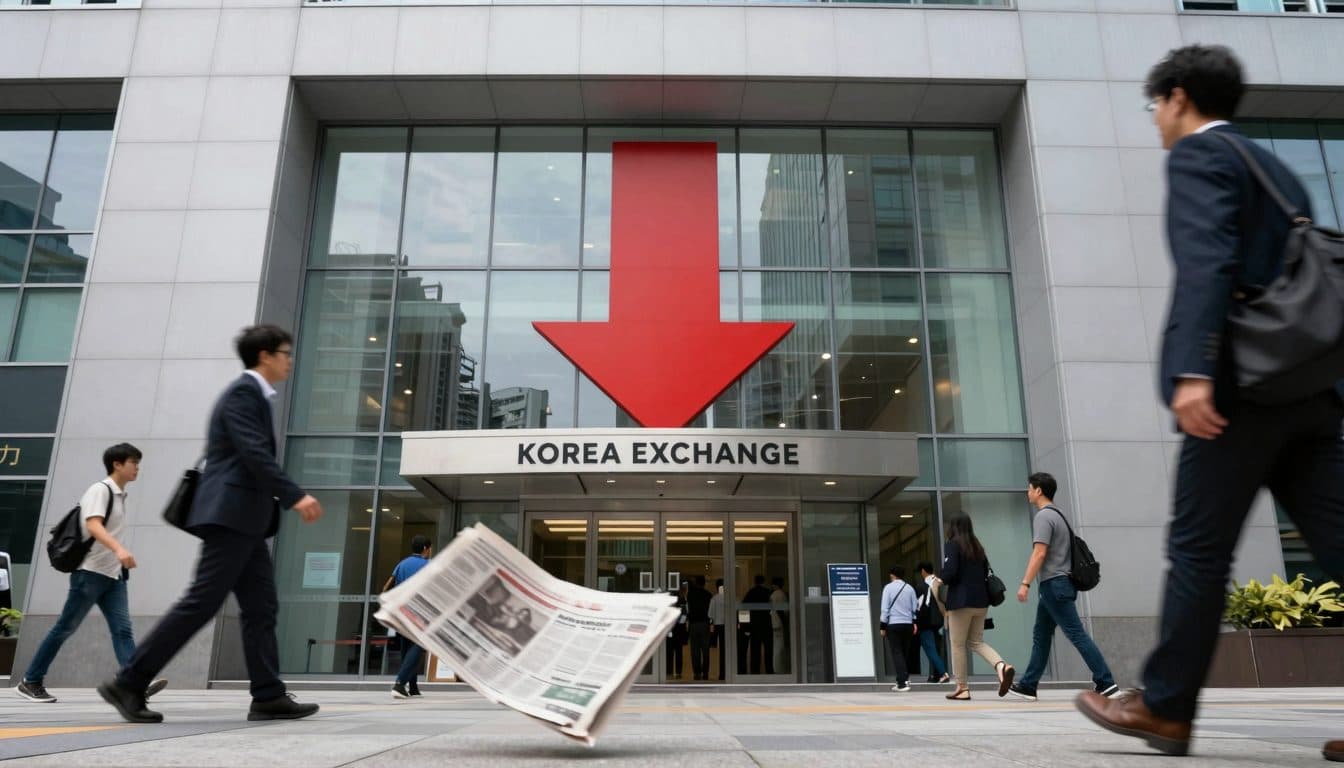
Asian Markets Under Pressure: Chip Stocks Plunge, KOSPI Crashes Temporarily
Frankfurt, July 16, 2026
AI-generated image (z-image via Kie.ai)
Summary
Asian stock markets were mostly lower on Thursday. A broad sell-off in semiconductor stocks pushed the South Korean KOSPI down more than six percent and also caused significant losses for Japan's Nikkei. Only Hong Kong managed to post gains.
Frankfurt, July 16, 2026
Asian stock markets were mostly down significantly on Thursday, driven by a broad sell-off in chip stocks, which caused the South Korean KOSPI to temporarily plunge more than six percent and also pulled the Japanese Nikkei deep into negative territory.
A broad sell-off in chip stocks sent stock markets in East Asia into a downward spiral on Thursday. In Seoul, Samsung Electronics and SK hynix are plunging, with both stocks together accounting for half of the KOSPI's weighting. The South Korean benchmark index temporarily crashed 6.41 percent to 6,817.72 points; trading in Seoul was temporarily halted due to excessive price swings, as has frequently been the case in recent weeks. In addition, the Bank of Korea has raised interest rates for the first time in three and a half years, with the key rate now at 2.75 percent following a 25 basis point move expected by market participants.
In Japan, prices also fell significantly: The Nikkei 225 temporarily lost a substantial 2.92 percent to 66,746.88 points, with the day's losses totaling around three percent. According to traders, the sell-off is driven by growing concerns that the AI-fueled rally in semiconductor stocks has gone too far, especially since chip stocks now make up a historically high weighting in the major indices. JPMorgan trader Brian Heavey commented: "Ich glaube nicht, dass es eine einzelne negative Schlagzeile gibt, die den Ausverkauf bei Halbleitern antreibt. Ich denke, es zeigt nur, wie hoch die Messlatte für die Chip-Ergebnisse liegt." Investors are particularly focused on TSMC's quarterly results due later in the day, as well as SK hynix's figures on July 22.
Hong Kong as the Exception in the Regional Trend
Hong Kong was a clear exception: While Hong Kong's Hang Seng clearly stood out with a gain of 1.93 percent to 25,157.56 points, driven by price gains in technology stocks outside the chip sector, the Shanghai Composite also came under pressure, falling 0.82 percent to 3,923.20 points. In China, Alibaba added just under five percent after already posting significant gains the previous day, while Tencent gained a good three percent.
The continued attacks in the Iran war also had a negative impact, even though oil prices did not rise further in response. The US government had responded with a second wave of attacks on Iranian military facilities that allegedly threatened ships in the Strait of Hormuz. US President Donald Trump also threatened to attack the country's civilian infrastructure. Jochen Stanzl, chief market analyst at Consorsbank, said: "Die relative Stärke der Aktienmärkte deutet darauf hin, dass kaum ein Anleger von einer Rückkehr zu einem Krieg mit unkontrolliertem gegenseitigen Beschuss ausgeht. Schnäppchenjäger würden darauf setzen, dass die Drohkulisse von Trump eine Verhandlungstaktik sei."
Geopolitical Tensions and the US Federal Reserve
US indices had posted moderate gains on Wednesday despite the tensions. The Dow Jones closed 0.3 percent higher at 52,659 points, the S&P 500 gained 0.4 percent to 7,572 points, and the Nasdaq rose 0.6 percent to 26,269 points. Broker IG quoted the DAX at 25,027 points at the time of reporting, representing a slight gain of 0.1 percent; at the close, the German benchmark index was 0.6 percent lower at 24,999 points, supported by the 50-day moving average.
Among individual stocks, South Korean automakers also came under pressure: Hyundai Motor, on the other hand, fell by three and a half percent: The automaker is taking over the remaining shares of Softbank Group in Boston Dynamics and thus gaining full control of the robotics company, after Softbank exercised a contractual put option. Financial details of the deal were not disclosed.
Market sentiment was also influenced by monetary policy signals. Surprisingly weak US producer prices fueled hopes that the Federal Reserve could refrain from further interest rate hikes. According to the CME FedWatch tool, the markets priced in only a 10.2 percent probability of an interest rate hike in the current month, down from 31 percent a week earlier. Fed Chair Kevin Warsh had painted a predominantly positive picture of the US economy before Congress, pointing to the economy's resilience despite the energy price shock stemming from the Middle East conflict. The Fed's Beige Book, released on Wednesday, noted rising employment and potentially easing inflation, but pointed to increased uncertainty regarding fuel costs.
Corporate News and Outlook
On the commodities markets, oil prices rose slightly: Brent gained 0.5 percent to $85.36 per barrel, while US WTI added 0.7 percent to $80.17. In the corporate sector, BlackRock and Morgan Stanley exceeded earnings expectations with their quarterly results; Morgan Stanley's stock rose 0.4 percent after the report. Johnson & Johnson, on the other hand, lost 2.7 percent, even though the company raised its full-year targets – the market pointed to mixed pharmaceutical sales. ASML closed slightly in negative territory, despite the company having raised its revenue forecast.
A potential multi-billion deal was also in focus: According to a Financial Times report, US ride-hailing provider Uber plans to submit a takeover offer worth approximately 12.5 billion euros for Berlin-based delivery service Delivery Hero today. Uber is reportedly offering 41 euros per share. Netflix is in the spotlight on Thursday with its quarterly results, thereby opening the reporting season for US tech giants. As the Reuters news agency reported, citing informed sources, Netflix is also reviewing bids for the US broadcasting rights to the 2030 and 2034 FIFA World Cups in order to attract advertising customers with live events, as growth from curbing password sharing and from price increases is slowing.
Benedict Kurschat, Editorial team at finanzen.net with material from Dow Jones Newswires.
Questions & Answers
Why did the South Korean KOSPI crash so sharply on Thursday?
A broad sell-off in chip stocks weighed on the index; Samsung Electronics and SK Hynix, which together account for half of the KOSPI's weighting, posted significant losses. In addition, the Bank of Korea raised interest rates for the first time in three and a half years by 25 basis points to 2.75 percent.
What role did geopolitical tensions play for the Asian markets?
The continued attacks in the Iran conflict and threats from US President Donald Trump against Iranian infrastructure weighed on sentiment, even though oil prices initially did not rise further.
What corporate events were also in focus on Thursday?
Netflix's quarterly results opened the reporting season for US tech giants, Uber announced a takeover offer for Delivery Hero worth approximately 12.5 billion euros according to the Financial Times, and Hyundai Motor took over the remaining shares in Boston Dynamics from SoftBank.
Asian Markets: Chip Selling Pressure Pulls KOSPI and Nikkei | allfacts360