Bundesrat votes in favor of Hessian draft: Denial of Israel's right to exist to become punishable
Berlin, July 10, 2026
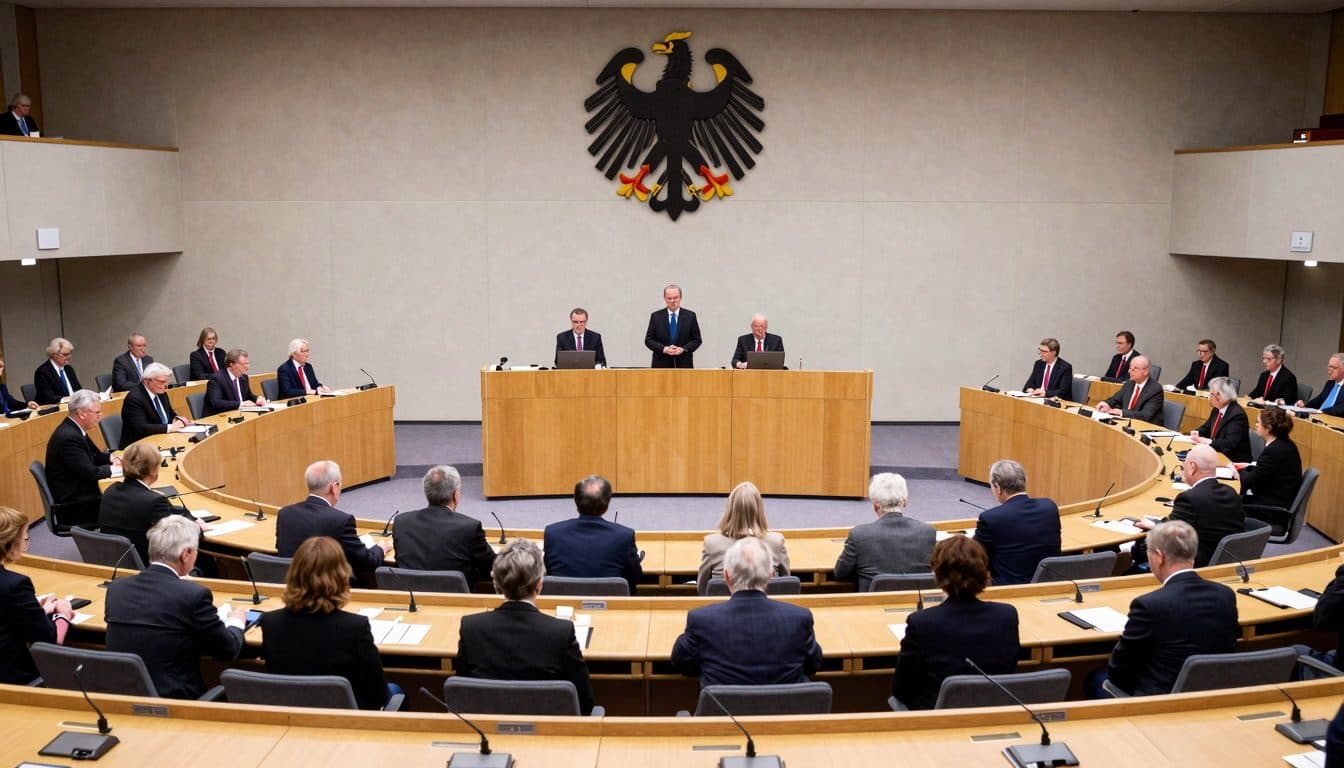
AI-generated image (z-image via Kie.ai)
Summary
On Friday in Berlin, the Bundesrat approved a Hessian draft law that would make the public denial of Israel's right to exist or calls for its elimination a criminal offense. The Bundestag must now address the proposal after the summer break, against which constitutional concerns have been raised.
Berlin, July 10, 2026
On Friday in Berlin, the Bundesrat approved a Hessian draft law that would punish the public denial of the State of Israel's right to exist or calls for its elimination with a prison sentence of up to five years or a fine.
Hessian draft and Bundesrat decision
The initiative originates from the office of Hessian Minister of Justice Christian Heinz (CDU) and was adopted by a majority in the chamber of the states on Friday. This means that after the summer break, the Bundestag must address the proposal. First, the federal government will have the opportunity to comment before Parliament deliberates on the draft.
The draft provides that people who publicly or at a gathering deny the State of Israel's right to exist or call for its elimination will be punished with a prison sentence of up to five years or a fine. The criminal liability would therefore only apply if the statement is suitable for promoting the willingness to engage in antisemitic acts of violence or arbitrary measures.
Content of the draft law
The draft's explanatory memorandum states that the current criminal provisions are insufficient. In particular, the offenses of incitement to hatred as well as the approval of criminal offenses or the use of insignia of terrorist organizations do not cover all cases. Maps of the Middle East showing a Palestinian state within the borders of Israel, the Gaza Strip, and the West Bank could also be classified as a denial of the right to exist under the draft.
Following the vote, Hessian Minister of Justice Christian Heinz said: „Von diesem Tag wird ein wichtiges Signal an alle Jüdinnen und Juden in unserem Land gesendet: Wir wollen und wir werden jüdisches Leben in Deutschland besser schützen." At the same time, Heinz emphasized that the draft law is not directed against freedom of expression nor against criticism of the Israeli government. The amendment is „rechtlich geboten und auch politisch notwendig".
Arguments of supporters
Hesse's Minister-President Boris Rhein (CDU) declared that the draft law is a signal to all Jews in our country: „Der Staat schaut nicht weg. Wir stehen an eurer Seite." Rhein said that what is needed is not only words of solidarity but clear protection. At the same time, he emphasized that criticism of Israel should not be banned and that peaceful debates must remain possible.
The background to the initiative is the rise in antisemitic crimes in Germany. According to the Federal Criminal Police Office (BKA), police recorded a five percent increase to 6,548 crimes last year. BKA President Holger Münch said when presenting the figures on politically motivated crime that international conflict situations also stir emotions in Germany. Almost half of the hate crimes classified as antisemitic in 2025 are connected to the Middle East conflict.
Antisemitic crimes as background
The draft refers to an „unauflösliche historisch-politische Verbindung": The founding of the State of Israel is inconceivable without the murder of European Jews. „Der Nationalstaat des jüdischen Volkes wurde eben deshalb gegründet, um die Opfer der Shoah und ihre Nachfahren vor erneuter Verfolgung und Entmenschlichung zu schützen." The explanatory memorandum also states that slogans such as „From the River to the Sea, Palestine will be free" or „We don't want no two-state, we want 48" should be banned in the future, as they have generally not been punishable until now.
There are significant constitutional concerns against the draft. At the end of May, the Scientific Service of the Bundestag prepared an expert opinion on the constitutionality of such a criminal provision. It states that a corresponding draft would be a „Sonderrecht gegen eine konkrete Meinung" and therefore fundamentally incompatible with freedom of expression under Article 5 of the Basic Law. The expert opinion was commissioned by the Die Linke parliamentary group.
Constitutional concerns
The Scientific Service pointed out that the denial of Israel's right to existence concerns expressions of opinion and not disputed facts such as Holocaust denial. Penalizing such statements constitutes an interference with the fundamental right to freedom of expression. The transferability of the reasoning from the so-called Wunsiedel decision of the Federal Constitutional Court from 2009 to the new norm is „schwer zu rechtfertigen".
In the Wunsiedel decision, the Court had declared special rules against the approval and trivialization of National Socialism permissible because of Germany's special history. The Court justified the restriction with Germany's special responsibility: The suffering inflicted by National Socialism is „identitätsstiftend" for the constitutional order of the Federal Republic; the Basic Law is a counterdraft to National Socialist arbitrary rule.
Wunsiedel decision as a comparison
Criminal law professor Matthias Jahn of Goethe University Frankfurt considers it likely that the Federal Constitutional Court will ultimately have to rule on the permissibility of the restriction on freedom of expression. Jahn said that Israel-hostile statements have a long history in the Middle East conflict, but the direct connection to Germany is lacking.
Article 5 of the Basic Law, the provision on freedom of expression, permits restrictions only through „allgemeine Gesetze", which must be formulated generally and may not be directed against a specific opinion or worldview. The Hessian Minister of Justice acknowledged that the new criminal provision interferes with freedom of expression and prohibits a specific opinion.
Outlook on the further procedure
The draft aims to counter the rise in antisemitically motivated demonstrations and attacks since October 7, 2023. The number of antisemitic incidents in Germany remains at a high level; in 2025, insults, graffiti, and assaults on Jews were recorded, among other things. Heinz said: „Der Antisemitismus hat solche Ausmaße angenommen, dass Prävention und Aufklärung nicht ausreichen. Wir brauchen deshalb auch das Strafrecht, damit der Rechtsstaat handlungsfähig bleibt."
Two years ago, the Bundestag had already deliberated on a similar draft from the Union parliamentary group, which met with massive criticism and ultimately failed due to the collapse of the coalition. With the Bundesrat's current decision, the issue is now being brought before the Bundestag again. Parliament is expected to address the draft in the fall.
Reporting: Charlotte Greipl, ZDF Law and Justice Editorial Team. The news was broadcast on 10.07.2026 on Deutschlandfunk.
Questions & Answers
Who introduced the draft law in the Bundesrat?
The draft law was introduced in the Bundesrat by the state of Hesse on the initiative of Justice Minister Christian Heinz (CDU). The chamber of the states approved the proposal by a majority on Friday in Berlin.
What penalty does the draft provide for denying Israel's right to exist?
The draft provides for a prison sentence of up to five years or a fine if the denial of the right to exist occurs publicly or at a gathering and is suitable for promoting the willingness to engage in antisemitic acts of violence or arbitrary measures.
What constitutional concerns are being raised against the draft?
The Scientific Service of the Bundestag classifies such a draft as a „Sonderrecht gegen eine konkrete Meinung" and sees a fundamental conflict with freedom of expression under Article 5 of the Basic Law. Criminal law professor Matthias Jahn considers a ruling by the Federal Constitutional Court likely.
Bundesrat: Denial of Israel's right to exist to become a | allfacts360