
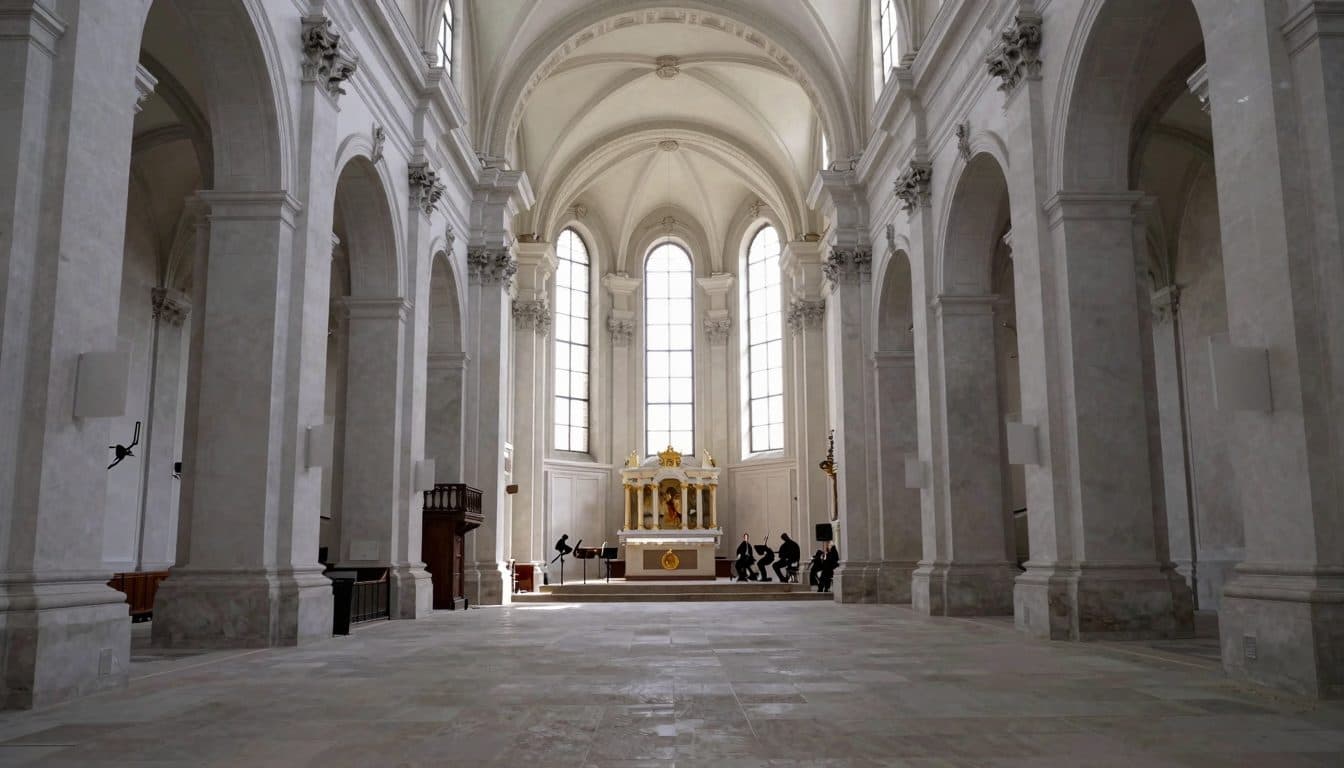
The opera "Passion" by Pascal Dusapin can be seen at the Salzburg Festival in a new production under the musical direction of Franck Ollu and in a staging by Ulrich Rasche, in which Georg Nigl and Sarah Aristidou appear as "Lui" and "Lei".
What Is New Since July 25
Update of July 26, 2026: At this year's Salzburg Festival, the opera "Passion" by Pascal Dusapin – premiered in 2008 in Aix-en-Provence – is being presented in a much-discussed new production. The most recent performances have drawn attention to the work's sonic aesthetic and scenic intensification, which mediates between early Baroque opera and contemporary sonic language.
Pascal Dusapin, who is one of the most important composers of the present, understands "Passion" as an "Opera Nocturne" that takes up the material of Claudio Monteverdi's "L'Orfeo" and transforms it into a modern, almost wordless dialogic form. The characters are called "Lei" and "Lui" – that is, "She" and "He" – and stand as representatives of a universal pair of lovers whose fate recalls the mythical archetype of Orpheus and Eurydice.
What Is New Since July 25
Background: From Aix-en-Provence to Salzburg
Since the last reporting, the festival has released further details about the staging. It is emphasized that atmospherically dense moments of calm alternate with tension-filled nervousness. Meditative flatness, including electronic feeds, merges with color contrasts that Franck Ollu and the Ensemble Modern brilliantly shape into an instrumental "being" that reacts reflexively to the emotional states of "Lei" and "Lui". The Schola Heidelberg is also involved in the production and takes on vocal tasks.
Compared with earlier reports, which focused above all on the personnel, the sonic means now come more to the fore. Critics point to the "sound carpet" that for most of the time conveys little emotion, neglects melody, and could be based on any other opera – if one did not know that it is "Orfeo". Precisely this reduction is seen by many as a deliberate choice by Dusapin in order to push the textual content into the background and the instrumental expression into the foreground.
The Staging by Ulrich Rasche
Background: From Aix-en-Provence to Salzburg
Georg Nigl and Sarah Aristidou as Protagonists
Dusapin had "Passion" premiered in 2008 in Aix-en-Provence. The work, which lasts around 90 minutes, unfolds its potential by entangling two existences in a dialogue of suffering whose sonic environment also radiates an interesting tradition-bound modernity. In his elegy of the painfully loving, he creates in dialogic form a dream- and nightmare landscape, a state of suspension given coherence by the sonic refinement of the orchestral writing.
Reception and Music-Dramatic Classification
The reference to Monteverdi is programmatic: Orpheus seeks his Eurydice in the underworld, finds her and yet loses her because, forbidden, he looks back at her. Dusapin transfers this core into a sonic language that fluctuates between Baroque quotation and New Music. Critics therefore speak of a work that possesses the ambiguous appeal of an "Opera Nocturne" and cannot be reduced to a simple story.
Festival Program and Cultural Context
The Staging by Ulrich Rasche
Outlook on the Remaining Performances
The staging is the work of Ulrich Rasche, who is known for his choreographically precise, often chorally conceived productions. Together with the Ensemble Modern and the Schola Heidelberg, a stage space is created in which movement, sound, and light come together into a unified whole. The production sees itself as part of the program of the Salzburg Festival, which this year places a focus on contemporary opera concepts.
Franck Ollu, who holds the musical direction, works with an instrumental sound that deliberately forgoes traditional operatic modes. Instead of large melodic arcs, he relies on repetitive surfaces, sudden intensifications, and electroacoustic feeds. This sonic stance corresponds with Dusapin's conception of the characters, who understands "Lei" and "Lui" as speaking, suffering, but also silent bodies.
Georg Nigl and Sarah Aristidou as Protagonists
In the leading roles, Georg Nigl can be seen as "Lui" and Sarah Aristidou as "Lei". Nigl, who possesses a broad repertoire ranging from Baroque to contemporary music, brings the vocal differentiation required for Dusapin's score. Aristidou, who is known for her expressive shaping of new music, designs the female lead as both counterpoint and mirror.
The encounter of the two voices forms the center of the performance. While "Lei" and "Lui" articulate their pain, longings, and memories, the orchestra condenses into a resonance space that absorbs every stir and translates it into sound. The Schola Heidelberg takes on choral functions that recall the role of the ancient choruses.
Reception and Music-Dramatic Classification
The reactions so far to the Salzburg production are mixed. While some observers praise the sonic sparseness as reduction, others see it as a weakness. Thus one hears that the "sound carpet" conveys little emotion over long stretches and dispenses with melody, making identification with the action difficult. Supporters counter that precisely this reduction sharpens the eye for the emotional microstructures.
Dusapin himself has emphasized in interviews that he is interested in the universality of the characters. The designation as "Lei" and "Lui" – Italian for "She" and "He" – points to a language beyond national or historical determinations. Thus a work emerges that, in its reduction to the essential, appears timeless and yet addresses the present directly.
Festival Program and Cultural Context
The performance of "Passion" is part of a Salzburg Festival program that deliberately links contemporary works with historical material. Alongside Dusapin, other compositions are on this season's schedule that engage with myths, memory, and social questions. In this context, Stift Klosterneuburg has also announced an art prize with a message of peace, seeking for 2027 works that move – an undertaking that is regarded in cultural reporting as a sign of a broader engagement with responsibility in art.
For the festival management, the Dusapin production is an important building block in sharpening the festival's profile between tradition and avant-garde. The response to the first performances suggests that the work provokes both approval and objection – a tension that Dusapin has deliberately built into his score.
Outlook on the Remaining Performances
The production will be performed several times during the festival period. Tickets for the remaining dates are in strong demand according to the festival administration. A transfer of the production to other houses is, according to sources close to the festival, not ruled out, but not yet decided.
With the Salzburg staging of "Passion", Dusapin – who has already attracted international attention with works such as "Roméo et Juliette" and "La Terrible Vie de Macbeth" – once again underscores his rank as one of the most frequently performed contemporary opera composers in Europe. The combination of Monteverdi's myth, a radically reduced sonic language, and scenically precise direction makes the production one of the outstanding opera events of the summer of 2026.
Alongside the "Passion" production, the launch of the art prize of Stift Klosterneuburg was also announced during the festival, which for 2027 seeks works with a message of peace. The initiative will continue to be covered in upcoming reporting.