Federal Judge Orders Removal of Trump's Name from Kennedy Center: "Only Congress Can Change It"
WASHINGTON — May 30, 2026
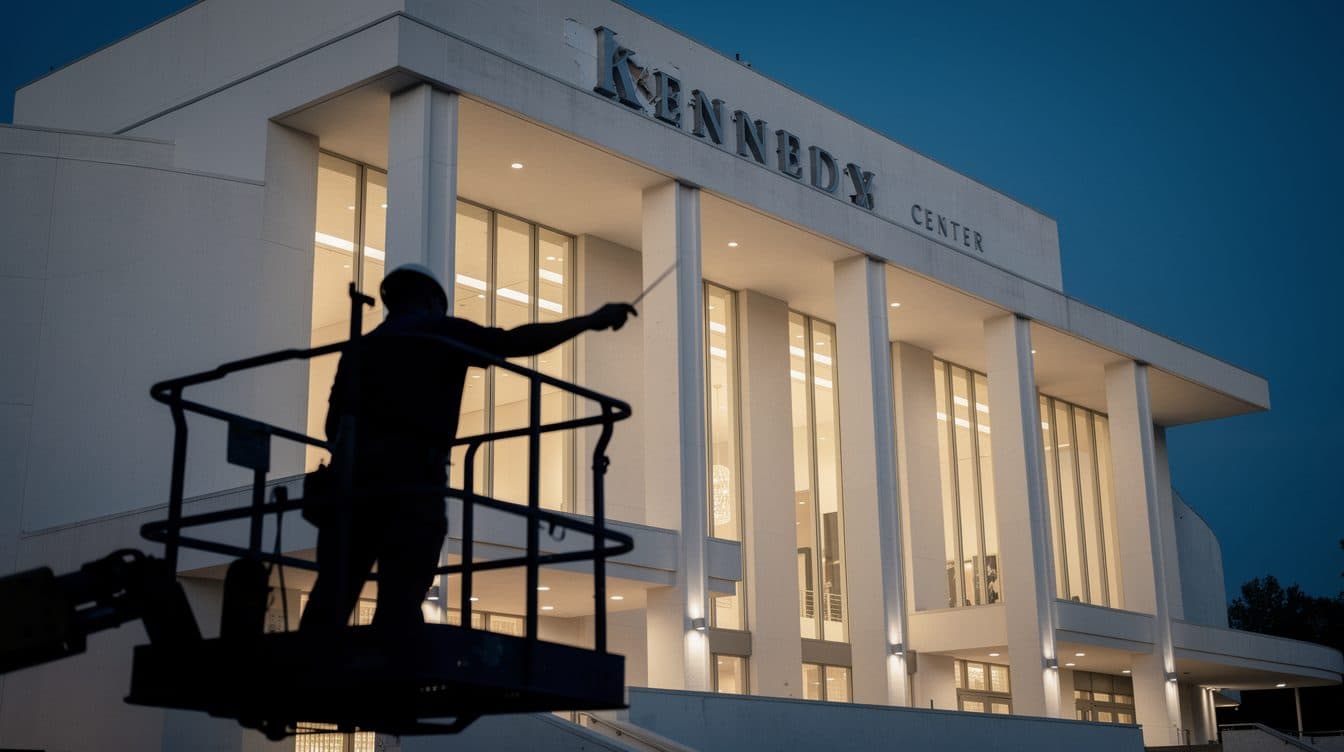
AI-generated image (flux-2/pro-text-to-image via Kie.ai)
Summary
A federal judge in Washington has ordered the removal of Donald Trump's name from the Kennedy Center facade within 14 days, ruling the renaming illegal without an act of Congress. The president reacted by announcing his resignation from the board chairmanship and accusing the judiciary of unfair treatment.
WASHINGTON — May 30, 2026
A U.S. federal judge ruled Friday that President Donald Trump's effort to rename the John F. Kennedy Center for the Performing Arts after himself is illegal, ordering the removal of all physical signage and any reference to the "Trump Kennedy Center" from official materials.
District Judge Christopher Cooper of Washington ordered the Trump administration to remove all signs bearing the president's name within 14 days and to eliminate any mention of a "Trump Kennedy Centre" from official documents. The ruling represents a significant setback for the president, who had taken control of the iconic cultural institution shortly after his inauguration, about 16 months ago.
Judge Cooper's Ruling
In his written opinion, Judge Cooper stated that the Kennedy Centre's organic statute makes unequivocally clear that the centre is to be named for President Kennedy and cannot bear any other formal name or public memorial based on a unilateral decision by the board of trustees. "The Kennedy Centre's organic statute makes crystal clear that the centre is to be named for President Kennedy, and it cannot bear any other formal name or public memorial based on the board's unilateral say-so," Cooper wrote.
The judge emphasized that Congress gave the Kennedy Centre its name and only Congress can change it. "Congress gave the Kennedy Centre its name, and only Congress can change it," the ruling states. The decision also blocked the administration's plan to close the facility for major renovation work, finding that the board of trustees' March 16 vote for closure was "mal informato e apparentemente preordinato," without any regard for legal obligations.
"I fiduciari avrebbero potuto valutare l'opportunità della chiusura in diversi modi prudenti. Questo non lo è stato," Cooper added. "The trustees might have assessed the propriety of closure in a number of prudent ways. This was not one," the magistrate concluded in his order.
Control of the Cultural Institution
Trump had taken control of the Kennedy Center shortly after his inauguration, firing the previous leadership and installing a new board of trustees under his chairmanship. The action was part of a broader offensive against what the president called "anti-American propaganda" in the cultural world. Trump had described the institution as a left-wing "woke" center and had announced a "patriotic" cultural program.
The Kennedy Center, whose full name is "John F. Kennedy Gedenkzentrum für die darstellenden Künste," was built in Washington in honor of the president assassinated in 1963 and opened in 1971, eight years after his death. Over the decades, it has become one of the most important cultural institutions in the United States.
On the building's facade, the inscription "Das Donald J. Kennedy Gedenkzentrum für die darstellenden Künste" had been affixed, a hybrid combining Trump's name with that of President Kennedy. Judge Cooper ordered that this designation also be removed, restoring the original title intended by Congress.
Trump's Reaction
The president's response was swift. Trump harshly attacked the judge's decision, declaring: "Es gab noch nie einen Präsidenten der Vereinigten Staaten, der von den Gerichten so ungerecht behandelt wurde wie ich." The president then accused the magistrate and the radical left of preferring that the Kennedy Center die rather than see it transformed into something everyone could be proud of.
"Dieser und die radikale Linke ziehen es vor, dass (das Kennedy Center) stirbt, anstatt zu erleben, wie Trump es in etwas verwandelt, worauf jeder hätte stolz sein können," Trump stated. The president's reaction continued with a surprise announcement: his resignation from the chairmanship of the board he himself had appointed.
On his Truth Social platform, Trump wrote: "Solange es mir nicht freisteht, das zu tun, was ich besser kann als jeder andere - diese Institution physisch, finanziell und künstlerisch wieder aufzubauen - habe ich keinerlei Interesse daran, einen Weg fortzusetzen, der nur eine hoffnungslose Reise ins 'Nimmerland' wäre." The president thus announced his withdrawal from what he called a "dying" institution, declaring he had no interest in continuing if he could not act as he pleased.
Blocking the Closure for Renovation
Beyond the name issue, Judge Cooper's ruling also addressed the plan to close the cultural center for major renovation work. The judge blocked the administration's project that envisioned closure starting on Independence Day, July 4.
The board of trustees' March 16 decision to close the facility was described by the magistrate as a choice that took no account of the institution's legal obligations. The blocking of the closure represents a further check on Trump's plans to radically reshape one of the temples of American culture.
The ruling comes at a politically sensitive moment, about two weeks before what would have been Trump's eightieth birthday. The president, who had sought to imprint his name on numerous buildings and institutions, now finds himself having to accept that the Kennedy Center remains named exclusively after the Democratic president assassinated in 1963.
The Institution's Future
With Trump's resignation from the board chairmanship and the court order to restore the original name, the immediate future of the Kennedy Center now appears more uncertain than ever. The institution will have to face the consequences of months of controversial management and a legal battle that has highlighted tensions between executive power and the limits imposed by federal law.
The ruling sets an important precedent on the role of Congress in naming federal cultural institutions and on the limits of presidential power to unilaterally alter their identity. The case could also have repercussions on other administration attempts to reshape cultural and artistic institutions according to a more conservative and patriotic vision.
Judge Cooper's decision, issued on May 30, 2026, was transmitted by the Deutschlandfunk program and represents the latest chapter in a controversy that has divided American public opinion on the role of politics in managing cultural institutions. The Kennedy Center, which since 1971 has hosted some of the most important expressions of American and international performing arts, now prepares to turn the page.
Questions & Answers
Why did Judge Cooper order the removal of Trump's name from the Kennedy Center?
The judge ruled that the Kennedy Center's statute requires the building to honor President Kennedy and that only Congress, not the board of trustees, can change its name.
What was Donald Trump's reaction to the ruling?
Trump declared himself the president most unfairly treated by the courts and announced his resignation from the board chairmanship.
Kennedy Center 2026: Judge Orders Removal of Trump Name | allfacts360