Final Castor Transport from Great Britain Reaches Brunsbüttel
Brunsbüttel, 16 June 2026
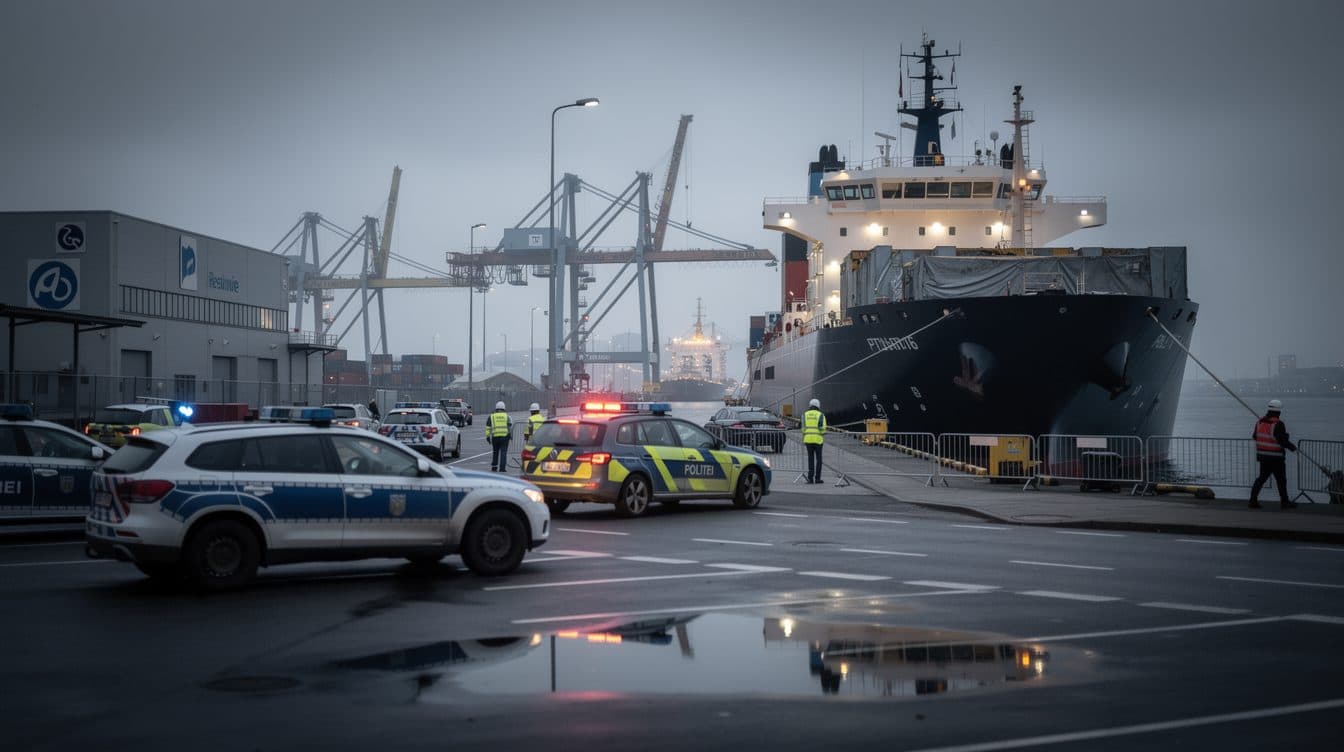
AI-generated image (flux-2/pro-text-to-image via Kie.ai)
Summary
The special vessel "Pacific Grebe" moored at the Elbe port in Brunsbüttel on Tuesday morning, bringing the last seven Castor containers from British reprocessing to Germany. From there, the containers are to be transported by special trucks to the interim storage facility twelve kilometres away at the decommissioned Brokdorf nuclear power plant.
Brunsbüttel, 16 June 2026
The special vessel "Pacific Grebe" moored at the Elbe port of Brunsbüttel in Schleswig-Holstein on Tuesday morning, 16 June 2026, delivering the last seven Castor containers with radioactive waste from the British reprocessing plant Sellafield to Germany.
Arrival of the "Pacific Grebe" in Brunsbüttel
According to the Gesellschaft für Nuklear-Service (GNS), the seven Castors reached the Elbe port of Brunsbüttel. According to the company, this completes the final Castor transport from Great Britain to Germany. The special vessel "Pacific Grebe" had set out the previous week and arrived in Brunsbüttel in the early hours of Tuesday morning.
As GNS further announced, these are the last seven Castor containers from foreign reprocessing. According to the information, they are seven containers with radioactive waste — so-called Castors. The nuclear waste originates from a reprocessing plant in Great Britain. The remnants of fuel elements from German nuclear power plants were brought to Brunsbüttel by a special vessel.
Police Secure the Transport
Frank Matthiesen, head of the Itzehoe Police Directorate, said of the transport: "Die Polizei passt auf, dass alles vernünftig über die Bühne geht". He praised the colleagues from the water protection police and coast guard who had already accompanied the special vessel on the water. A coast guard vessel had been travelling at slow speed from Helgoland towards Brunsbüttel since Monday evening. Since Tuesday morning, police have been blocking access roads to the harbour with several emergency vehicles.
Further Transport to the Brokdorf Interim Storage Facility
The containers are to be transported by special trucks, probably on Wednesday, to the interim storage facility of the decommissioned Brokdorf nuclear power plant on the Elbe. The exact route is secret. They are to be transported to the interim storage facility twelve kilometres away in Brokdorf in the district of Steinburg. On Tuesday morning, the first Castor container was transferred from the ship onto a special truck. A special crane was used for this, lifting the heavy Castors.
According to GNS, the loading operations are proceeding as planned and without incident so far. They are expected to continue until at least Wednesday. After the arrival of the transport, specialists carry out final safety precautions on the containers. Finally, the containers are placed in their final position in the storage area and connected to a monitoring system. In addition, the cavity between the two lids is filled with helium. This makes it possible to detect defects in the sealing protection in the event of a loss of pressure.
Storage and Search for a Final Repository
According to the operator of the interim storage facility, the Gesellschaft für Zwischenlagerung mbH (BGZ), the containers are to remain there until a final repository exists. This could take several decades, the company said. With the seven new Castors, 83 of 100 storage positions in the facility would be occupied. There are already 76 nuclear waste containers there, although another figure mentions around 75 containers. The waste is to be stored in Brokdorf until a site for the final disposal of high-level radioactive waste is found in Germany.
The nuclear waste consists of remnants of fuel elements that had been taken from German nuclear power plants to Sellafield before 2005. They originate from the reprocessing of German fuel elements at Sellafield in Britain. David Gramatzki emphasised that the nuclear waste would naturally be taken back — Germany was obliged to do so after all. "Richtig ist, dass Deutschland verpflichtet ist, die radioaktiven Abfälle zurückzunehmen." It must be safely stored and disposed of.
Protests and Vigils
Frank Matthiesen went on to explain: "Grundsätzlich kann man sagen, dass in Deutschland Castor-Transporte ein gewisses Protestpotenzial haben". The Castor-Stoppen alliance announced a rally in front of the nuclear power plant. The "Castor stoppen!" initiative had announced the rally in advance. At 5:30 p.m., around ten people gathered for a vigil at the Brokdorf nuclear power plant.
The "Castor-Stoppen" alliance had previously announced a vigil for Wednesday at the S-Bahn station Hamburg-Barmbek and at other locations along a possible transport route, as well as protest actions at the Brunsbüttel nuclear power plant. According to an activist, vigils are also planned for Wednesday along the possible route from Brunsbüttel towards Brokdorf.
Criticism of Nuclear Waste Policy
Christian Völker criticised the transports with the words: "Das Narrativ ist: Wir müssen es wieder zurücknehmen. Aber es wird wieder Zeug durch die Gegend gekarrt, damit sind wieder Gefahren verbunden und es gibt wieder kein Endlager-Konzept". The activists criticise the fact that high-level radioactive waste is being transported on the road: "Atommüll per Lkw zu transportieren ist gefährlich".
Cécile Lecomte, a participant in a vigil, said: "Keiner weiß, wohin mit diesem Atommüll. Der Betrieb von AKW war für mich wie ein Flugzeug ohne Landebahn, und wir suchen immer noch die Landebahn." She thus summed up the fundamental concern of many critics that no final repository yet exists for high-level radioactive waste.
Most of the Castor containers from reprocessing are already in other interim storage facilities in Baden-Württemberg, Bavaria, Hesse and Lower Saxony. There are 16 such interim storage facilities in several federal states in Germany. The return of German nuclear waste from the French reprocessing plant La Hague was already completed in 2024. The return of waste from Great Britain has now also been completed.
The cargo of the "Pacific Grebe" that arrived today is the final Castor transport from Great Britain to Germany — and also the last radioactive waste to arrive in Brokdorf. This fulfils the obligation to take back waste from British reprocessing. The special vessel reached the port of Brunsbüttel in the northern federal state of Schleswig-Holstein on Tuesday morning.
Exactly when the containers will be transported by road to Brokdorf is not known. The authorities are keeping the exact route secret for security reasons. According to GNS, all that is certain is that the loading operations are proceeding as planned and that no incidents have been reported so far.
Questions & Answers
What is being brought to Brunsbüttel by the special vessel "Pacific Grebe"?
The special vessel "Pacific Grebe" transported the last seven Castor containers with radioactive waste from the British reprocessing plant Sellafield to Germany. According to GNS, these are the last Castor containers from foreign reprocessing.
Why is the exact route of the transport to Brokdorf secret?
The exact route is secret because the authorities do not make it public for security reasons. The containers are to be transported by special trucks to the interim storage facility of the decommissioned Brokdorf nuclear power plant, about twelve kilometres away.
What happens to the Castor containers in the Brokdorf interim storage facility?
According to BGZ, the containers are to remain in the interim storage facility until a final repository for high-level radioactive waste is found in Germany. This could take several decades. With the seven new containers, 83 of 100 storage positions in Brokdorf would be occupied.
Final Castor from Great Britain Arrives in Brunsbüttel | allfacts360