German government plans mandatory sick note from day one and abolition of phone sick notes
Berlin, 02 July 2026
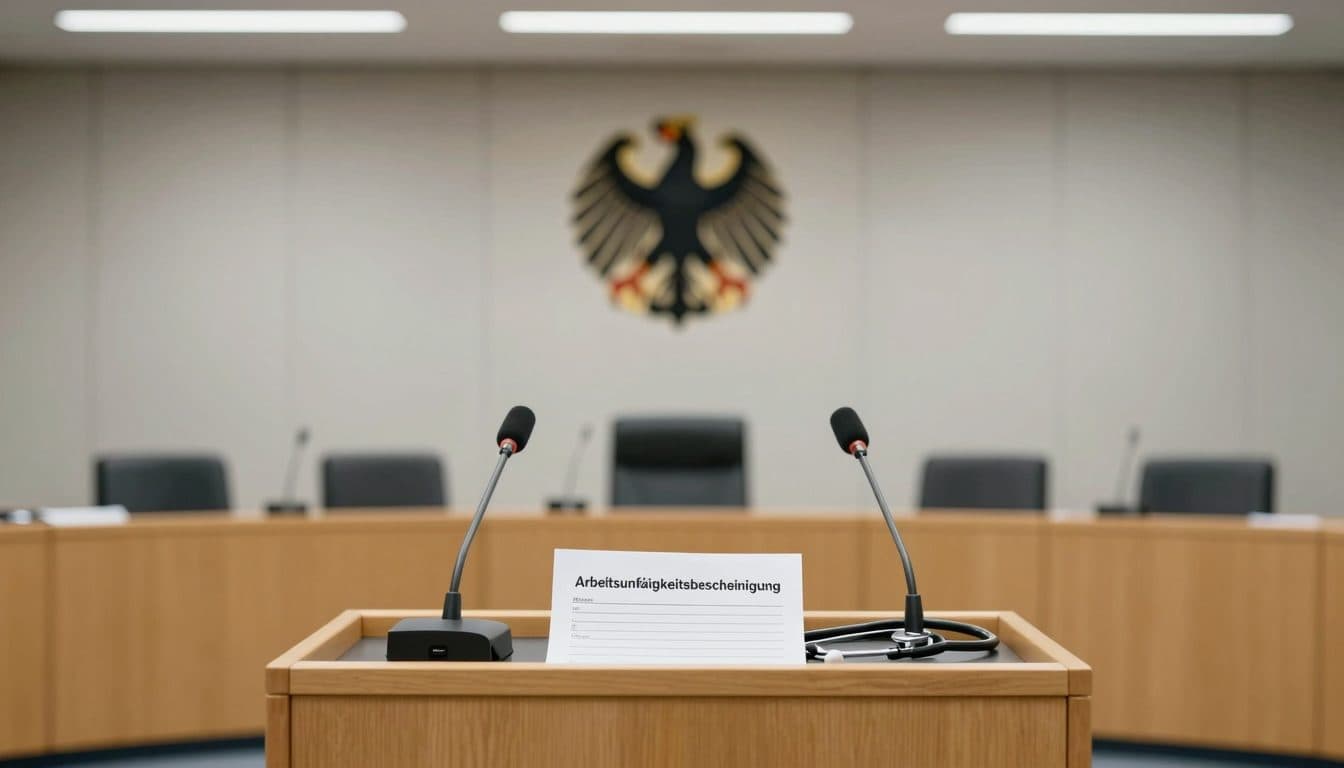
AI-generated image (z-image via Kie.ai)
Summary
The black-red coalition wants employees to present their employer with a medical certificate of incapacity to work on the very first day of illness. At the same time, phone sick notes are to be abolished. Chancellor Friedrich Merz calls the reform a tough decision – family doctors and trade unions are up in arms.
Berlin, 02 July 2026
The black-red German federal government has agreed to abolish phone sick notes and to require employees to present a medical certificate of incapacity to work from the very first day of illness, as Chancellor Friedrich Merz (CDU) announced on Thursday.
Background: Exceptions for businesses possible
The black-red coalition in Berlin wants to tackle high rates of absenteeism in companies by introducing stricter requirements for sick notes. In future, the legal default will be that a doctor's sick note must be presented from the first day of absence. Until now, a medical certificate has only been mandatory from the fourth day of illness. The Continued Remuneration Act would need to be amended for the reform.
The phone certificate of incapacity to work was originally introduced as a special rule during the coronavirus pandemic, in order to ease the burden on doctor's practices and avoid unnecessary contacts in cases of contagious illnesses. Since then, it has been extended several times. Since the end of 2023, patients in Germany have been able to obtain a sick note without visiting a practice by phone, provided they are known to the practice and do not have severe symptoms. The phone AU is regulated in a directive of the Federal Joint Committee and could be issued for up to five calendar days.
The federal government's reasoning
Chancellor Friedrich Merz justified the tightening by pointing to a rise in sickness levels after the end of the coronavirus pandemic. He said he had informed the coalition committee that the federal government was abolishing phone sick notes, said the CDU politician. "We can no longer afford this competitive disadvantage caused by long absences in our companies," said Merz. "The number of sick days in Germany is too high," he added. He described sickness levels after the coronavirus crisis as "exorbitant" and said: "This is a tough decision."
According to the will of the CDU, CSU and SPD, employees should in future present their employer with a certificate of incapacity to work on the very first day of an illness. According to the federal government, the new provisions are planned as a framework law. "Businesses can deviate from this, either through individual contractual agreements between employee and company, or through a works agreement, or through a collective bargaining agreement," it was said from the environment of the coalition leaders. However, even businesses that did not want to could waive the requirement for a certificate of incapacity to work from the first day, Merz stressed.
At the same time, penalties for the improper issuance of a certificate of incapacity to work are to be tightened. Section 278 of the Criminal Code currently provides for fines or imprisonment of up to two years. In future, the issuing of so-called "courtesy sick notes" is to be punished more consistently. In addition, according to participants, Merz advocated a legislative package with a total of 34 points on taxes, work, and deregulation. In it, the coalition also announced a relaxation of protection against dismissal for higher earners above an annual salary threshold, as well as more flexible handling of fixed-term contracts until the end of 2030.
Business voices welcome the move
Business broadly welcomes the initiative. The Confederation of German Employers' Associations (BDA) said the coalition was rightly responding to sickness levels that were above the international average. President Rainer Dulger welcomed the abolition of phone sick notes and the requirement for a medical certificate from day one. Johann Pöttering, chief executive of the North Rhine-Westphalian Metal and Electrical Industry Association (Metall NRW), told WDR: "The federal government is for the first time acknowledging that the really above-average sick days in Germany compared internationally are a real problem for the competitiveness of the country as a business location." Mohammed Kasha, who works in retail, also sees a risk of abuse in the existing rules.
Federal Health Minister Nina Warken (CDU) defended the plan. Phone sick notes had proven their worth during the pandemic, "but that was a time of exception," she told the Rheinische Post. Anyone who is so ill that they cannot work should stay at home. Digital options such as video consultations would remain available. The CDU party conference had most recently also called for the abolition of phone sick notes.
Family doctors warn of a wave of bureaucracy
Family doctors are up in arms against the plans. Markus Blumenthal-Beier, federal chairman of the German Association of Family Doctors, called the coalition's decisions "absolutely catastrophic" and spoke in an MDR interview of a "culture of mistrust with more bureaucracy." The phone AU was "one of the few deregulation measures this country has seen in the last five years." Blumenthal-Beier described Merz's reasoning as "totally fact-free" and warned: "A huge wave of bureaucracy is coming our way that will be almost impossible to manage. We are expecting millions and millions of additional people in our practices." He also pointed to statistics showing that the rise in sick notes since 2022 was mainly due to the electronic transmission of the AU, not to the phone procedure.
The board of the National Association of Statutory Health Insurance Physicians (KBV) spoke of an "outrage bordering on impertinence." "Anyone who is ill belongs in bed – and not in an overcrowded practice," the KBV said. "It is bordering on madness to drive thousands upon thousands of people into practices just to fill out forms," it added. The KBV had previously proposed the opposite – a relaxation – and had advocated making a sick note mandatory only from the fourth or fifth day of illness.
Manfred Imbert, deputy chairman of the board of the Rhineland Family Doctors' Association, warned of an overload of practices. "Given the high number of sick notes, it is understandable that policymakers want to insert a filter," he said. "But for us family doctors, phone sick notes were a relief. The additional workload from patients in the practice that is to be expected will be hard to manage. We are already at our limits – and what will it be like when every third doctor retires in the near future?" Barbara Römer, chairwoman of the Rhineland-Palatinate Family Doctors' Association, called the plans "pointless activism" and a sick note on the first day "the bureaucratic super-GAU for family practices." The German Medical Association spoke of an affront and of putting the medical profession under general suspicion.
Criticism from the states and trade unions
Criticism is also coming from the states. Clemens Hoch (SPD), Health Minister in Rhineland-Palatinate, rejects the plans and called the requirement to present an AU from the first day "totally absurd." "This does not provide relief, but additional bureaucracy – for patients as well as for doctor's practices," Hoch said. "This is how we will paralyse outpatient care in the state." The Green faction leader in Rhineland-Palatinate, Katrin Eder, warned that in the worst case serious illnesses would be dragged out and psychological burdens in the workplace would be intensified.
The VdK social association accused the government of once again implying that people "exploit the welfare state to skive off work." The services trade union ver.di called the plans a "massive attack on employees" and called on the state governments in Rhineland-Palatinate and the Saarland not to support the planned worsening in the Bundesrat. Ver.di state chief Marion Paul said: "Employees are being put under general suspicion and put under pressure, instead of easing the burden on the health system, which is already at its limit, and strengthening trust in employees." Ver.di chief Frank Werneke criticised the plans as an expression of a "culture of mistrust." IG Metall also spoke of an "unsocial wish list of employers." Bavaria's Economics Minister Hubert Aiwanger (Free Voters) warned on WDR: "Perhaps we will end up with even more sick days," because patients would be signed off directly for three days instead of one.
Data on sickness levels partly supports this concern. According to the company health insurance funds, the share of phone sick notes is only 0.85 percent. An OECD analysis found that the sickness rate in Germany has been fairly constant at 6.8 percent for the last ten to twelve years. At DAK-Gesundheit, employees were signed off sick for an average of 19.5 calendar days last year. Among AOK-insured persons, the figure in 2025 was 23.3 days; in 2017 it was around 19 days. Health economist Ron Seitfudem of the Central Institute of Statutory Health Insurance Physicians explained that the increase since 2022 was mainly due to the switch to the electronic AU, which had made many previously unrecorded cases visible.
From the perspective of labour lawyers, the consequences for employees can be significant. Labour lawyer Arndt Kempgens warned: "Anyone who does nothing risks a warning, and in extreme cases dismissal." If you cannot prove you are ill, the employer can reduce your pay. Iris Kläsener from the manufacturing industry is already familiar with the requirement to present a sick note immediately in her company and views it critically. "Not every cold has to end up in the waiting room straight away," says Hamza Ayata, who works in care in Ahlen. When the new rules are to come into force is still unclear.
Figures and data on sickness levels
The traffic-light coalition at the federal level is visibly trying to balance the interests of business, the medical profession, and the trade unions with this initiative. Within the federal government, the reform is expected to be pushed forward quickly as part
Sick note from day one: coalition abolishes phone AU | allfacts360