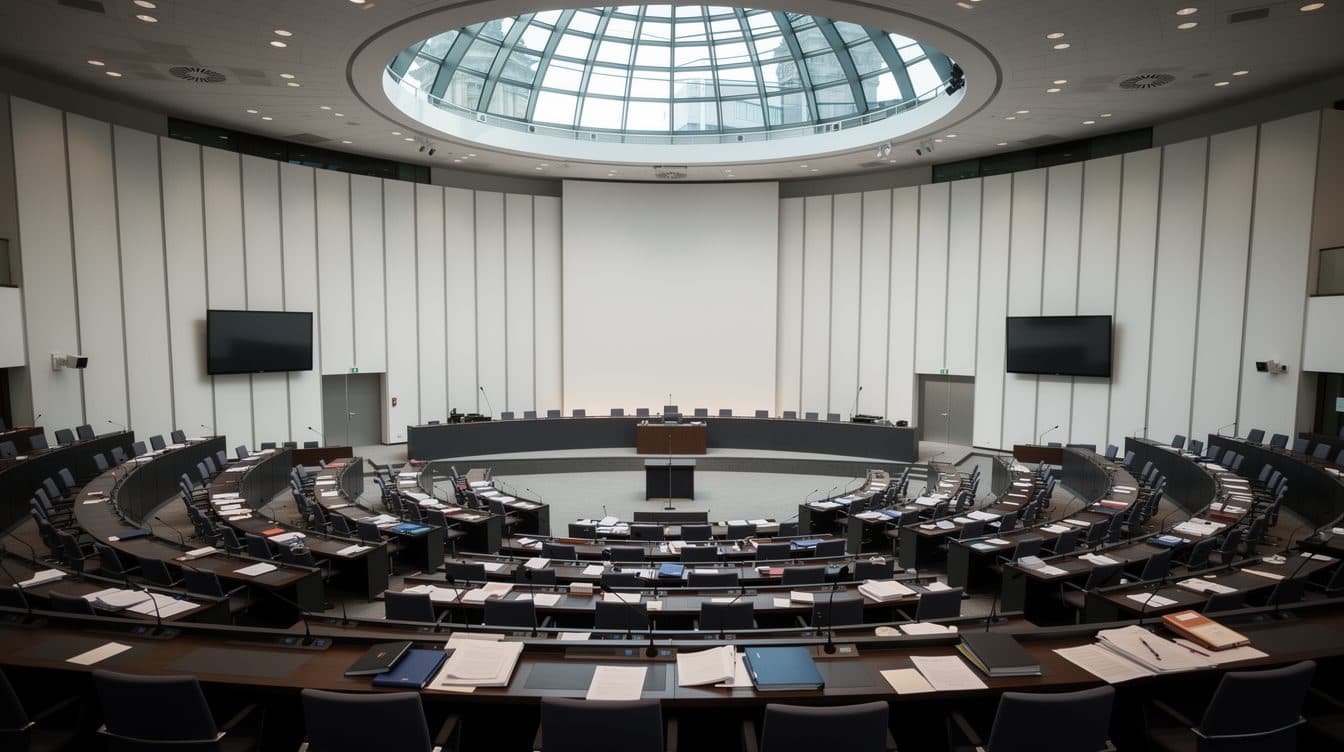
German Bundestag debates Warken's healthcare reform amid higher projected deficit and criticism from doctors and opposition
Berlin, June 12, 2026
AI-generated image (flux-2/pro-text-to-image via Kie.ai)
Summary
German Health Minister Nina Warken presents a bill in the Bundestag that aims to relieve the statutory health insurance funds by 16.3 billion euros in 2027, after revising the projected deficit upward. The opposition, doctors, and federal states are criticizing the cuts and fear a deterioration in outpatient care.
Berlin, June 12, 2026
Federal Health Minister Nina Warken (CDU) will present on Friday in the Bundestag a bill that aims to relieve the statutory health insurance funds by at least 16.3 billion euros in 2027 in order to prevent additional contribution rate increases, after revised calculations raised the projected deficit for next year to nearly 19 billion euros.
What's new since June 9
Update of June 12, 2026: Federal Health Minister Nina Warken is presenting on Friday in the Bundestag her bill to stabilize statutory health insurance (GKV) contribution rates, after acknowledging that the financial shortfall of the funds in 2027 will be 3.5 billion euros higher than previously calculated.
Warken justified on Thursday the scope of the reform by pointing out that spending in the first quarter of 2026 grew more than forecast for the year as a whole. "Der Blick auf die Zahlen macht ja auch den Handlungsbedarf sehr deutlich", the minister declared in the Bundestag, adding that without the reform "würde das erwartete Defizit 2027 bei knapp 19 Milliarden Euro liegen". In her address, she argued that the growing deficits of the statutory health insurance system make a reform unavoidable and warned: "Unser Gesetz verlangt allen etwas ab, niemandem aber Unzumutbares".
What's new since June 9
Scope of the bill
The main update compared to the previous version of this report is the revision of the official figures. Until now, Warken's draft assumed a financial gap of around 15 billion euros in 2027. The new provisional calculations raise that figure by 3.5 billion, to nearly 19 billion, and add an additional savings requirement of at least 2.5 billion to fund a new safety buffer. Overall, the relief for the GKV now amounts to 16.3 billion euros in 2027 and up to 38.1 billion in 2030, compared with previous plans.
Along the same lines, the chair of the board of the GKV-Spitzenverband, Doris Pfeiffer, had already rejected any contribution-rate cosmetics at the expense of insured persons. "Niemand braucht Beitragssatzkosmetik zulasten der Versicherten", she told the Deutsche Presse-Agentur. Anja Piel, a member of the executive board of the same body, also warned that "Der Rest muss jetzt dann noch zusätzlich gehoben werden, um Beitragsstabilität zu bekommen", according to what Warken said on Thursday.
Scope of the bill
The draft, registered as 21/6130 with the title "Statutory Health Insurance Contribution Rate Stabilization Act" (GKV-Beitragssatzstabilisierungsgesetz), was debated for the first time in the Bundestag plenary on Friday, June 12, from 9:00 a.m., in a session broadcast live. After this first reading, the text will be referred to the parliamentary committees. In parallel, the Bundesrat plans to address the reform plans in its morning session.
According to the draft, the GKV is to be relieved by 16.3 billion euros in 2027 through additional revenue and lower spending — a figure that could rise to 38.1 billion in 2030. The measures include a 10 percent reduction in the fixed subsidies for dental prosthetics, a 50 percent increase in co-payments by insured persons in this area — with a minimum of 7.50 euros and a maximum of 15 euros, indexed to wage developments — and the introduction of a 2.5 percent surcharge on income subject to contributions for spouses currently insured free of charge.
Criticism from the opposition and from doctors
The text also provides for limitations on free coverage for spouses, higher co-payments for medications, cuts in remuneration for medical consultations, hospitals and pharmacies, and an increase in the pharmacy discount (Apothekenabschlag) from 1.77 to 2.07 euros. For 2027, an increase of 300 euros per month is also planned for both the contribution ceiling and the mandatory insurance threshold. In addition, the federal contribution to the Health Fund will be reduced from 2027 by 2 billion euros, to 12.5 billion.
On the revenue side, the draft raises the flat employer contribution for minor employment (geringfügig Beschäftigte) to the general rate of 14.6 percent plus the average additional contribution. Also planned, in a separate legislative process, is the introduction from 2028 of a levy on sugary drinks, as well as the creation of a partial sick leave (Teilkrankschreibung) with three levels of reduced capacity of 25, 50, and 75 percent. From 2027, the Federal Joint Committee (G-BA) must introduce annually a mandatory second-opinion procedure for at least one of the planned interventions prone to overuse.
Warken also argued in Deutschlandfunk that her ministry has presented a balanced package. "Im Deutschlandfunk sagte Warken, man habe ein ausgewogenes Paket vorgelegt. Jeder trage seinen Teil, die Versicherten ebenso wie die Leistungserbringer." The minister added that the reform seeks to stabilize GKV finances without restricting the quality of care, although the draft's own explanatory memorandum acknowledges that, if income and expenditure are not balanced, the shortfall could grow to around 44 billion euros by 2030.
The Bundesrat and possible mediation
Criticism from the opposition and from doctors
Timeline and key figures
The reform is facing outright rejection from the opposition and parts of the healthcare system. Green party lawmaker Dahmen denounced the draft as threatening a "Kahlschlag" in medical care. The AfD parliamentary group, through its health policy spokesperson Sichert, called the law a "Katastrophe" and warned of new burdens for hospitals. Several Bundesrat committees have already expressed their rejection, and various parliamentarians also criticized the fact that the healthcare costs of Bürgergeld recipients continue to be financed largely through insured persons' contributions rather than with tax resources.
Medical associations and chambers are also raising their voices. In their protests, which they plan to continue in the coming weeks, they argue that the savings fall on outpatient care and that services previously reimbursed outside budgetary caps will be subject to stricter control. Gynecologist Christiane von Holst, who runs a practice in Heidelberg, sums up the sector's discontent. "Hundertprozentig wird man das im nächsten Jahr schmerzlich spüren. Und zwar der Patient", she warned, adding: "Wir wollen das nicht, aber wir müssen wirtschaften. Dann wird es zu Einschränkungen kommen."
Von Holst described the reform as a "Sparen durch die Hintertür" and warned that the scope of coverage could gradually shrink without official benefits being formally cut. The gynecologist, who on the morning of the day in question saw seven acute cases and receives patients who travel up to an hour to get an appointment, gave the example of prenatal care. "In der Schwangerenvorsorge soll budgetiert werden. Das heißt, wir müssten den Patientinnen irgendwann sagen: 'Sie sind schwanger, das ist wunderbar. Aber wir dürfen nur noch bestimmte Untersuchungen vornehmen.' Das finde ich katastrophal."
The doctor also questioned the very structure of the system. "Man sollte sich fragen, ob wir wirklich 97 Krankenkassen brauchen. Wird durch Werbung auf Fußballtrikots irgendein Patient gesund? Ich glaube nicht." A patient interviewed in the report summed up the most widespread fear: "So schnell kriegt man dann keinen Termin mehr, wenn man akut kommt." The Health Ministry declined to comment on the specific effects for practices and patients and referred to the text of the draft.
The Bundesrat and possible mediation
Bundesrat President Andreas Bovenschulte (SPD), the mayor of Bremen, indicated on the ZDF-Morgenmagazin that the Länder could exercise their right to refer the bill to the Mediation Committee. "Ich gehe im Moment davon aus, dass die Länder davon auch mehrheitlich Gebrauch machen werden von diesem Recht", he stated. The Mediation Committee is the joint body of the Bundestag and the Bundesrat tasked with seeking a compromise in legislative disagreements, and it can be convened by the federal states once the bill returns from the Bundestag after its first approval.
Timeline and key figures
The draft envisages a gradual escalation of measures: 250 million euros more in 2027, 500 million in 2028, 1,000 million in 2029, 1,500 million in 2030, and 2,000 million in 2031. The draft already assumes a coverage gap of 15.3 billion euros in 2027, which could rise to around 40 billion in 2030, according to the explanatory memorandum. In the years 2027 to 2029, a one-percentage-point cut in physicians' remuneration will be applied, and the accumulated federal debt to the GKV — 5.6 billion corresponding to loans granted in 2023, 2025, and 2026 — will be refinanced through
2027 healthcare reform: German health insurance deficit | allfacts360