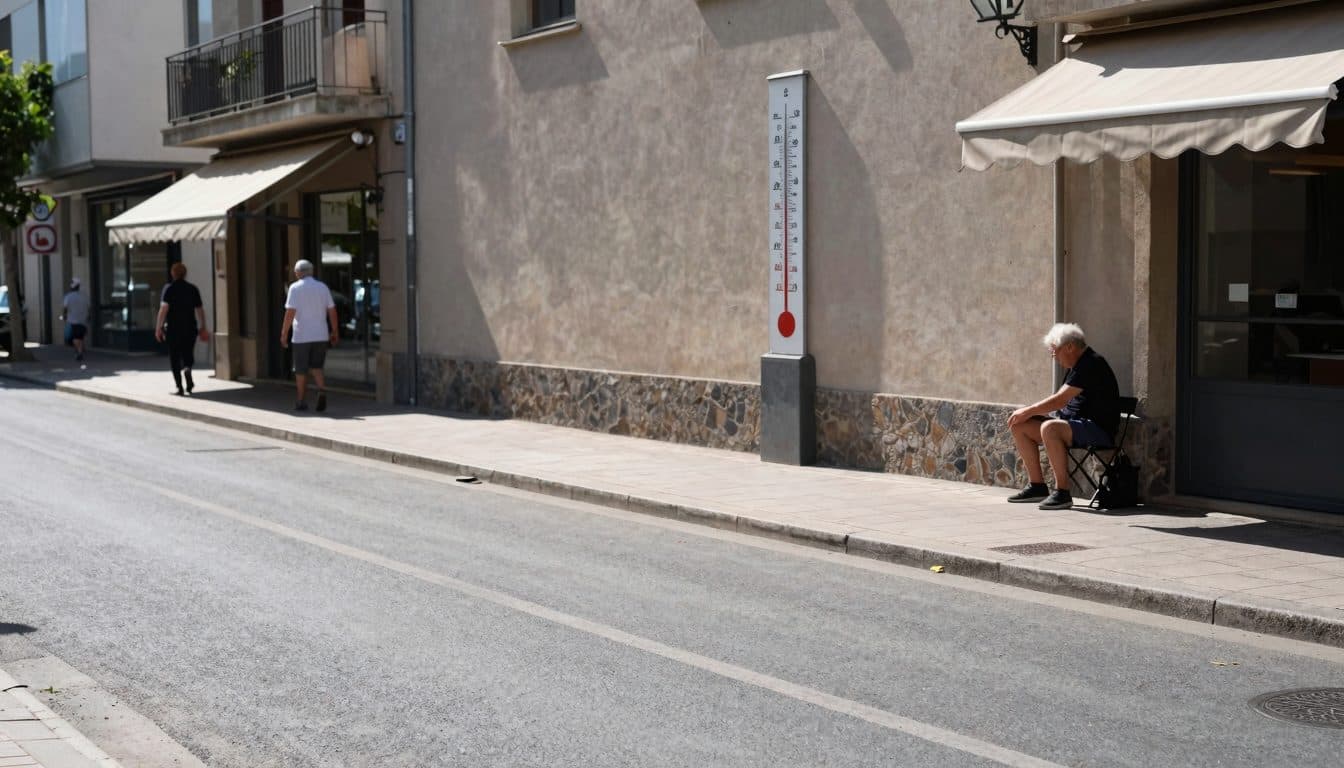
Heat Wave and Muscle Loss: Medical Expert Explains Health Risks During Record Temperatures
Augsburg, July 1, 2026
AI-generated image (z-image via Kie.ai)
Summary
In light of an unprecedented heat wave in Western Europe, medical expert Claudia Traidl-Hoffmann is warning of severe health risks – from multi-organ failure to circulatory collapse. At the same time, a new study shows how closely muscle strength in old age is linked to life expectancy.
Augsburg, July 1, 2026
In light of a heat wave with temperatures exceeding 30 degrees Celsius in several Western European countries, physician and university professor Claudia Traidl-Hoffmann has warned of the health consequences of extreme heat and recommended concrete protective measures.
How the Body Reacts to Heat
The body begins compensatory mechanisms once outdoor temperatures reach 23 degrees Celsius, Traidl-Hoffmann explained. "Ab 23 Grad Außentemperatur beginnt der Körper mit Ausgleichsmechanismen", explains the medical expert. When the heat persists over several days or nights, however, this mechanism comes under increasing strain – especially when the nights no longer contribute to recovery.
The consequences can be severe: "Funktionieren diese Mechanismen nicht gut oder versagen ganz, können die Folgen von Herz-Kreislauferkrankungen über Schlaganfälle bis hin zu Multiorganversagen reichen." When core body temperature rises very high, there is a danger to life. "Steigt unsere Körpertemperatur zu stark an, beschleunigen sich Stoffwechselprozess zunächst immer weiter – bis der Körper die Kontrolle verliert – auf allen Ebenen vom Immunsystem bis zum Nervensystem. Ab etwa 42 Grad drohen schwere Zellschäden, Multiorganversagen und ohne sofortige Behandlung der Tod", Traidl-Hoffmann says.
Traidl-Hoffmann is Director of the Institute for Environmental Medicine and Integrative Health at University Hospital Augsburg, where she treats patients with environmental illnesses. She is also Director of the Institute for Environmental Medicine at Helmholtz Munich. As a member of the German federal government's Scientific Advisory Board, she also advises policymakers.
An additional risk factor is disturbed sleep during hot nights. "Weil die Hitze vielen Menschen den Schlaf raubt, kommt es schneller zur sogenannten Dekompensation. Der Körper schafft es dann nicht mehr, Fehlfunktionen auszugleichen." The lungs also respond sensitively to hot air. "Die Lunge entzündet sich eher und wird anfälliger für Infektionen", the physician explains.
Who Is Especially at Risk
Particularly at risk are small children, pregnant women, older people, individuals with pre-existing conditions, and people who must perform physically demanding work or work outdoors. Traidl-Hoffmann therefore advises her patients to begin preparing for hot days as early as January. This includes speaking with a doctor about adjusting medication dosages. During a heat wave, the expert additionally recommends drinking plenty of water and eating light, plant-based meals, and avoiding cigarettes and alcohol wherever possible.
June brought temperature records in France, Spain, Great Britain, the Netherlands, Switzerland, and Germany. The German Weather Service (DWD) reported: never before has it been so hot so early in the year for such an extended period in Germany. A heat wave of this kind, with temperatures exceeding 30 degrees Celsius and nights in which the thermometer does not drop below the 20-degree mark, poses particular challenges for the body.
Human Adaptation Is Reaching Its Limits
In her book "Die Medizin der Zukunft – Heilen in einer veränderten Welt", Traidl-Hoffmann also writes about the limits of human adaptation: adaptation processes to changing environmental conditions require time, Traidl-Hoffmann also writes in her book "Die Medizin der Zukunft – Heilen in einer veränderten Welt". Not years, but centuries. "Dieser exponentielle Anstieg der Hitzetage, diese schnelle Veränderung ist weder für Ökosysteme noch für den Menschen machbar, was die Anpassung betrifft."
She nonetheless emphasizes that adaptation is in principle possible: "Der menschliche Körper hat Anpassungsmöglichkeiten und die sind trainierter bei Menschen, die kontinuierlich Hitze ausgesetzt sind", physician and university professor Claudia Traidl-Hoffmann says. Heat acclimatization alone, however, cannot offset the current developments.
Muscle Strength as a Marker for Health
Alongside the strain caused by heat, medical experts are pointing to another frequently underestimated health marker: muscle strength in old age. From age 40 onward, people continuously lose muscle mass without targeted training. In medicine, this creeping decline is referred to as sarcopenia. As strength diminishes, the risks of falls, loss of independence, and earlier death increase.
A long-term study by a research team at the University of Buffalo tracked 5,472 women aged between 63 and 99 over a period of approximately eight years. Clinical studies use a hand dynamometer to precisely measure the strength of the hand and forearm muscles. The University of Buffalo team's results are extremely clear: women with the strongest grip strength of more than 24 kilograms had a 33 percent lower mortality risk than those in the weakest group with less than 14 kilograms. Statistically, the risk dropped on average by 12 percent for every additional seven kilograms of grip strength.
A simple everyday test was also evaluated: the second check is the sit-to-stand test. You stand up from a chair five times as quickly as possible – entirely without using your hands. The time is recorded. Anyone who completed the five repetitions in 11.1 seconds or faster had a 37 percent lower mortality risk than the slowest test group, who required more than 16.7 seconds. No athletic peak performances or records were measured here; the focus was purely on everyday strength. Specifically, it came down to gripping firmly and standing up independently from a chair.
Women are particularly affected, since they start with less muscle mass and lose additional strength during menopause. The protective effect of muscle strength persisted even when the women did not meet the officially recommended amounts of physical activity. Strength and conditioning researcher Joshua Davidson of the "BBC" provides a benchmark: one should be able to apply maximum pressure to a ball for 15 to 30 seconds until the grip tires. Medical experts therefore use these values as a marker for overall health. Experts recommend strength training twice a week and giving the body rest periods for recovery in between.
Questions & Answers
Who is Claudia Traidl-Hoffmann?
Claudia Traidl-Hoffmann is a physician and university professor. She is Director of the Institute for Environmental Medicine and Integrative Health at University Hospital Augsburg, as well as Director of the Institute for Environmental Medicine at Helmholtz Munich, and a member of the German federal government's Scientific Advisory Board.
From what temperature does heat become dangerous for the body?
According to Traidl-Hoffmann, the body begins compensatory mechanisms already at 23 degrees Celsius outdoor temperature. From around 42 degrees Celsius core body temperature, severe cell damage, multi-organ failure, and, without immediate treatment, death are threatened.
What do experts recommend to prevent muscle loss in old age?
Experts recommend strength training twice a week and giving the body rest periods for recovery in between. Muscle strength is regarded by medical experts as a marker for overall health and is closely linked to a lower mortality risk.
2026 Heat Wave: Risks for Heart, Lungs and Muscles | allfacts360