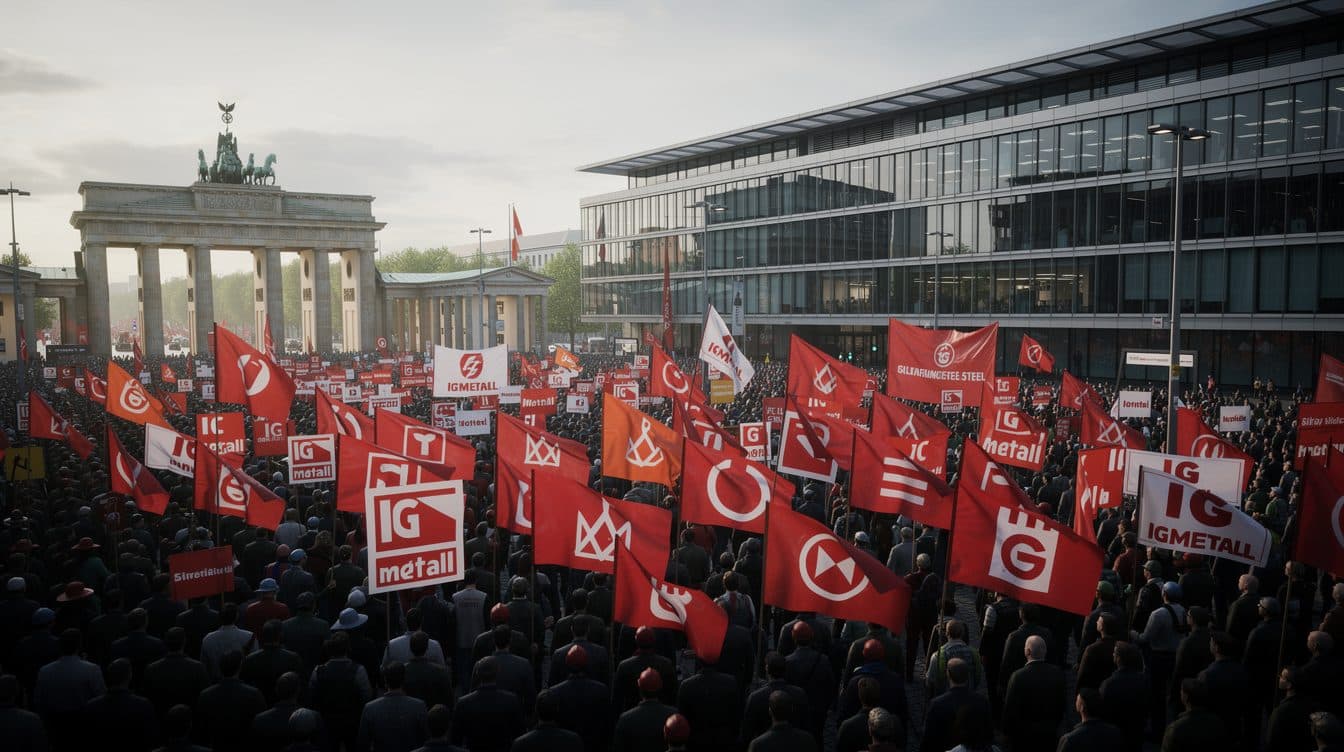
IG Metall mobilises steel workers in Berlin and Völklingen to demand action on industry crisis
Berlin, 12 June 2026
AI-generated image (flux-2/pro-text-to-image via Kie.ai)
Summary
IG Metall has called on around 1,000 steel workers from about 30 companies to march from the Brandenburg Gate to the Federal Ministry of Economic Affairs in Berlin, demanding protection against cheap imports, reliable framework conditions for climate-friendly production, and the preservation of jobs. A parallel rally in Völklingen in Saarland is expected to draw several thousand more participants.
Berlin, 12 June 2026
Germany's IG Metall union is staging a major demonstration of steel workers in Berlin on Friday, with about 1,000 participants from roughly 30 companies marching from the Brandenburg Gate to the Federal Ministry of Economic Affairs to press the government over a deepening crisis in the domestic steel industry.
A nationwide mobilisation
The trade union said participants from across Germany would gather for a demonstration march beginning at 10:00 at the Brandenburg Gate before moving on to the Bundeswirtschaftsministerium. A separate rally in the nearby Invalidenpark is scheduled to begin at 11:00, under the motto "Stahl hat Zukunft – bei uns!" (Steel has a future – with us!), according to a news report aired on Deutschlandfunk on 12 June 2026.
IG Metall expects participants from about 30 steel industry companies from across the country, with around 1,000 people in total taking part in the Berlin events. A parallel rally is being held in Völklingen in Saarland, where several thousand participants are expected.
Among those slated to speak at the Berlin rally is Jürgen Kerner, the Second Chairman of IG Metall, alongside works council chairs and labour directors drawn from the steel sector. The union said the action was intended to highlight what it describes as the existential pressures facing the industry.
Demands on the federal government
Workers are demanding protection against cheap imports and unfair competitive conditions, reliable political framework conditions for the transition to climate-friendly steel production, and the preservation of jobs. The union is also calling on the federal government to deliver an industrial policy that secures long-term investment in domestic steelmaking.
The political backdrop to the demonstration includes anticipated appearances by the leaders of two opposition parties. Felix Banaszak, party chairman of the Greens (Grüne), and Ines Schwerdtner, party chairwoman of Die Linke, are expected to attend the rally, underscoring the cross-party attention the industry crisis has attracted.
Industry under pressure
The demonstration comes against a backdrop of prolonged strain on European steelmakers, who have faced rising energy costs, weak demand in key construction and automotive markets, and competition from subsidised producers abroad. Unions and employer groups have repeatedly called on Berlin and Brussels to strengthen trade defence instruments and accelerate funding for the green transformation of blast furnace capacity.
For IG Metall, the Berlin march is the latest in a series of industrial actions aimed at forcing a political response. The union has argued that without a coherent strategy, the decarbonisation of steel production risks hollowing out an industry that still employs tens of thousands of workers in Germany, particularly in regions such as the Saarland, North Rhine-Westphalia and Bremen.
Why Völklingen matters
Völklingen, the site of the parallel rally, has historic significance for German steelmaking. The town's former ironworks, now a UNESCO World Heritage site, symbolises both the heritage of the industry and the upheaval of its deindustrialisation. The choice of the city for a major rally reflects the continuing weight of steel employment in Saarland's economy and identity.
The dual-city format of the protests allows IG Metall to combine a symbolic show of force at the heart of political power in Berlin with a mass mobilisation in a region where steel remains a defining economic factor. Together, the two events are intended to convey a single message: that the federal government must act decisively to safeguard the sector.
Speaking arrangements at the Berlin rally will include not only IG Metall's leadership but also works council chairs and labour directors from the steel branch, putting a human face on the union's demands and tying the policy ask directly to the lives of affected workers and their families.
A test for industrial policy
Industry observers say the demonstration will be a test of how the federal government balances the competing pressures of climate policy, international trade and industrial competitiveness. The Bundeswirtschaftsministerium, the destination of the march, has been at the centre of negotiations over subsidy frameworks and trade measures.
While IG Metall has not announced further industrial action beyond Friday's events, union officials have signalled that the response from policymakers in the coming weeks will determine whether escalation is necessary. For now, the union is framing the demonstration as a public warning rather than the prelude to a strike.
The choice of the Brandenburg Gate as the starting point carries deliberate political resonance. The square at the heart of Berlin is closely associated with major national moments, and the union's decision to begin there underlines the message that it considers the steel crisis a matter of national economic importance.
Symbolism of the route
The rally's slogan, "Stahl hat Zukunft – bei uns!" encapsulates the union's two-pronged argument: that the industry has a future only if the political and economic conditions are right, and that this future should be realised in Germany rather than outsourced abroad. The march to the economics ministry is designed to translate that slogan into concrete policy demands.
Friday's events are likely to draw substantial media attention given the participation of senior political figures, the visibility of the route through central Berlin, and the parallel mobilisation in Saarland. For the federal government, the demonstration will represent one of the most visible labour-led interventions on industrial policy in recent months.
Questions & Answers
Who is Jürgen Kerner and what role does he play in the Berlin demonstration?
Jürgen Kerner is the Second Chairman of IG Metall and is expected to speak at the rally, alongside works council chairs and labour directors from the steel industry.
Why is IG Metall marching to the Federal Ministry of Economic Affairs?
The union is marching on the Bundeswirtschaftsministerium to demand protection against cheap imports, reliable framework conditions for the transition to climate-friendly steel production, and the preservation of jobs.
What is happening in Völklingen alongside the Berlin rally?
A parallel rally is taking place in Völklingen in Saarland, where several thousand participants are expected to show solidarity with the Berlin demonstration.
IG Metall steel rally: Berlin and Völklingen protests | allfacts360