Iran fears World Cup matches against Belgium and Egypt: Visa of attacking player Torabi initially invalid
Los Angeles, 17 June 2026
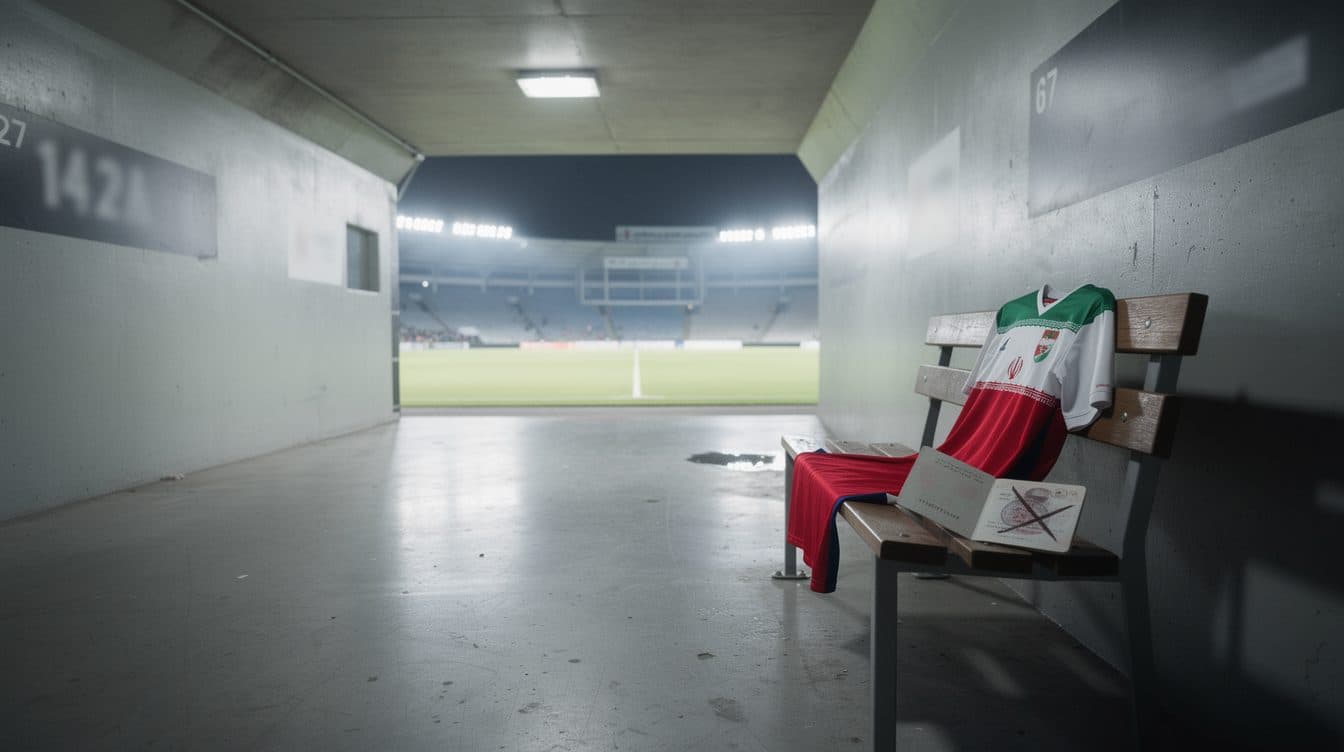
AI-generated image (flux-2/pro-text-to-image via Kie.ai)
Summary
Following the 2:2 opening draw against New Zealand, Iranian attacking player Mehdi Torabi had his US visa revoked because it had been issued for a single entry only. In the meantime, according to World Cup envoy Andrew Giuliani, he has received a new visa and is expected to be able to play against Belgium and Egypt.
Los Angeles, 17 June 2026
Iranian attacking player Mehdi Torabi (31) had his US visa revoked after the World Cup opener against New Zealand (2:2) in Los Angeles, as it had been issued for a single entry only; according to World Cup envoy Andrew Giuliani, the issue has since been resolved.
Background: One visa, one entry
The Football World Cup in the USA, Canada, and Mexico is causing significant logistical and political strain for the Iranian team. After the opening match against New Zealand, which ended 2:2 in Los Angeles on 16 June 2026, the 31-year-old attacking player Mehdi Torabi had his US visa declared invalid. As reported by the official Iranian news agency Irna, the document had been issued for a single entry only and expired after the match. Torabi was on the bench for the opener and was not used.
World Cup envoy Andrew Giuliani commented on the situation the day after the match. "This problem has been resolved," said Giuliani. Torabi had received a new visa that would allow him to participate in the remaining World Cup matches. Giuliani added that the Iranian team would henceforth be permitted to enter the country on the day before each match and to leave again afterwards. "The team will be allowed to enter (…) that is, on the day before the match. They will be able to do the same in Seattle," he stated.
IRGC as a political factor
According to Giuliani, the strict visa regulations are rooted in the Iranian Revolutionary Guard Corps (IRGC). The US envoy made clear that "anyone with a connection to the IRGC (note: the Iranian Revolutionary Guard) will not be allowed into the United States of America, and the World Cup will not be the reason for them to be let in." When asked whether Torabi personally had such a connection or whether it was purely a matter of the visa conditions, he declined to comment after the 2:2.
Iranian coach Amir Ghalenoei had sharply criticised the circumstances immediately after the match. "We are the most battered team of the entire World Cup," Ghalenoei said at a press conference on Monday. Players and officials had only been informed at short notice that they would have to return to Mexico on the evening of the match, with no time to recover. The team had originally planned to stay in California between matches. "They are making things increasingly difficult, confronting us with more hurdles," the coach said, referring to the US authorities.
Base relocated from Tucson to Tijuana
The long travel between match venues is a direct consequence of the relocation of Iran's World Cup base. The team had originally been based in Tucson, Arizona, but moved to Tijuana, Mexico in recent weeks due to ongoing difficulties. The travel between Tijuana and the US venues costs time and energy, which Ghalenoei clearly denounced.
The Iranian delegation is also not fully present in the USA in terms of personnel. Federation president Mehdi Taj and parts of the backroom staff did not receive US visas and likewise had to remain in Mexico. According to the Iranian Football Federation, the uncertainty over travel arrangements had at one point also extended to the players' visas. In the meantime, however, all Iranian players had received a valid entry document for the USA, according to federation circles.
Incomplete delegation
The fact that the visa issue is not merely bureaucratic in nature but also has a geopolitical dimension is evident from the weeks of debate in the run-up to the World Cup. Iran's participation had long been uncertain given the strained relations between the USA and Iran. The reference to the IRGC in Giuliani's statement makes clear that the US authorities are handling the entry of Iranian officials and players with particular restrictiveness.
Taremi, who was already on the pitch for the opening match against New Zealand, had complained not only about the rapid departure but also about missing visas for team members. The Iranian federation, for its part, said it had acted immediately once the irregularities became known. "As soon as we became aware of it, we worked to ensure that the player can take part in every match," it said from the Iranian camp. The irregularities have since been clarified.
The background makes clear how sensitive the interface between sport and politics is at this World Cup. Travel routes, visa requirements, and security concerns intertwine and directly affect the team's sporting performance. Ghalenoei's statement that they are the "most battered team of the entire World Cup" sums up the totality of these burdens.
Outlook: Belgium, Egypt, and the question of strain
For Iran's team, the sporting schedule now continues at a rapid pace. The second group match against Belgium is on Sunday in Los Angeles, followed by the final group match against Egypt on 26 June in Seattle. Two decisive matches therefore lie ahead, in which the team needs points to keep alive its chance of reaching the round of 16. Torabi, who plays a key role in attack, is expected to be available for the upcoming tasks, provided the new visa works smoothly.
The open question remains whether the US authorities will erect further hurdles over the coming matches or whether the solution now found – entry on match day, immediate departure afterwards – will hold. Giuliani had indeed stressed in his statement that the Torabi issue had been resolved, but did not comment on the political background. Ghalenoei likewise avoided commenting further on the situation beyond his general complaint.
From an Iranian perspective, the sporting situation is not hopeless despite the adversities. The 2:2 against New Zealand at least earned a point, and with Belgium and Egypt, two opponents lie ahead against whom a win seems possible. It will be crucial whether the team can shake off the travel strains and the psychological burden of the visa affair as the tournament progresses. The coming days will show whether the federation and the US side can find a permanently smooth solution.
Conclusion: Politics and sport in a field of tension
Overall, the incident throws a spotlight on the special conditions of a World Cup in a country where diplomatic relations with a participating state are strained. Major sporting events are meant to bring people together, but in Iran's case it is evident that political realities can significantly influence the competition – right down to the question of whether individual players are even allowed to enter.
The next test comes on Sunday evening, when the Iranian team faces Belgium in Los Angeles. Should Torabi then take part, it would be a first indication that the agreement now reached is holding. If not, the debate over visas, politics, and sport in the USA is likely to gather further pace.
From the Iranian federation's perspective, the hope remains that the official procedures will function reliably in the coming days. Mehdi Taj himself remains on Mexican soil, and the same applies to the team: the logistical rollercoaster between Tijuana and the US venues is, for the time being, the normal state of affairs at this World Cup.
Questions & Answers
Who is Mehdi Torabi and why is he at the centre of the visa affair?
Mehdi Torabi is a 31-year-old Iranian attacking player. According to the Iranian news agency Irna, his US visa had been issued for a single entry only and expired after the World Cup opener against New Zealand, meaning he would initially have been unable to play in the subsequent matches.
What role does the Iranian Revolutionary Guard Corps (IRGC) play in this conflict?
World Cup envoy Andrew Giuliani stated that anyone with a connection to the IRGC would not be allowed into the USA and that the World Cup would not be accepted as a reason for entry. The IRGC is thus the political background to the strict visa requirements imposed on Iranian players and officials.
How does the Iranian team proceed in the tournament?
Iran plays against Belgium in Los Angeles on Sunday and against Egypt in Seattle on 26 June. According to Giuliani, Torabi has since received a new visa, so he is expected to be able to take part in the remaining group matches.
Iran visa scandal: Torabi faces World Cup exit against | allfacts360