Military Parade Paris July 14, 2026: Macron, Merz, Zelensky | allfacts360
Macron's Final National Celebration: Major Military Parade in Paris with Clear Signals for Ukraine
Paris, July 14, 2026
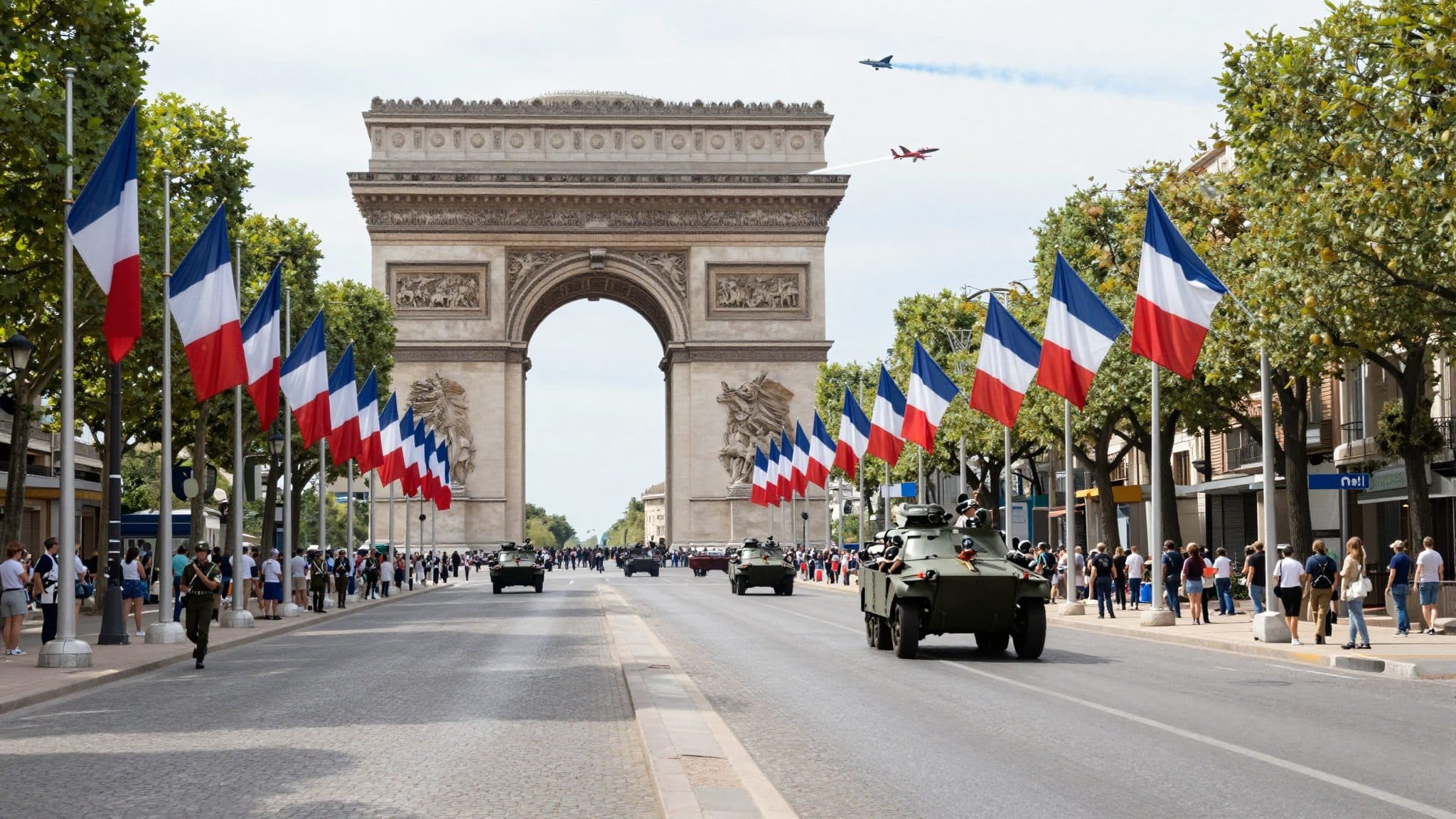
AI-generated image (z-image via Kie.ai)
Summary
France held its largest military parade of President Emmanuel Macron's term on the Champs-Élysées on July 14, 2026. At the head of the procession marched 500 soldiers from the Coalition of the Willing, led by France and the United Kingdom, including German forces. Chancellor Friedrich Merz and Ukrainian President Volodymyr Zelensky were among the guests.
Paris, July 14, 2026
France held its largest-ever military parade on the occasion of the national holiday on Tuesday, July 14, 2026, on the Champs-Élysées in Paris; at the head of the procession marched 500 soldiers from member states of the Coalition of the Willing, with Chancellor Friedrich Merz and Ukrainian President Volodymyr Zelensky among the guests.
With nearly 6,800 service members in uniform and a significantly increased number of vehicles, the parade surpassed all previous displays under outgoing President Emmanuel Macron, according to the Élysée Palace. The march was opened by 500 soldiers from 30 European countries, who proceeded down the avenue together with 25 Ukrainian military personnel. The parade was held under the sign of support for Ukraine and was intended, in the words of the presidency, to make visible France's rearmament, its strategic autonomy, and a "strategic awakening of Europe."
Chancellor Friedrich Merz was among the guests of honor on the tribune, as reported by Deutschlandfunk on July 14, 2026. It is the first time since 2019 that a German Chancellor has again participated in the Paris parade — that time it was Angela Merkel. Germany was represented, according to information from Paris, with four aircraft and 21 soldiers from Artillery Battalion 295 based in Stetten am kalten Markt, which is part of the Franco-German Brigade.
Merz as Guest of Honor on the Tribune
As the guest of honor and central figure of the event, Macron paid tribute to Ukrainian President Volodymyr Zelensky, who took his seat on the honorary tribune together with around 30 other heads of state and government as well as European Commission President Ursula von der Leyen. After the parade, Zelensky thanked the Ukrainian soldiers as well as France and all partners standing by Ukraine's side: "We thank our soldiers. We thank France and all our partners who stand by Ukraine." He described Macron's invitation as a sign of respect and recognition of the strength of Ukraine, its people, and its armed forces.
For Macron, this is the last parade in office. Since France allows only two consecutive terms, he is not running again; presidential elections are scheduled for spring 2027. The parade thus also coincided with a look ahead to the succession. At the Élysée Palace, the staging on July 14, 2026, was described as the final military parade of this scale under Macron.
Macron's Final Parade in Office
In the run-up to the parade, Macron had affirmed at a meeting with the French General Staff that France wanted peace and rejected any warmongering. On the evening before, representatives of the Coalition of the Willing, which Macron and British Prime Minister Keir Starmer had initiated in spring 2025, gathered for a dinner in Paris. Moldova and North Macedonia were admitted as two new members. At a press conference, Macron announced initial joint maneuvers by the coalition, along with additional arms deliveries and cooperation on missile defense.
At the same time, ten particularly committed states — including Germany, Italy, Great Britain, and France — presented an "Anti-Ballistic Front" designed to intercept Russian ballistic missiles, which are faster and harder to neutralize than cruise missiles. According to Zelensky, the German-Ukrainian air defense system "Freya" is to become operational earlier than announced, although it will only be fully available at the beginning of 2027. Macron announced that France, in a manner similar to the recent United States approach with Patriot systems, wants to enable the production of French cruise missiles, bombs, and anti-aircraft missiles on Ukrainian soil.
Maneuvers, Weapons, and an Anti-Ballistic Program
Polish Prime Minister Donald Tusk declared in Paris that the maneuvers were to take place in Poland in the autumn of this year, with troops from France, Great Britain, and Poland. They were intended to prepare the coalition for "concrete security guarantees for Ukraine, but also for the region." Polish Defense Minister Wladyslaw Kosiniak-Kamysz signaled readiness for a permanent stationing of troops from France and Great Britain. Chancellor Merz made no comment on the announced maneuvers on Monday evening in Paris and merely pointed out that the Coalition of the Willing was ready to play "an important role" in security guarantees for Ukraine after a ceasefire "in close coordination with the United States." Previously, he had left open Germany's contribution to a multinational protection force for Ukraine.
Overhead, Mirage fighter jets with Franco-Ukrainian crews caused a sensation — a model that France had previously already delivered to Ukraine. According to information from Paris, 55 Ukrainian soldiers took part in the march, with a further 25 marching on the avenue. Zelensky described the invitation as a "great honor" for his country: "It is a great honor for us to be here."
Mirage, March Numbers, and Ukrainian Participation
The mood in the streets, however, was also shaped by the shadows of the past. On the evening of July 14, a commemoration was to be held in Nice for the victims of the Islamist truck attack ten years ago, in which 86 people died and more than 400 were injured. Macron and his predecessors François Hollande and Nicolas Sarkozy, as well as the Prince of Monaco Albert II, were expected at the memorial event in Nice.
France's national holiday commemorates the storming of the Bastille on July 14, 1789, which is regarded as the symbolic beginning of the French Revolution. The annual military parade on the Champs-Élysées is one of the most politically charged dates on the French president's calendar. The fact that this year a German Chancellor was present for the first time since 2019 and that, with 500 soldiers from around 30 European states as well as 25 Ukrainian forces, the largest foreign participation ever took place underscored the message Macron wanted to send: "the strategic rearmament of France and the strategic awakening of Europe."
Commemoration of the Victims of Nice
The background to the staging was also the near-doubling of France's defense spending since 2017 — since Macron's first inauguration. Macron used the parade to make the grown military capability visible and at the same time to demonstrate the solidarity of European states with Ukraine. Those on the tribune were predominantly the heads of state and government of the coalition countries; Macron and Starmer, the two initiators of the Coalition of the Willing, will both leave office in the foreseeable future.
In the background remained the situation in Ukraine itself: according to information from Kyiv, Russia shelled civilian targets in Kyiv, Zaporizhzhia, and Kharkiv; on the night leading into Tuesday, Ukraine struck an oil refinery not far from the Ural Mountains. President Zelensky stated that Ukraine was running low on effective American Patriot interceptor missiles. According to a report, Russian President Vladimir Putin does not envisage a ceasefire.
Background: Defense Spending and Foreign Policy
The Paris military parade was thus more than a symbolic troop review: it bundled together several signals — European rearmament, support for Ukraine, and the indication that Macron, in his final year in office, wanted once again to set accents in security and foreign policy.
Questions & Answers
Who took part in the military parade for the French national holiday in 2026?
According to the Élysée Palace, nearly 6,800 service members took part in the parade on the Champs-Élysées, including 500 soldiers from 30 European countries of the Coalition of the Willing, 25 Ukrainian military personnel, and 55 Ukrainian soldiers in total. Guests included Chancellor Friedrich Merz, Ukrainian President Volodymyr Zelensky, and around 30 other heads of state and government.
What military decisions did Macron announce on the margins of the parade?
Macron announced initial joint maneuvers by the Coalition of the Willing in countries neighboring Ukraine, additional arms deliveries, and the possibility of producing French cruise missiles, bombs, and anti-aircraft missiles on Ukrainian soil. At the same time, ten states — including Germany, Italy, Great Britain, and France — presented an "Anti-Ballistic Front."
Why was the parade also significant in domestic political terms?
Since France allows only two consecutive terms and Macron is not running again, the parade on July 14, 2026, was his last in office; presidential elections are scheduled for spring 2027.