Marjane Satrapi, Iranian-French creator of 'Persepolis', dies in Paris at 56
Paris, 4 June 2026
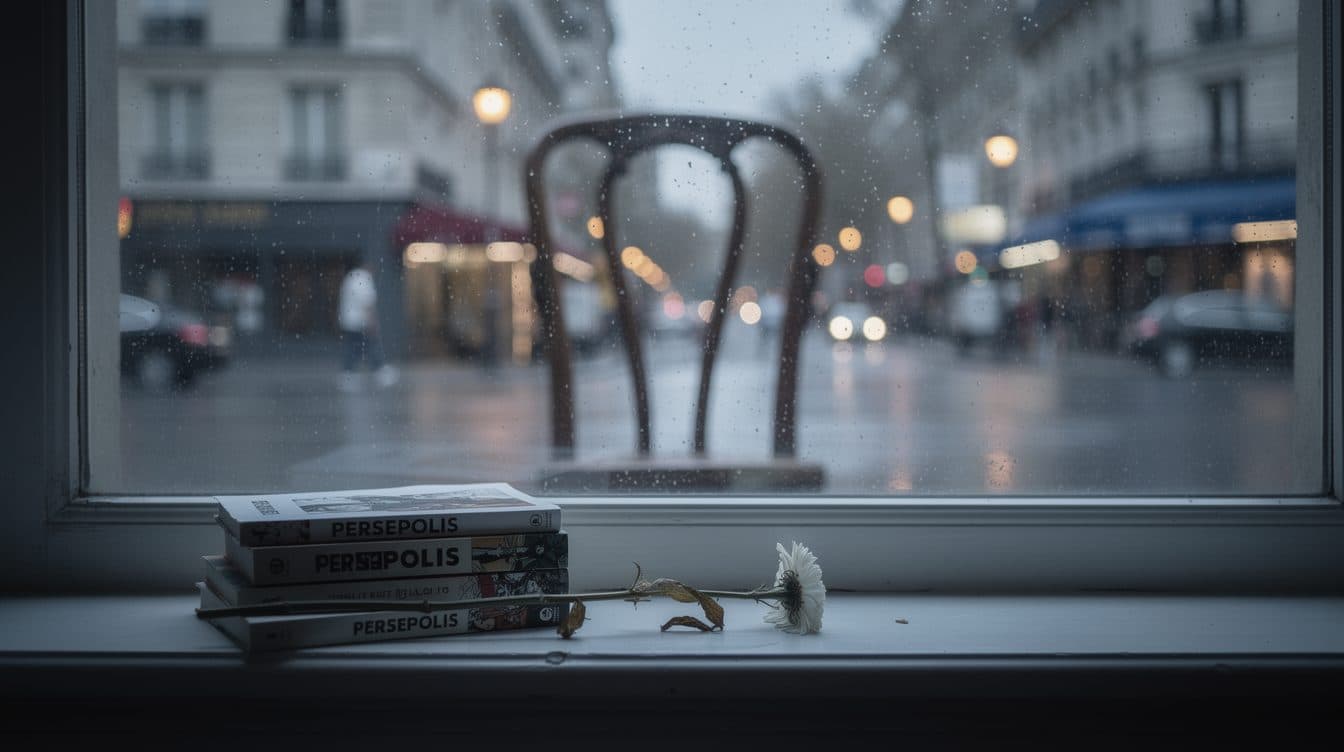
AI-generated image (flux-2/pro-text-to-image via Kie.ai)
Summary
Marjane Satrapi, the Iranian-French author, illustrator and filmmaker best known for the autobiographical graphic novel and animated film 'Persepolis', has died in Paris at the age of 56. French President Emmanuel Macron and the Élysée Palace announced her death on Thursday, June 4.
Paris, 4 June 2026
Marjane Satrapi, the Iranian-French author, illustrator and filmmaker whose autobiographical graphic novel and animated film 'Persepolis' brought her worldwide recognition, has died in Paris at the age of 56, the Élysée Palace and her circle announced on Thursday.
From Tehran to Paris
The news was confirmed on Thursday, June 4, by both the office of French President Emmanuel Macron and Abbas Bakhtiari, the head of the Iranian cultural association Pouya in Paris, and was carried by Agence France-Presse. No details about the circumstances, place, or time of her death were initially provided.
According to a statement released to AFP, Satrapi died of grief approximately one year after the death of her husband Mattias Ripa. The German-language version of the statement read: "Marjane Satrapi starb an Trauer, ungefähr ein Jahr nach dem Tod von Mattias Ripa, ihrem Ehemann und der Liebe ihres Lebens." In a post on Instagram, Satrapi had written that she had lost the love of her life after her husband's death.
Mattias Ripa, a Swedish actor and screenwriter who also translated 'Persepolis' into English, died on April 8 of the previous year, according to multiple reports. The statement that Satrapi died "of grief" is unusual in public health terms but reflects how the author herself framed her loss on social media in the months after Ripa's death.
A childhood shaped by revolution and war
Satrapi was born in 1969 in the northern Iranian city of Rasht and grew up in Tehran, in a politically active, left-leaning middle-class family. Her parents sympathized with communism and pushed back against the new order after the 1979 Islamic Revolution. She had spoken about the family politics and her childhood in extensive interviews over the years.
At the age of 14, in 1984, her parents sent her to Vienna, where she attended a French lycée, to escape the political repression and war that followed the establishment of the Islamic Republic and the outbreak of the Iran-Iraq War. She returned to Tehran in 1988 to study art before ultimately emigrating to Strasbourg and then Paris in 1994.
Satrapi obtained French citizenship in 2006 and lived in Paris for the rest of her life. In a 2009 essay for the New York Times, she wrote: "Egal wie lange ich in Frankreich lebe und obwohl ich mich nach all diesen Jahren auch als Französin fühle – für mich hat das Wort 'Heimat' nur eine Bedeutung: Iran."
Persepolis on the page and on screen
Her international breakthrough came with the autobiographical graphic novel 'Persepolis', drawn in stark black-and-white panels, which recounted her childhood in Tehran under the Islamic Republic, the upheavals of the revolution and the Iran-Iraq War, her teenage exile in Vienna, and her eventual return. The English-language edition of the work was published in 2003 and was eventually translated into roughly 25 languages, reaching millions of readers worldwide.
In 2007, Satrapi and the French director Vincent Paronnaud adapted 'Persepolis' into an animated feature film. The film won the Jury Prize at the Cannes Film Festival and later received two César awards, and it was nominated for an Academy Award in 2008, where it served as France's official submission. The success of the film cemented Satrapi's reputation as one of the most internationally recognized Iranian comic artists of her generation.
Beyond 'Persepolis', Satrapi produced further graphic novels, including 'Embroideries' (in French 'Broderies') and 'Chicken with Plums' ('Poulet aux prunes'), the latter of which she adapted into a 2010 film. She also worked as a director and screenwriter of live-action features, including 'The Voices' (2014) with Ryan Reynolds and Gemma Arterton, and the 2019 biographical film 'Marie Curie – The Courage of Knowledge' (in German 'Marie Curie – Elemente des Lebens') starring Rosamund Pike.
Voice for Iran's 'Woman, Life, Freedom' movement
In recent years, Satrapi became an outspoken voice on the situation in Iran, particularly after the death in 2022 of Jina Mahsa Amini, a Kurdish woman whose death in police custody set off mass street protests under the slogan 'Woman, Life, Freedom'. In 2023 and 2024, she coordinated and directed a collective graphic-novel project bearing that same name, contributing her own drawings and editing the work of other artists to support protesters in Iran.
In January 2025, Satrapi made headlines when she publicly declined the Legion of Honour, France's highest order of merit, accusing France of a hypocritical stance toward the Islamic Republic. On Instagram, she wrote that supporting the women's revolution in Iran could not be reduced to "taking photos with victims or celebrities at memorial services for Mahsa Amini's death" – in the original German: "Fotos mit Opfern oder Prominenten bei den Gedenkfeiern zum Tod von Mahsa Amini zu machen."
Declining the Legion of Honour
She also publicly criticised France for denying tourist visas to young Iranians, artists and dissidents. In a separate interview with the New York Times, Satrapi said of Iran: "Sogar grundlegende Menschenrechte verweigern sie uns. Du hast kein Recht zu tanzen, kein Recht zu singen." She had long disliked the label 'graphic novel', telling the New York Times in 2007 that she believed the term was coined to keep the bourgeoisie from being afraid of comics: "Ich glaube, dieser Begriff wurde erfunden, damit die Bourgeoisie keine Angst vor Comics hat."
Tributes from the Élysée
Reacting to her death, the Élysée Palace issued a statement in which President Macron and his wife offered their "deep condolences" to Satrapi's family and to "all who loved the artist". The statement described her passing as "den Verlust einer führenden Persönlichkeit der französischen Kultur und einer Künstlerin, die sich der Freiheit verschrieben hatte, deren Werk eine universelle Botschaft vermittelte und ihr immensen internationalen Ruhm eingebracht habe." Macron separately called her a "Symbolfigur für das iranische Volk und für die Frauenrechte."
Satrapi is widely regarded as a defining voice of her generation, both for bringing Iranian stories to a global audience and for her activism in defence of freedom of expression and women's rights. Her death closes a chapter in French and Iranian cultural life, and tributes are expected from literary, cinematic and political circles in the days to come. She is survived by friends, collaborators and readers across the many countries where 'Persepolis' has been read, taught and screened.
Among the readers and writers who grew up with 'Persepolis' in the 2000s, the book remains a staple of school curricula and a touchstone for graphic memoir as a serious literary form. Satrapi's insistence on the political content of art, and her willingness to break with official honours when she felt her principles were at stake, set a public example that extended well beyond the worlds of comics and cinema.
Questions & Answers
Who was Marjane Satrapi?
Marjane Satrapi was an Iranian-French author, illustrator and filmmaker, born in 1969 in Rasht, Iran, best known internationally for the autobiographical graphic novel 'Persepolis' and its 2007 animated film adaptation.
How did Marjane Satrapi die?
According to a statement released to AFP and to her own Instagram posts, Satrapi died in Paris of grief roughly one year after the death of her husband, the Swedish actor and screenwriter Mattias Ripa, who had died on April 8 of the previous year.
Why did Satrapi refuse the Legion of Honour?
In January 2025, Satrapi publicly declined the Legion of Honour, France's highest order of merit, in protest against what she called France's hypocritical attitude toward the Islamic Republic of Iran and its refusal to issue tourist visas to Iranian artists and dissidents.
Marjane Satrapi dies at 56: Persepolis creator | allfacts360