
Rendsburg, 16 July 2026
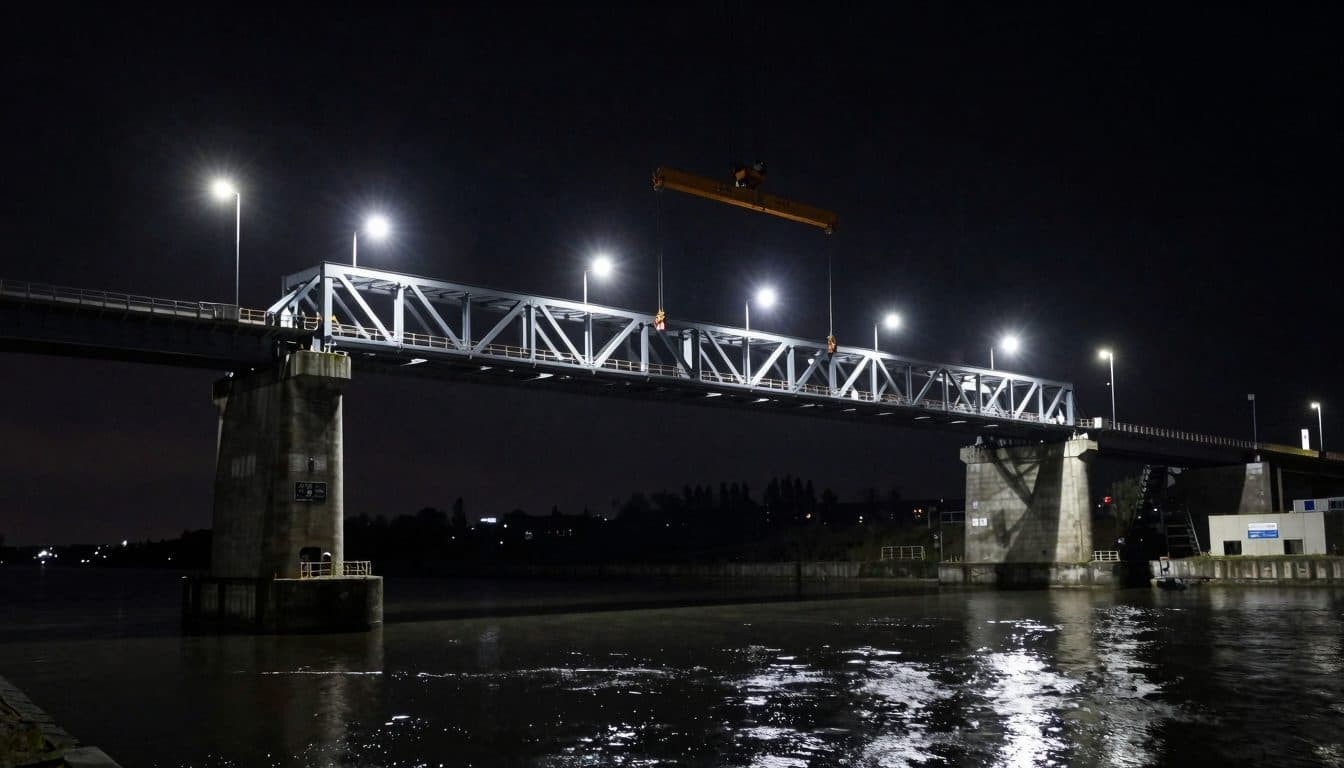
During the night leading into Thursday, the 118-metre-long, approximately 1,250-tonne middle section of the first half of the bridge was lifted into place at a height of 50 metres during the construction of the new Rader Hochbrücke over the Kiel Canal near Rendsburg.
The steel element had been loaded onto a floating pontoon at the port of Rendsburg the previous day. The pontoon then covered the roughly six-kilometre stretch to the lifting point beneath the bridge. The actual lifting operation using so-called strand jacks began in the evening at around 9:30 p.m., according to a statement from the Federal Waterways and Shipping Administration. For the spectacular lift starting at approximately 9:30 p.m., the constructors need space – which is why shipping traffic is being stopped for 16 hours, from 5 p.m. on Wednesday to 9 a.m. on Thursday.
According to information from Deutsche Einheit Fernstraßenplanungs- und -bau GmbH (DEGES), the middle section was loaded using two Self-Propelled Modular Transporters, whose axles can be coupled as needed. The middle section required 13 axle lines per transporter. „Der Grund, warum wir das nachts machen, ist, dass morgens um 5.00 Uhr das Bauwerk am kühlsten, am kältesten ist und damit die Lücke auch am größten. Denn Stahl und Beton zieht sich bei Kälte zusammen und dehnt sich bei Wärme aus und wir wollen sichern, dass wir oben auch in die Lücke reinpassen“, erläuterte DEGES-Projektleiter Martin Steinkühler.
How the lift proceeded
DEGES spokesperson Ulf Evert expressed satisfaction with the progress of the project. „Alle Beteiligten seien sehr glücklich damit, wie das Projekt bislang läuft“, sagte er. Schleswig-Holstein's Transport Minister Claus Ruhe Madsen also spoke of a „grandiosen Ingenieursleistung". Steinkühler described himself as a passionate bridge builder and declared: „Ich bin leidenschaftlicher Brückenbauer" – the new crossing is already the fifth or sixth major bridge project of his professional career.
After more than three years of construction, the connecting middle section for the first part of the structure was lifted into place today. With the lift, the first half of the structure enters its final phase. According to planning, traffic on the A7 is to flow over the new three-lane bridge section from the end of the year, while the old bridge is demolished. The contract value for the first partial structure is 307 million euros; DEGES puts the total cost of the project at just under 900 million euros. The total length of the structure: 1,500 metres; the length of the entire construction project: approximately 5.3 kilometres.
Why a new build became necessary
The old Rader Hochbrücke dates from 1972 and is thus 54 years old. After a partial closure of the bridge in the summer of 2013, the decision was taken to build a new bridge – there was wear and tear on the concrete elements. During a routine inspection in the summer of 2013, experts identified serious damage to concrete components, after which the bridge had to be partially closed to trucks. According to structural assessments from 2014, the old Hochbrücke may only be used until the end of 2026 inclusive – by then it must have been replaced by the new structure. Expert assessors certified the old bridge with only a remaining useful life until the end of 2026.
Expansion to six lanes and further plans
Because of increasing traffic, DEGES also decided to widen the carriageway from the current four lanes to a total of six lanes. According to the automatic traffic counters of the Bundesanstalt für Straßen- und Verkehrswesen (BASt), around 53,000 motor vehicles used the A7 at this point at the time construction began in 2023. Current DEGES forecasts assume that this figure could reach 60,000 by 2030. In April 2023, things then got under way.
The pontoon will then remain in the port until this afternoon, until it begins the roughly six-kilometre journey to the lifting point beneath the bridge. Using heavy cranes on both sides of the bridge, the middle section is to be positioned at a height of around 50 metres. „Das größte Risiko bei so einem Einhubvorgang ist der Wind", warned Steinkühler. „Aber wir sind sehr zuversichtlich, dass die Wetterbedingungen morgen Nacht sehr gut sind, sodass wir tatsächlich pünktlich durchkommen." He expects a useful life of 100 years for the new structure, provided there is no earthquake in Schleswig-Holstein.
Timeline until 2031
The tendering process for the demolition of the old bridge is currently under way. The start of construction for the second half of the bridge is scheduled for 2028; the bridge is to be fully completed in 2031 – assuming continuous funding, according to DEGES. The bridge plays a central role for traffic to Denmark and Scandinavia, DEGES says. According to DEGES, the lift is expected to have no impact on road traffic over the old bridge.
As part of the project, new noise and wind barriers are also being built: 6.9 kilometres of new noise and wind barriers are being erected. Additional noise barriers will be installed for Borgstedt and Schacht-Audorf (both in the Rendsburg-Eckernförde district) along the A7. Compared with the old structure, which used 330 kilograms of steel per square metre, the new structure makes do with 550 kilograms per square metre and additionally receives a concrete slab as the road surface. Responsibility lies with DEGES as the project company on behalf of Autobahn GmbH des Bundes.