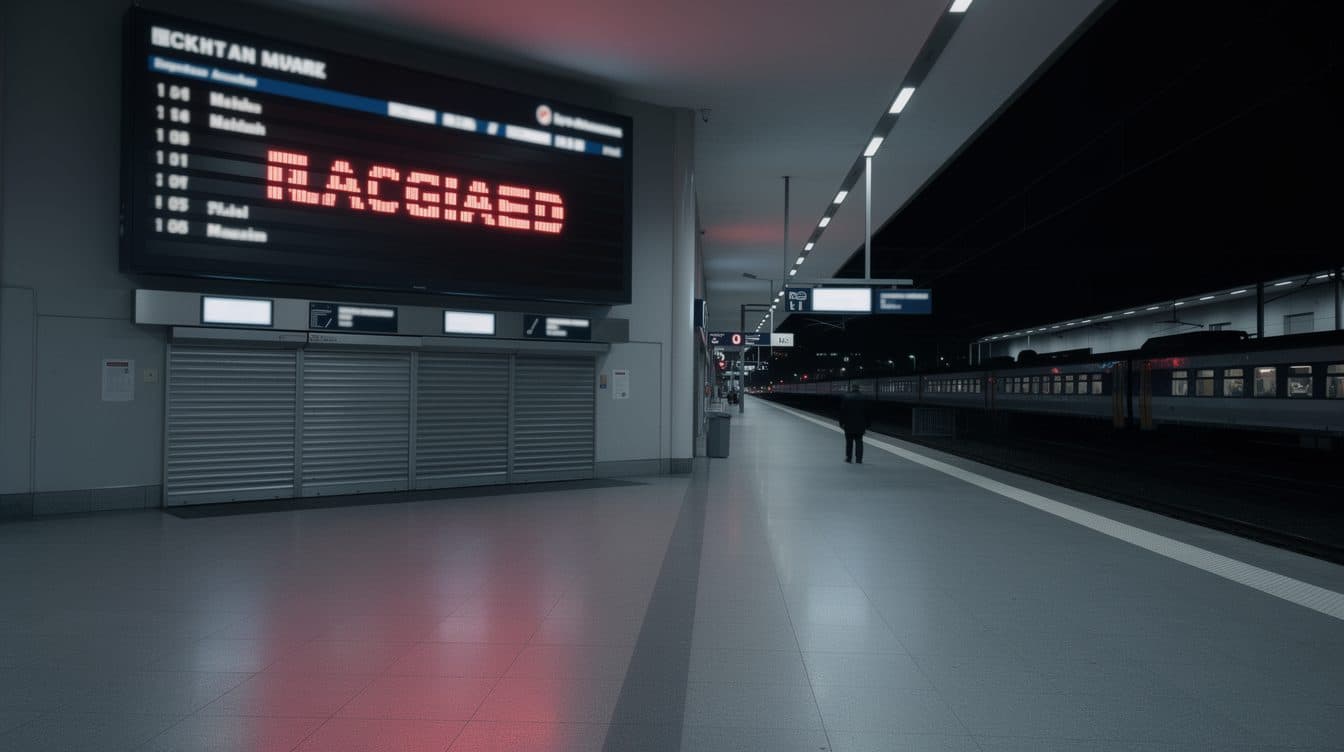
Nationwide digital train radio disruption brings rail traffic to a standstill for hours
Berlin, 25 June 2026
AI-generated image (flux-2/pro-text-to-image via Kie.ai)
Summary
A nationwide disruption of the digital train radio system GSM-R brought rail traffic in Germany to a near-complete standstill for around two hours late on Tuesday evening. Federal Transport Minister Patrick Schnieder (CDU) demanded a comprehensive investigation; in Ludwigshafen, 125 school students from Kaiserslautern were stuck overnight.
Berlin, 25 June 2026
A nationwide disruption of the digital train radio system GSM-R brought Deutsche Bahn's rail traffic to a near-complete halt for around two hours late on Tuesday evening; Federal Transport Minister Patrick Schnieder (CDU) demanded a comprehensive investigation.
Shortly after 22:30, Deutsche Bahn reported a nationwide disruption of the digital train radio GSM-R. "Wir arbeiten mit Hochdruck daran, die Störung zu beheben", the company said in a statement. Shortly afterwards, just after 23:00, all Deutsche Bahn trains across the country came to a standstill. Long-distance, regional and S-Bahn services were affected, as were trains operated by private competitors and nighttime freight traffic. Passenger trains were temporarily parked at stations.
The company cited a suspected fault in a core technical component, said to have occurred during scheduled maintenance work, as the cause. Philipp Nagl, head of the rail infrastructure subsidiary DB InfraGO, explained that planned work on the GSM-R digital radio system had caused the problems. The exact cause would be investigated "mit höchster Priorität". Bahn CEO Evelyn Palla said the situation had been stabilised with the help of an emergency system. The company ruled out a cyberattack. The Federal Office for Information Security (BSI) and Deutsche Bahn have also been in contact about the incident since Tuesday evening.
Cause and sequence of events
According to Deutsche Bahn, there are fallback levels. Before it was possible to switch to the functioning redundant radio system, however, the cause first had to be narrowed down and an IT attack ruled out. According to Nagl, it took 90 minutes to find the fault. Shortly after midnight, the problem was fixed; from around 00:30, the first trains were running again, and traffic gradually resumed. Due to the high energy demand when starting up the trains, it took further time before operations could be fully resumed.
The consequences were immediately felt at several major hub stations. "Kurz nach 23:00 Uhr standen bundesweit alle Züge der Deutschen Bahn still. Der Grund: Laut Bahn gab es eine großflächige IT-Störung", Deutsche Bahn described the sequence of events. In Stuttgart, the entire S-Bahn service was suspended. At Ludwigshafen main station, hundreds of travellers had to make an unscheduled stop in the middle of the night; for hours, no train departed from the station. Particularly affected were 125 school students from Kaiserslautern.
A teacher alerted the fire brigade at around 23:30 to provide the stranded students with drinks. Two travellers had to be cared for by the emergency services; several children suffered from dehydration and had further complaints due to the heat. Deutsche Bahn distributed taxi and hotel vouchers, but accommodation was not available everywhere. Long queues formed at information counters in many places; in some cases there was no communication about departures. Deutsche Bahn has so far been unable to put a figure on the number of passengers affected nationwide.
Impact on travellers
Travellers such as Martin Beck and Zoe Kaun reported chaotic conditions at the stations. Beck criticised Deutsche Bahn's information policy as "mangelhaft". Displays in the app sometimes continued to show trains as "fahrend" when nothing was actually moving on the platform. Kaun recounted that half an hour earlier, everything had still appeared on time online, and then suddenly all connections had failed. In Vohwinkel, the station was almost empty in the morning; one traveller only found the replacement service stop after searching online.
Deutsche Bahn had identified the GSM-R system, the "Global System for Mobile Communications – Railway", as the cause of the disruption by midday on Wednesday. The standard is used for secure communication between locomotive crews, signal boxes and control centres and is also important for systems such as ETCS. The system is more than 20 years old and is based on the older 2G mobile standard; it is not coupled to public mobile networks, which, according to the company, makes it less vulnerable to sabotage. If GSM-R fails, no emergency calls can be made – for this reason, operations were suspended for safety.
Deutsche Bahn announced that the cause of the disruption had been identified and rectified during the night. Such a disruption had "durch die hohen Sicherheitsvorkehrungen im Eisenbahnbetrieb bisher nie vorgekommen". The financial damage to the group has not yet been quantified. After the failure, experts also asked whether the railway had dispensed with a test run on a test server. It remains unclear whether the problems were related to hardware components or a possible server update.
GSM-R technology and open questions
In freight traffic, the situation remained extremely tense the morning after. Neele Wesseln, chair of the "Die Güterbahnen" association, said that around half of freight trains were still standing distributed across the country and at borders; the situation was extremely tense. "Wettbewerber im Güterverkehr berichteten von erheblichen fortbestehenden Einschränkungen", it was said. Eight night trains to or from Austria were blocked in Germany for two hours. The association assumes that logistics chains will be affected for several more days. A railway manager told Bild that the company is currently trying to source spare parts worldwide – which is proving difficult.
The incident evoked memories of previous incidents. In 2022, for example, saboteurs in northern Germany had cut cables, paralysing radio traffic for hours. At the Vohwinkel signal box, traffic between Hagen and Düsseldorf had also been almost completely interrupted for about a week. In view of the accumulation, the pressure to modernise the rail infrastructure is growing. EVG chief Burkert told NTV that too little had been invested over decades, "und es trifft natürlich auch die Technik".
Politically, the outage prompted immediate reactions. Federal Transport Minister Patrick Schnieder (CDU) demanded that the company must set up its systems in such a way that such an incident does not happen again. SPD economic politician Armand Zorn said the case shows "einmal mehr, wie verwundbar Teile der kritischen Infrastruktur sind", and called for swift, comprehensive action. Oliver Krischer (Greens), Transport Minister of North Rhine-Westphalia, spoke on WDR of a "neuen Tiefpunkt bei einer ohnehin schwachen Betriebsqualität" and said he was "fassungslos": "Aufgrund einer technischen Störung zwei Stunden lang alle Züge in Deutschland stehen, das darf eigentlich nicht passieren."
Political reactions
In the Bundestag, the incident became embroiled in an already heated debate over Stuttgart 21. Bahn CEO Palla, who appeared at the Transport Committee on Wednesday morning for a previously scheduled appointment, named 2031 as the new target year for the opening of the underground station, according to participants. The Chairman of the Supervisory Board of Deutsche Bahn, Werner Gatzer, announced that the incident would be on the agenda of that day's strategy meeting.
Passenger associations also demanded consequences. Pro Bahn called for greater resilience in train radio. "Wir erwarten von der Bahn, dass sie auch beim Zugfunk für mehr Resilienz sorgt", said the chairman of the association, Neuß, to the Rheinische Post. A software update should not lead to such a massive disruption. The Allianz pro Schiene association pointed out that Finland has already switched off GSM-R in rail traffic and is preparing the introduction of the successor system.
Tarek Al-Wazir (Greens), chairman of the Transport Committee, drew a sharp technological comparison: "GSM ist das, was man heute 2G nennen würde, und wir sind ja gerade beim Übergang von 5G auf 6G." The current system is considered reliable, but is outdated. Greens transport expert Gastel told Deutschlandfunk that a medium- to long-term alternative is needed. Train radio must ultimately function across borders; the Swiss SBB are following the same timetable as Deutsche Bahn.
Debate on modernisation and FRMCS
The successor system is called FRMCS, "Future Railway Mobile Communication System", and is based on the 5G mobile standard. It is to replace GSM-R by the mid-2030s and, according to plans, be introduced in Germany by 2035. EU approval is still pending. EU law provides that 2G technology must be switched off by 2035 at the latest, as it is outdated and prone to failure; Deutsche Telekom plans to switch off its 2G network by mid-2028, and all mobile operators in Austria are doing the same.
According to experts, the conversion is complex. For the Berlin–Hamburg route, around 280 kilometres long, 300 masts had to be newly erected and fibre-optic and power lines laid; according to Deutsche Bahn, a mast costs around 800,000 euros, and construction work took ten months. In total, according to Bild research, around 15,000 masts would have to be erected for the new technology, while the German rail network is around 33,000 kilometres long and the conversion is "umständlich ist und sie dauert". During the transition phase, old and new systems would have to run in parallel.
Consequences for freight traffic
On Wednesday morning, passenger services were running largely according to schedule again, according to Deutsche Bahn, albeit with individual follow-on delays. By the morning, the company was speaking only of occasional delays or train cancellations; traffic was gradually returning to normal.
Train radio disruption GSM-R: Schnieder demands | allfacts360