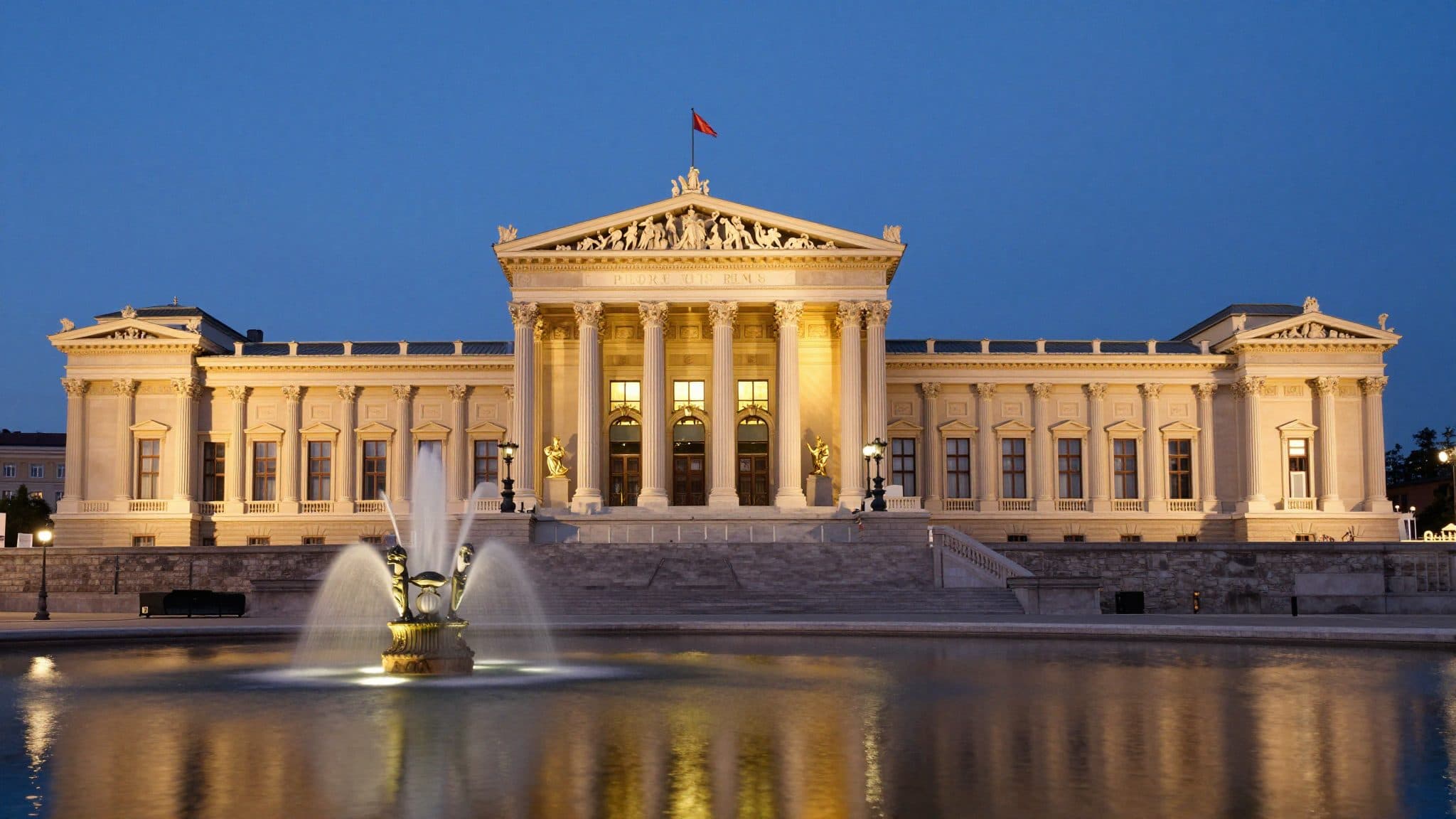
NEOS Under Pressure: Internal Conflicts over Parliamentary Discipline, Party Departures, and Accusations of Authoritarian Leadership
Vienna, July 13, 2026
AI-generated image (z-image via Kie.ai)
Summary
The NEOS are facing a series of internal conflicts: expelled MP Veit Dengler accuses party leader Beate Meinl-Reisinger of authoritarian behavior. At the same time, Wolfgang Routil is also leaving the party, while political scientists analyze parliamentary group discipline in Austria.
Vienna, July 13, 2026
The Austrian governing party NEOS is currently being shaken by a wave of internal conflicts after expelled MP Veit Dengler leveled serious accusations against party leader Beate Meinl-Reisinger in an oe24.TV interview and former Doctors' Chamber president Wolfgang Routil announced his departure from the party.
Background: The Conflict Between Dengler and the Party Leadership
The accusations are serious: Dengler, who voted against the party line in a budget vote in the National Council and had a budget chapter removed, said in the interview that Meinl-Reisinger had reacted loudly in a parliamentary group meeting and pressured him to resign. The party leader then spoke of a "Vertrauensbruch" and firmly rejected the portrayal that she leads NEOS in an "authoritarian" manner.
The trigger was a vote on the budget of the Federal Chancellery, in which party funding is anchored. Dengler took issue with the fact that the funds for party funding were to be increased by around three percent. As he explained, the state allocations to the parties – parliamentary group funding, party funding, and academies combined – are a "Bundesanteil von insgesamt 80 Millionen Euro," placing the total figure at 340 million euros. "Aber wenn man es aufsummiert, sind es 340 Millionen Euro," Dengler said in the conversation.
The events in the National Council on Friday proceeded quickly from the perspective of those involved. "Es dürfte am Freitag relativ schnell gegangen sein," according to the reporting. During the session, Dengler moved to have a budget chapter removed – "unverschämt mitten in der Sitzung," as oe24.TV put it. He ultimately did not carry out his original intention of voting against it: "Aber Sie wollten dagegenstimmen und sind dann umgefallen."
During the oe24.TV broadcast, Dengler was asked whether he now felt liberated or weighed down. The already tense relationship with the party leadership was also addressed: "Das Verhältnis war ja schon etwas gespannt, würde ich sagen, zwischen Veit Denker und der NEOS-Führung." In retrospect, Dengler said the work of the past 1.5 years had been "eher beengend" because parliament is not a "wirkliches Arbeitsparlament." The conflict culminated in his expulsion from the party.
The Budget Vote as the Trigger
The party leader herself struck back. Meinl-Reisinger complained of a "Vertrauensbruch" by Dengler and rejected his criticism. During the oe24.TV broadcast she was also confronted with questions about her leadership: "Hat Beate Meinl-Reisinger, das was Sie und der Matthias Strolz aufgebaut haben, diese Art Neos, hat Sie das ruiniert?" – to which she responded, among other things, by pointing out that Dengler's behavior had endangered the parliamentary group's ability to act. The proceedings left what the newspaper called a "katastrophale Außenwirkung," as the reporting continued.
Dengler, in turn, picked up on the criticism of NEOS's participation in government and declared: "Vor 14 Jahren haben wir das aus der Taufe gehoben" – referring to the NEOS movement, which he had helped co-found. When asked whether he had been in favor of NEOS joining the government with the ÖVP and SPÖ, he answered evasively; the current development had "wahrscheinlich noch ihre schlimmsten Befürchtungen übertroffen."
The incidents have triggered a fundamental debate about parliamentary group discipline and the free mandate in Austria. Political scientist Laurenz Ennser-Jedenastik, professor of Austrian politics at the University of Vienna, told STANDARD that he could understand MPs from the same parties voting in unison: "Leute aus ähnlichen ideologischen Lagern sehen die Dinge auf der Welt ähnlich." At the same time, he warned against an exaggerated picture of "Klubzwang": "Denn dass einzelne Abgeordnete dagegen stimmen, gefährdet dank der komfortablen Mehrheit nicht per se die Regierung." In summary, "der sogenannte Klubzwang einen viel schlechteren Ruf, als ihm eigentlich gerecht wird," Ennser-Jedenastik says.
Political Scientists on Parliamentary Discipline in Austria
The political scientist also emphasizes the structural incentives for parliamentary group discipline: "Es gibt wenige starke Anreize für Abgeordnete, dass man abweicht." After all, to obtain a parliamentary seat one must be placed on a candidate list for an election by a party – "weit oben." For this reason as well: "Das bedeutet ja nicht, dass Abgeordnete sich nicht koordinieren oder sanft absprechen können." In a parliament with 183 members, some form of coordination is needed: "Wenn da alle als Individuen agieren würden, würde gar nichts passieren."
Michael Imre of the Institute for Political Science at the University of Vienna, whose research includes governments, shares this assessment. He asks: "Wie soll man ein Koalitionsabkommen umsetzen, wenn man nicht damit rechnen kann, dass alle mitstimmen?" A high degree of discipline among MPs – that is, as uniform a voting pattern as possible – leads "zu einer höheren Stabilität von Koalitionen," he tells STANDARD. However, parliamentary group discipline, as he calls it, is more pronounced in Austria than in other European countries.
Both experts point to the logic of the party system: "Bis auf ein paar pazifische Inselstaaten gibt es eigentlich keine demokratischen Systeme ohne Parteien." Parties risked a "gewissen Reputationsverlust" if they did not abide by agreements. "Die Verhandlungsmacht von Regierungsparteien seien die Stimmen ihrer Abgeordneten im Parlament," says Ennser-Jedenastik: "Und wenn ich mir nicht sicher sein kann, ob die Stimmen wirklich da sind, bin ich nicht Pakt-fähig." A basic consensus exists: "Es kann nur effizient agiert werden, wenn die Leute miteinander agieren."
NEOS thus faces a twofold problem: internally, they had to resolve the conflict with Dengler; externally, they must maintain the image of a reliable governing party. In the concrete case, a single dissenter could not have brought down the coalition with the ÖVP and SPÖ – the majority is comfortable. But the outward signal that an MP votes against the party line is considered politically precarious. "Für eine Partei ist das das Schlimmste, was passieren kann," according to the reporting.
Wolfgang Routil Leaves the Party
"In Österreich würde das wohl immer zu einem Regierungsbruch führen," Ennser-Jedenastik says with a view to a scenario of larger disciplinary breaches. In other countries such as Denmark, people are "schmerzbefreiter." The question is whether the coalition partners, the ÖVP and SPÖ, would publicly denounce Dengler's behavior: "Die Frage ist aber, ob sie das riskieren wollen." After all, one does not want to unnecessarily damage the negotiating partner who is needed for one's own majority.
Scholars also point to a remarkable peculiarity of NEOS: only NEOS have explicitly written the principle of parliamentary group discipline into their party statutes. All other parties rely on the fact that National Council members are "bei der Ausübung dieses Berufes an keinen Auftrag gebunden" – which raises the question of why precisely the party that most strongly emphasizes the free mandate is now expelling a member who exercised exactly that right. "Nicht bei den Neos, die das explizit in ihre Parteisatzung geschrieben haben, nicht bei den anderen Parteien, die sich darauf berufen, dass Nationalratsabgeordnete „bei der Ausübung dieses Berufes an keinen Auftrag gebunden" sind."
The second prominent departure came from Wolfgang Routil. As the "Kleine Zeitung" reports, the former president of the Styrian Doctors' Chamber, who had joined NEOS in 2024, announced his withdrawal in a letter to the party. NEOS thus loses two prominent members within a short period of time. Routil had previously described NEOS's handling of important future issues as "verantwortungslos für eine Regierungspartei" – under the title "Neos im Club der Altparteien" he formulated his criticism.
Observers see this as a confirmation for those who were already skeptical of NEOS's participation in government. Dengler's statements – "Es ist mein Baby, seit 2011 hat es mich sehr, sehr viel beschäftigt" – also show the personal dimension of the conflict: the co-founder of the NEOS movement sees his life's work endangered by the current course. The question of whether the party can politically contain the conflict remains open.
Parliamentary Discipline in Comparison: Austria and Europe
Political science research suggests that coalitions with detailed "Spielregeln" about how they work together also last longer, according to the STANDARD interview. These "Spielregeln" have now been put to the test by the Dengler case – with consequences beyond NEOS as well. For the behavior of a single MP could – "die Frage ist aber, ob sie das riskieren wollen" – also put the coalition partners under
NEOS Crisis: Meinl-Reisinger Pushes Back Against Dengler's | allfacts360