Norway's Football World Cup Sparks National Euphoria and Overshadows Political Scandals
Oslo, July 10, 2026
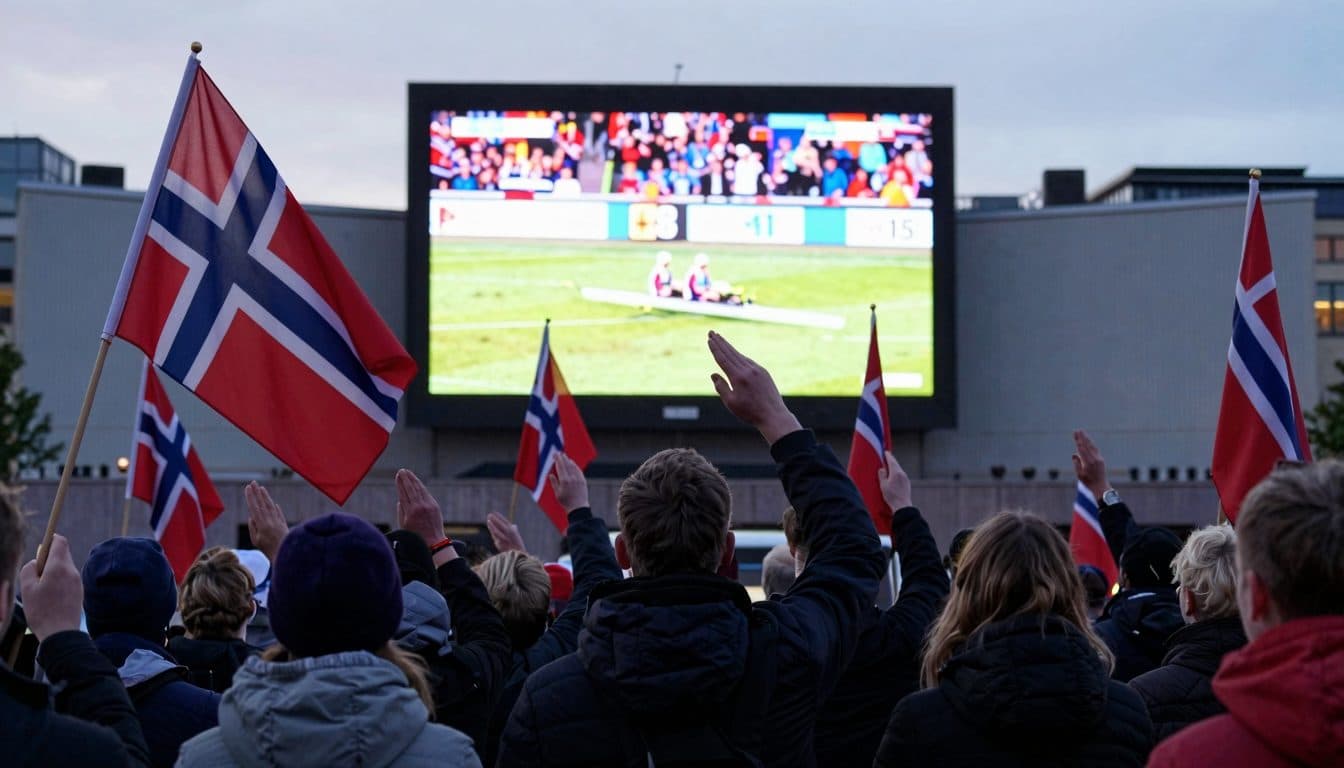
AI-generated image (z-image via Kie.ai)
Summary
After months of political crises, Norway is experiencing a wave of national enthusiasm thanks to the success of its national football team at the World Cup. Across the country, public celebrations are being hastily organized, tickets for public viewing events are selling out within seconds, and even special flights to Miami are being launched.
Oslo, July 10, 2026
After months of political scandals, Norway is experiencing a wave of national euphoria through the success of its national football team at the ongoing World Cup, a wave that has swept the country all the way to the quarterfinal against England.
A Country in Rowing Fever
For weeks, Norwegian football fans have been belting out "Ro! Ro! Ro!" and "rowing" on dry land for their team — in parliament, in kindergartens, and at festivals. The celebratory ritual has become a nationwide phenomenon. A spokesperson for the transport operator explained: "Die wenigsten von uns können schließlich nach Hause rudern."
The emotional turning point was marked by the victory against Brazil. Oslo-based media scholar Gunn Enli sees more than just a sporting success in it: "Der Sieg über Brasilien ist ein Sieg für die norwegische Sozialdemokratie, und er überlagert alle Schwierigkeiten des Königshauses." The team's success offers the country a unifying symbol in turbulent times.
The contrast with political reality could hardly be greater. Earlier this year, the US Department of Justice released more than three million documents from the Epstein files, triggering a political earthquake in Norway. The population reacted in horror, and the royal family offered no distraction either: In June, Marius Borg Høiby, son of the Crown Princess, was sentenced to four years in prison following serious allegations of violence.
Public Festivals and Sold-Out Public Viewings
In Oslo and other cities, public festivals are now being hastily organized to celebrate the World Cup run. At Frogner Stadium, 22,000 tickets for the live broadcast of the quarterfinal sold out in less than 30 seconds. Kim Frydenberg, head of the event, told Norwegian broadcaster NRK: "So etwas haben wir hier noch nie erlebt." Many municipal employees even cut short their summer holidays for it.
Oslo has announced a "großes Volksfest" for the match against England. City councilor Mehmet Kaan Inan for culture, sports, and business announced the celebration on Monday on Facebook. He told the daily newspaper "VG": "Viele derjenigen, die das alles möglich machen, waren im Urlaub." In other locations as well, residents are to gather in blue-white-red national pride.
The enthusiasm extends far beyond the capital. The airline Norse has announced several special flights from Oslo to Miami ahead of the quarterfinal to meet the enormous demand. Thor Stenhaug, a Norwegian who normally lives in London, traveled home especially for the match and told Norwegian broadcasting: "Sonst hätte es sich angefühlt, als wären alle bei einer Geburtstagsparty ohne dich."
National Identity Between Humor and Pathos
Enli places the events in a larger context. "Sportereignisse handeln nie nur von Sport, sondern davon, wie eine Nation in der Öffentlichkeit auftritt und wahrgenommen wird", she explained. In times of political or cultural uncertainty, major sporting events can acquire a different symbolic meaning than in more stable times.
Humor is not short-changed either. Norwegian football fans are once again chanting: "Wenn wir wollen, können wir ganz Schweden kaufen." The song, which celebrates the humorous rivalry with neighboring Sweden, is a hit among football enthusiasts and high school graduates. Given Norway's sovereign wealth fund of more than 200 billion, the lyrics are not even far-fetched.
The team's togetherness evokes memories of a famous political legacy. More than 30 years ago, then-Prime Minister Gro Harlem Brundtland declared: "Es ist typisch norwegisch, gut zu sein." While the women have already won everything in international football, that was long not the case for the men — making the current success all the more intensely celebrated.
More Than a Game
Enli sees an expression of Norwegian self-understanding in the team's performance. "Die Mannschaftsleistung bei der Weltmeisterschaft stärkt den Glauben an ein kollektives und gemeinschaftsorientiertes Norwegen", she said. "Es wird viel darüber gesprochen, dass es um das Team geht, dass alle wichtig sind, dass sie zusammenstehen, dass alle gleich wichtig sind."
The national anthem, which begins with the words "Ja, wir lieben dieses Land", carries a special resonance these days. "Der Fußball hat uns stolz gemacht, Norweger zu sein", Enli summarizes the mood. What began as a major sporting event has become a societal moment in which the country renegotiates its understanding of itself.
With the quarterfinal against England, the next highlight is now on the horizon. For Enli, one thing is clear: "Sie werden dann nicht mehr nur als Sport wahrgenommen, sondern als Arenen, auf denen Vorstellungen von Nation, Gemeinschaft und Identität verhandelt und inszeniert werden." Norway is looking ahead to the match with anticipation — and to the continuation of a collective euphoria that extends far beyond football.
Questions & Answers
Why is the Norwegian royal family currently struggling with scandals?
Earlier this year, the release of more than three million documents from the Epstein files by the US Department of Justice triggered a political earthquake. In addition, Marius Borg Høiby, son of the Crown Princess, was sentenced to four years in prison in June following serious allegations of violence.
How is the World Cup euphoria specifically manifesting in Norway?
At Oslo's Frogner Stadium, 22,000 tickets for the public viewing broadcast sold out in less than 30 seconds, public festivals are being organized across the country, and the airline Norse has announced special flights from Oslo to Miami.
What does Oslo-based media scholar Gunn Enli say about the significance of the tournament?
Enli sees the team's successes as a collective symbol that, in politically uncertain times, strengthens belief in a community-oriented Norway and overshadows all societal difficulties.
Norway Football World Cup Euphoria: Scandals Overshadowed | allfacts360