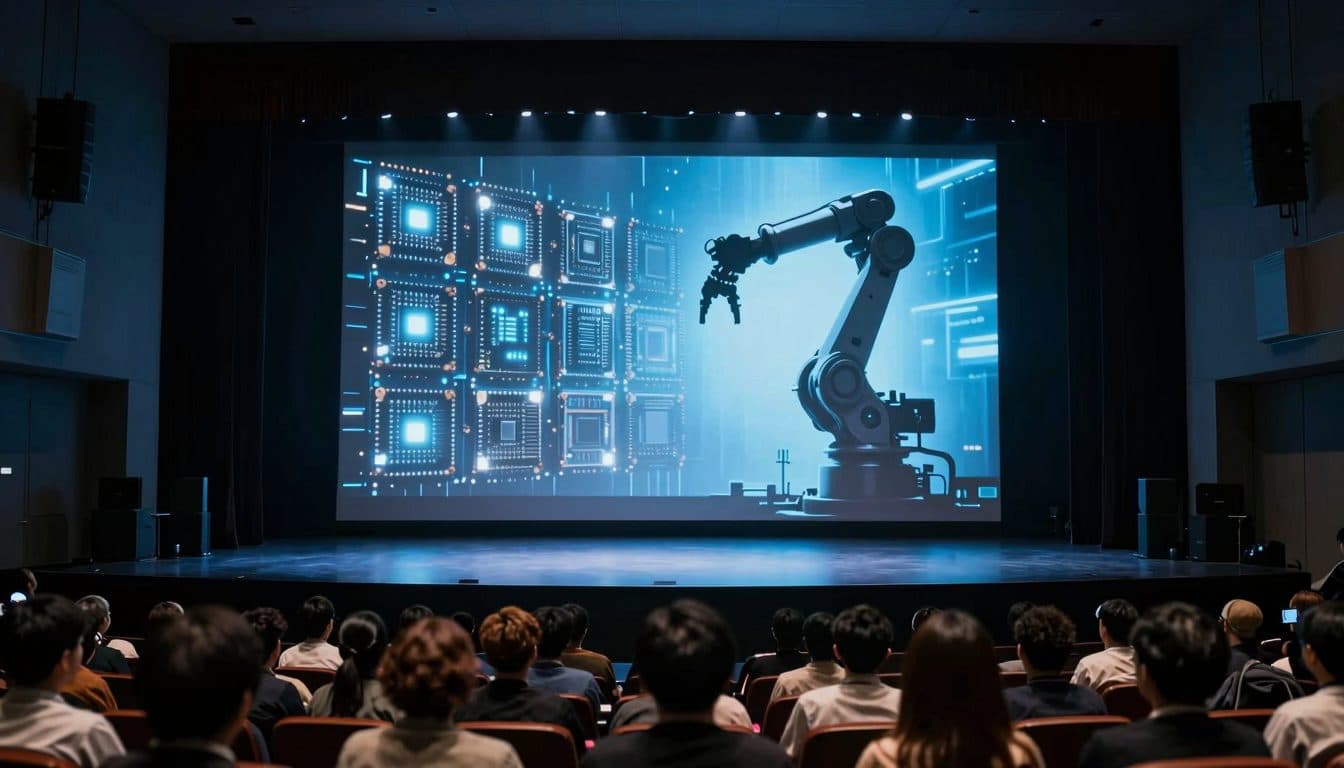
NVIDIA Forges Robotics Alliance in Japan and Builds AI Factory with 27,500 Rubin GPUs
Tokyo, July 16, 2026
AI-generated image (z-image via Kie.ai)
Summary
NVIDIA chief Jensen Huang announced in Tokyo a comprehensive cooperation with Japanese robot manufacturers and at the same time presented the construction of a Vera Rubin AI factory for the state-run METI project FRONTia. With the alliance, Fanuc, Yaskawa Electric, Fujitsu, and Kawasaki Heavy Industries intend to use NVIDIA's Cosmos, Isaac, and Omniverse platforms for industrial robots and thus compete with China.
Tokyo, July 16, 2026
NVIDIA CEO Jensen Huang announced on Thursday in Tokyo a far-reaching cooperation with the Japanese robotics groups Fanuc and Yaskawa Electric and at the same time announced the construction of an AI factory based on the new Vera Rubin processor generation with 27,500 GPUs.
At an AI event organized by the Japanese government, Huang announced that NVIDIA would in future work closely with the mechanical engineering companies Fanuc and Yaskawa Electric as well as with Fujitsu and Kawasaki Heavy Industries. The goal is to develop artificial intelligence for industrial robots and thus safeguard the global competitiveness of Japanese manufacturers. The alliance ties into a global robotics coalition already presented at the GTC conference in March 2026.
As an NVIDIA release from Wednesday shows, Fujitsu is building, together with Fanuc, Yaskawa Electric, and Kawasaki Heavy Industries, a shared control platform for industrial robots. It is based on the NVIDIA technologies Cosmos, Isaac, and Omniverse, which are used for digital twins and simulations. The aim is to virtualize production processes and optimize them with AI support.
Vera Rubin AI Factory for METI Project FRONTia
The day after the robotics alliance, NVIDIA also announced the construction of a Vera Rubin generation AI factory with the Japanese company Noetra Corp. The facility is to be equipped with 27,500 Rubin GPUs and a capacity of 140 megawatts of computing power to serve the state-run METI project FRONTia. Among the owners of Noetra are the Japanese state and the electronics group Sony.
Huang also used his appearance in Tokyo to warn against Japan falling behind in the area of so-called Physical AI. Japan, once the cradle of modern manufacturing, must now set the course to play a leading role in the next industrial revolution as well. In his words: 'Jetzt baut das Land die KI-Fabriken, die die nächste industrielle Revolution antreiben werden'. Japan is a stronghold of industrial robotics, while Chinese providers are rapidly catching up in terms of unit numbers and software.
Symbolic Appearances and Pop-Star-Like Reception
Huang was accompanied, among others, by Japanese Economy Minister Ryosei Akazawa, who, like the NVIDIA CEO, was dressed in a black leather jacket. Huang joked with Akazawa: 'Ich bin froh, dass wir einen ähnlichen Geschmack haben'. On the role of AI in robotics he said: 'Dank KI werden Roboter intelligent, anpassungsfähig und problemlos einsetzbar' and further: 'Mit KI werden Roboter intelligent, leicht anpassbar und zugänglich'.
On the previous evening, according to reports, Huang had attended an event by an entertainment company in Tokyo's electronics district Akihabara and had been received by onlookers like a star. In his native Taiwan and in many other Asian states, Huang is regarded as a pop-star-like figure, underscoring the cultural backdrop of the Japan tour.
Markets and Competitive Situation
Markets reacted cautiously: in pre-market trading on the day of the announcement, the NVIDIA stock was down 1.35 percent at $209.63, after the previous day's closing price on the NASDAQ had still been $212.50, up 0.33 percent. The robotics news was also accompanied by positive signals from the semiconductor sector: ASML had raised its revenue forecast on Wednesday and announced a capacity expansion; TSMC is, according to reports, heading for a fifth record quarter in a row.
Japan's Robotics Strategy Through 2040
However, observers urge sobriety. Most of the Japanese groups mentioned have so far only declared their intention to join the coalition. Concrete series products are still pending. In addition, Japanese manufacturers are competing directly with Chinese robotics firms, which in recent years have caught up significantly both in unit numbers and in software solutions. Bloomberg accordingly classified the cooperation as an attempt to position Japanese manufacturers in international competition against China.
The Japanese government itself is pursuing the goal of reaching a global market share of more than 30 percent in the area of AI robotics by 2040, as a robotics strategy presented in March 2026 shows. The partnerships with NVIDIA now announced, along with the construction of the Vera Rubin AI factory, are intended to form a central building block of this strategy and at the same time safeguard the country's industrial sovereignty.
Overall, a deepening of the technology-policy axis between the USA and Japan is emerging, with NVIDIA acting as the central hardware and platform partner. Should the planned AI factories go into operation as announced and the control platforms go into series production, Japan could get a second chance in the area of Physical AI to translate its historical strength in manufacturing into the AI age.
Questions & Answers
Welche japanischen Unternehmen arbeiten mit NVIDIA zusammen?
NVIDIA kooperiert nach eigenen Angaben mit den Robotik-Konzernen Fanuc, Yaskawa Electric, Fujitsu und Kawasaki Heavy Industries. Fujitsu baut gemeinsam mit den Partnern eine Steuerungsplattform auf Basis von Cosmos, Isaac und Omniverse.
Was ist die Vera-Rubin-KI-Fabrik in Japan?
NVIDIA und Noetra Corp. bauen in Japan eine KI-Fabrik auf Basis der Vera-Rubin-Prozessorgeneration mit 27.500 Rubin-GPUs und 140 Megawatt Kapazität. Sie soll Rechenleistung für das staatliche METI-Projekt FRONTia liefern.
Welches Ziel verfolgt Japan mit seiner Robotik-Strategie?
Die im März 2026 vorgestellte Robotik-Strategie der japanischen Regierung zielt darauf ab, bis 2040 einen weltweiten Marktanteil von mehr als 30 Prozent im Bereich KI-Robotik zu erreichen und im Wettbewerb mit China zu bestehen.
NVIDIA Japan: AI Factory with 27,500 Rubin GPUs and | allfacts360