
Surabaya, 02 August 2026
A passenger ferry caught fire off the coast of East Java on Sunday, killing at least five people and leaving dozens unaccounted for, according to Indonesia's National Search and Rescue Agency.
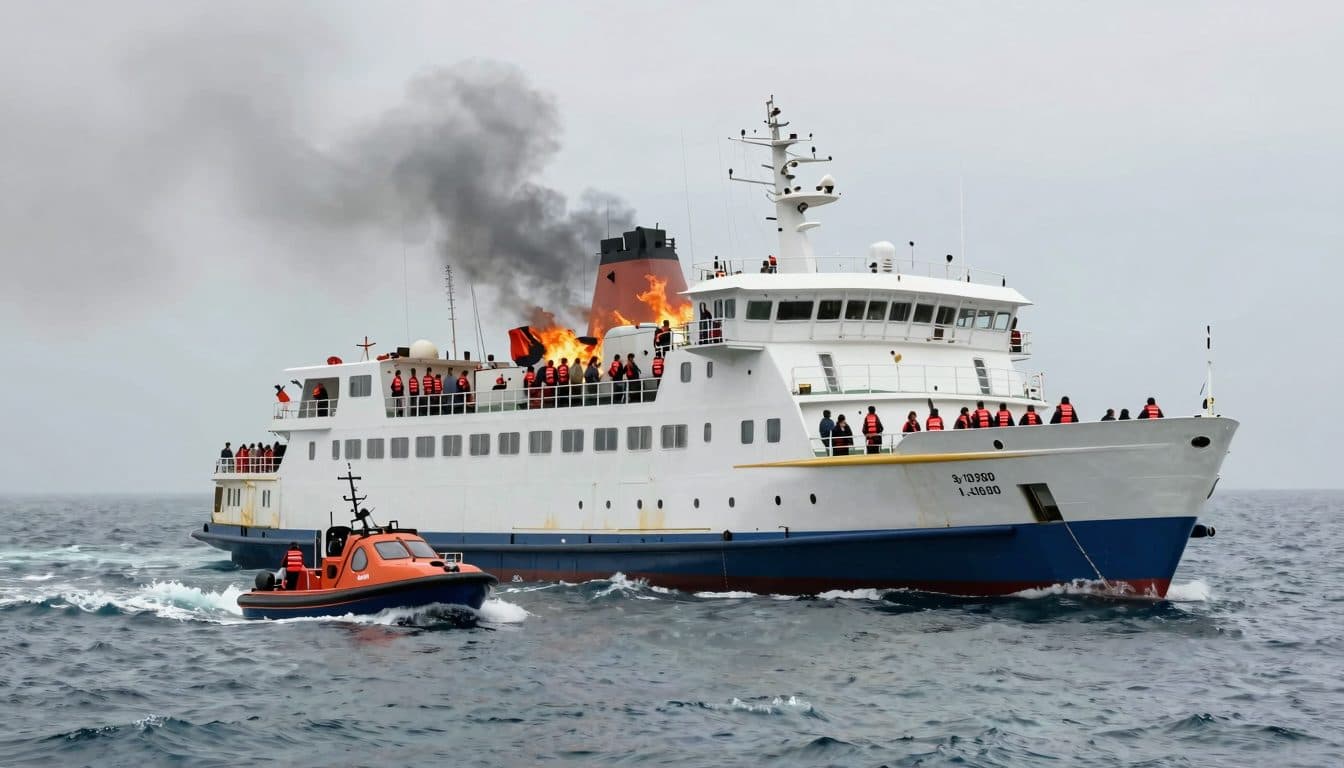
The vessel went ablaze while carrying passengers between ports in East Java, prompting a major rescue operation coordinated by the National Search and Rescue Agency, known locally as Basarna, from its base in Surabaya. Survivors gathered on the upper decks as orange flames and thick black smoke rose from the lower sections of the ship, in scenes captured on widely shared mobile phone footage.
Videos circulating on social media and messaging apps showed terrified passengers, mostly wearing life jackets, clustered on the deck and upper sections of the vessel awaiting rescue. Some passengers jumped into the sea as the fire spread, while rescue boats approached through smoke and waves to pull people from the water.
Rescue operation under way
Five people have been confirmed dead, and dozens remain missing, according to the rescue agency. The agency did not provide an exact figure for the missing in its initial updates, citing the need to verify passenger manifests and survivor accounts before releasing a final toll.
Rescue vessels and fishing boats from nearby ports diverted toward the burning ferry as the operation got underway. The agency said weather conditions and the open-water location of the blaze were complicating efforts to account for everyone on board.
Indonesian authorities have not yet released the name of the ferry operator or the vessel involved, nor have they said what may have caused the fire. Maritime accidents involving passenger ferries are a recurring concern in Indonesia, an archipelago of more than 17,000 islands where sea transport is a vital link between regions but where safety oversight has long been criticized as inconsistent.
Indonesia's history of ferry disasters
Relatives of passengers gathered at ports in East Java as news of the disaster reached shore, waiting for confirmation of who had been rescued and who was still missing. Local officials set up information points for families and began coordinating with hospitals that had received the injured.
The rescue agency said the search would continue through the night and into the following days, with additional vessels and aircraft being deployed to widen the sweep. Survivors were being transported to hospitals on the Java coast for treatment of burns and injuries sustained while entering the water.
Investigation and next steps
Indonesia's transport ministry signaled that an investigation into the cause of the fire would be opened once the search phase concluded, a standard step following major maritime incidents. Officials did not give a timeline for that inquiry.
The disaster occurred against the backdrop of routine ferry traffic between East Java and islands further east, including in South Sulawesi province, where crossings are common for trade and family travel. The scale of the rescue response reflects the volume of passengers typically aboard such vessels.
Indonesia sits on major shipping lanes and across an arc of volcanic islands, but its domestic ferry network has repeatedly drawn scrutiny after past disasters, including a 2018 lake sinking that killed more than 150 people and earlier vessel fires that prompted safety overhauls.