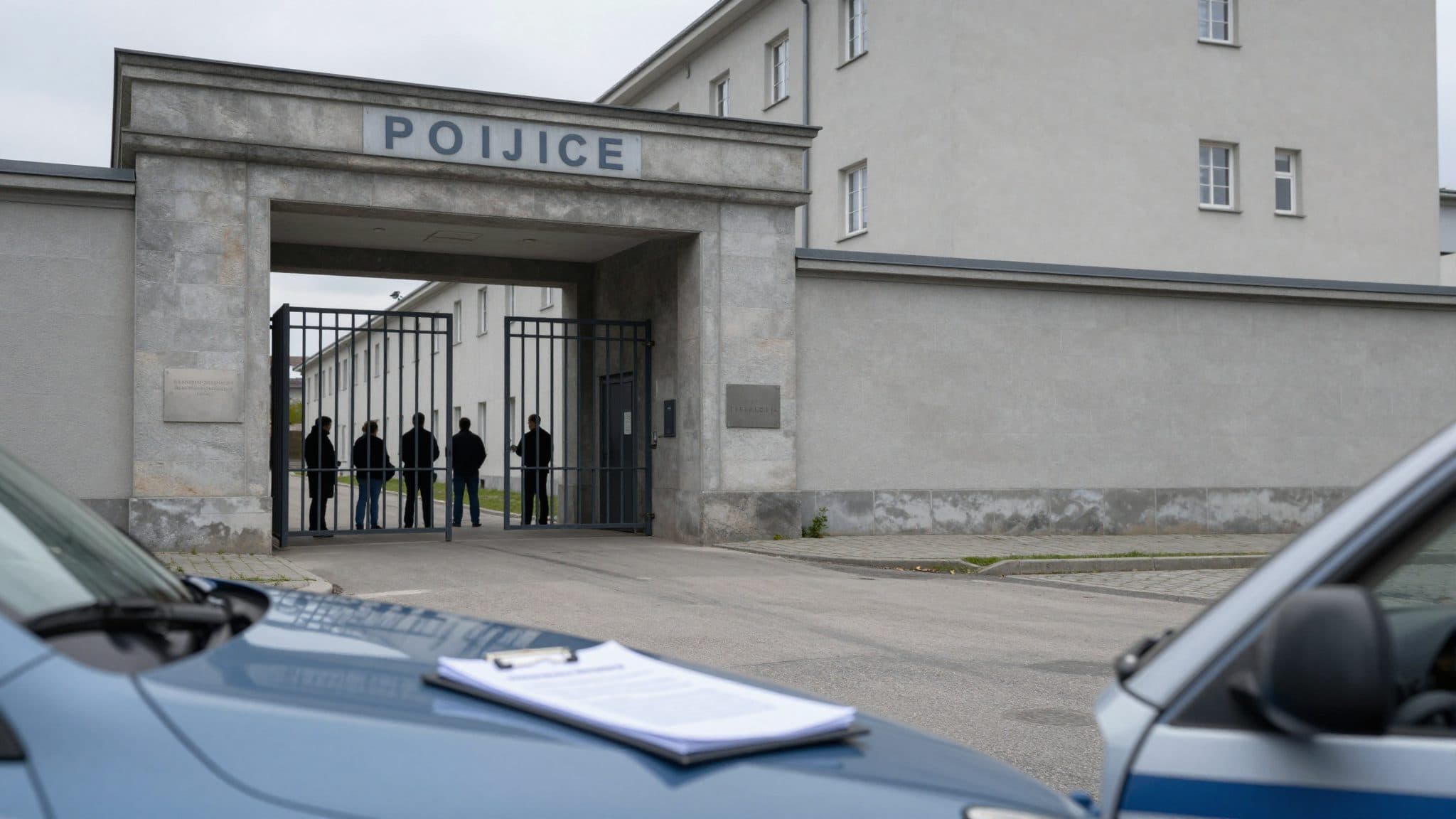
Prosecutors investigate death of 50-year-old prisoner in Vienna's Josefstadt jail
Vienna, 11 July 2026
AI-generated image (z-image via Kie.ai)
Summary
Prosecutors in Korneuburg are investigating the death of a 50-year-old Irish national who died in Vienna's Josefstadt prison in August 2025 after a suspected medication overdose. A forensic report points to systemic shortcomings in the chain of care during his transfer from Salzburg.
Vienna, 11 July 2026
Prosecutors in Korneuburg are investigating the death of a 50-year-old Irish prisoner who died in Vienna's Josefstadt correctional facility in August 2025 after a suspected quetiapine overdose, with a forensic expert citing a non-optimal chain of care during his transfer from Salzburg.
Scope of the investigation
The Korneuburg public prosecutor's office confirmed on Friday that it is conducting a wide-ranging investigation into the death of the man, an Irish citizen and father of a four-year-old daughter who had most recently been registered at an address in Salzburg. According to spokesperson statements reported by the APA news agency, the probe is examining whether any officials can be charged with negligent homicide or other offences. "Im Zusammenhang mit dem Ableben des Mannes wird demnach 'umfassend und in alle Richtungen ermittelt'," prosecutor Josef Mechtler said, adding: "Es wird überprüft, ob jemandem ein Fehlverhalten vorgeworfen werden muss."
The investigation is not limited to staff at the Josefstadt facility itself. "Die Ermittlungen richten sich nicht nur gegen Beamte der JA Josefstadt, 'sondern den gesamten, mit dem Sachverhalt befasst gewesenen Personenkreis'," Mechtler explained. A spokesperson for the prosecutor's office told APA on Friday midday that "ein amtswegiges Prüfverfahren" was underway, meaning the case was opened on the authorities' own initiative rather than following a complaint.
Transfer from Salzburg
The 50-year-old had been taken into custody in mid-February 2025 and subsequently remanded in pretrial detention. According to the file, he was transported to Vienna in a wheelchair and placed in the vehicle after refusing to stand, where he was strapped in. During the journey, the forensic expert concluded, "schon kurze Zeit nach Fahrtantritt aus Salzburg 'Symptome einer Quetiapinintoxikation vorlagen'." Quetiapine is a powerful antidepressant. The man reportedly moved "ruckartig nach vorn" repeatedly during the transfer, as if trying "aus dem Rollstuhl zu rutschen," according to a protocol.
After arriving at the Josefstadt facility, the prisoner repeatedly let himself fall to the floor, according to the account given by the judicial guard service, but remained "ansprechbar," or responsive. In his cell, the man again "fallen gelassen," after which his condition "verschlechtert" suddenly. He was unresponsive from 19:00 until 07:00 the following morning and was not transferred to an external clinic.
Findings of the forensic report
The forensic report, which APA said it had obtained, found that "fassbare Anhaltspunkte für andere dem Tod vorangegangene grobe mechanische Gewalteinwirkungen oder Misshandlungen waren nicht zu eruieren" — in other words, there were no discernible indications of gross mechanical violence or mistreatment preceding the death. The emergency response inside the Josefstadt facility was described by the forensic doctor as "sachgerecht," or professionally appropriate.
However, the expert identified what he termed "eine nicht optimale Versorgungskette" — a non-optimal chain of care. The report argues that "eine unverzügliche Beiziehung ärztlicher Hilfe bei merkbarer Benommenheit" would have been advisable during the transfer, as would "eine längere klinische Beobachtung" at a hospital in Lower Austria and "eine umgehende psychiatrische Vorstellung beim Verdacht auf eine suizidale Medikamentenintoxikation."
The expert also noted that "in jedem Fall hätte 'eine rechtzeitige Ankündigung' des Transports in die JA Josefstadt 'entsprechende personelle bzw. organisatorische Vorkehrungen' möglich gemacht," and pointed to shortcomings in "Kommunikation zwischen den beteiligten Organisationen und Personen." It remains unclear how the prisoner came into possession of the large quantity of tablets at the Salzburg facility.
Limits of criminal liability
According to the forensic report, the certainty required for criminal proceedings cannot be established on one key question. "Mit der für ein Strafverfahren erforderlichen Sicherheit könne aber nicht gesagt werden, 'ob der kritische Zustand für die Beamten erkennbar war (...) und ob der Tod des Mannes (...) mit an Sicherheit grenzender Wahrscheinlichkeit verhindert hätte werden können'," the report states.
Political and institutional response
The case has drawn political attention after Justice Minister Anna Sporrer of the SPÖ appointed a commission of inquiry that earlier this week identified systemic shortcomings in the Austrian prison system and called for substantial reform. The ministry said on Friday afternoon that "zum konkreten Fall können wir aufgrund des laufenden Ermittlungsverfahrens derzeit keine näheren Angaben machen," but confirmed that "eine umfassende interne Prüfung des Vorfalls sei im Gang" and that its outcome would also depend on the criminal investigation. The Austrian People's Ombudsman (Volksanwaltschaft) is aware of the case.
The prisoner had collapsed at Vienna Airport after the transfer from Salzburg. Officers from the Hirtenberg facility, who had been guarding him at his bedside, said he had woken around 11:00 and behaved "unruhig, unkooperativ und aggressiv," according to the file. He was then transported onward to the Josefstadt facility, where he died in August 2025 of the medication poisoning.
The investigation now extends to all individuals and institutions that had contact with the prisoner during the chain of events leading to his death. Prosecutors are reviewing whether the failure to seek timely medical assistance, the decision not to transfer him to an external hospital, and the broader coordination between the Salzburg, Hirtenberg and Josefstadt facilities amounted to criminal negligence.
The forensic findings stop short of attributing blame to individual officers. The expert explicitly stated that the emergency care provided inside the Josefstadt facility was professionally appropriate, and that there was no evidence of physical violence or abuse. The criticism is directed at systemic and procedural shortcomings rather than at any single act of misconduct.
Support services
Mental-health support services in Austria have been highlighted in coverage of the case. The Telefonseelsorge crisis line is reachable around the clock free of charge at 142, the Ö3-Kummernummer is available anonymously at 116 123 between 16:00 and 24:00 daily, and the Rat auf Draht youth hotline can be reached anonymously and free of charge at 147. Further contact details for support organisations are listed at www.suizid-praevention.gv.at.
The Korneuburg prosecutors have not yet set a timetable for completing the investigation. The internal review by the Justice Ministry is also ongoing, and its conclusions will be tied to the outcome of the criminal probe. The case is likely to feed into the broader reform debate triggered by the Sporrer commission's findings on systemic deficiencies in Austrian prisons.
Questions & Answers
Who is Josef Mechtler?
Josef Mechtler is the prosecutor speaking for the Korneuburg public prosecutor's office, which is leading the investigation into the prisoner's death. He confirmed that the probe is examining whether any officials can be charged with negligent homicide.
Why did the prisoner die in Vienna's Josefstadt jail?
According to a forensic report obtained by APA, the 50-year-old died in August 2025 of a quetiapine intoxication. The expert identified a non-optimal chain of care during his transfer from Salzburg but found no evidence of physical violence or mistreatment.
What reform measures are being discussed after this case?
Justice Minister Anna Sporrer appointed a commission of inquiry that earlier this week identified systemic shortcomings in Austrian prisons and called for substantial reform. The ministry has also launched an internal review of the incident, whose outcome depends on the criminal investigation.