Report: Trump considering expanding US attacks on Iran — Jordan comes into focus
Washington/Tehran, July 20, 2026
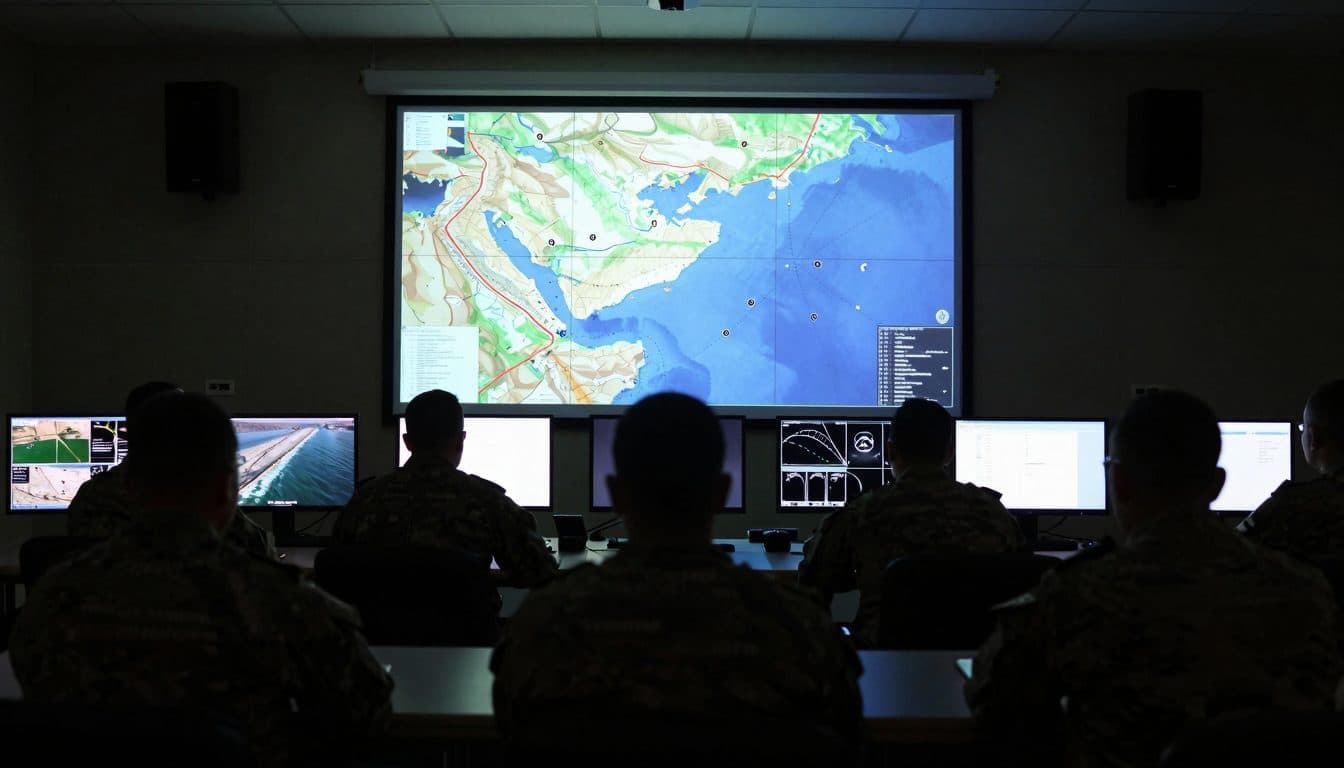
AI-generated image (z-image via Kie.ai)
Summary
According to a report by the "Wall Street Journal," US President Donald Trump is leaning toward further expanding military operations against Iran. Meanwhile, Iran is increasingly shifting retaliatory strikes to Jordan, where around 4,000 US soldiers are stationed.
Washington/Tehran, July 20, 2026
According to a report by the "Wall Street Journal," US President Donald Trump is leaning toward further expanding military operations against Iran, while the US is already carrying out airstrikes on Iranian targets for the tenth night in a row and Iran is increasingly extending its retaliation to Jordan.
The attacks began on Monday at 4:00 p.m. US Eastern Time (10:00 p.m. German time), as the responsible US regional command Centcom announced on the platform X. State-run Iranian media reported explosions in, among other places, the port city of Bandar Abbas as well as in Isfahan and Chabahar. The goal is to further weaken Iran's military capabilities in order to be able to attack merchant ships in the Strait of Hormuz. In addition, Tehran is to be forced to reopen the strait.
According to Centcom, Iranian facilities for air defense and coastal surveillance, missile and drone launch ramps, as well as communications networks were targeted. In the vicinity of the Bushehr nuclear power plant, air defense systems were said to have been activated. Nothing is yet known about possible damage resulting from the attacks.
Targets of the US attacks: Air defense, missiles, and the strait
Iran speaks on its side of 50 dead so far and more than 500 injured. The Iranian currency has already lost 96 percent of its value before the war. President Pezeshkian said on Monday, after the ninth night in a row of heavy US airstrikes: "Die Realität ist, dass die Islamische Republik Iran heute einem totalen Krieg gegenübersteht." President Pezeshkian had previously declared that his country was in a "vollumfänglichen Krieg" with the United States.
The Strait of Hormuz, through which 20 percent of global oil and liquefied gas trade was handled before the military campaign, has been de facto closed for days. "Kein Tropfen Öl und (Flüssig-)Gas" should pass through the strait as long as US aggression in the region continues, it was said from Tehran. The Revolutionary Guards announced that two tankers had "explodiert" while attempting to pass the strait and were subsequently seized. The British maritime security organization UKMTO also reported a cargo ship that caught fire after being hit by a "Projektil."
Iran threatens "totem Krieg"
The 50-year-old Foreign Ministry spokesperson Esmaïl Baghaï defended Tehran's actions with the words: "Wir dürfen nicht zulassen, dass diese Wasserstraße erneut zweckentfremdet wird, um die Sicherheit und die nationalen Interessen Irans zu bedrohen."
US President Donald Trump stated that the latest strikes had been carried out "zu Ehren" of the American soldiers recently killed. Trump described the latest wave of attacks as retaliation for the death of two US soldiers last Friday, bringing the American casualty toll since the start of the new Iran war at the end of February to 17. After the soccer World Cup final, Trump said: "Wir habe sie wieder sehr hart getroffen, militärisch haben sie fast alles verloren."
Trump wants to expand operations according to WSJ
According to the "Wall Street Journal," Donald Trump is leaning toward further expanding operations against Iran. To this end, the WSJ continues, the US would deploy F-16 fighter jets from Germany to the Middle East, and F-35 jets from Great Britain as well. Tanker aircraft are also already on their way to the crisis region, the "New York Times" reports. A total escalation of the war, however, is being prevented primarily by the dwindling weapons stockpiles of the United States; the White House is also aware of this fact, the "Washington Post" quotes a US official as saying.
US Secretary of State Marco Rubio meanwhile called on the international community to protect shipping in the region together with Washington. Presumably one reason why, despite all his other martial posturing, Rubio once again spoke out in favor of a negotiated solution: "Wir sind stets offen für Diplomatie," but it must be an agreement that Tehran also adheres to. The declaration of intent itself — with its 60-day deadline, the sanctions relief, the reopening of the Strait of Hormuz — has in fact now become moot, because the most important points of this agreement were simply broken.
In the meantime, Iran is increasingly shifting the focus of its retaliatory attacks to Jordan. In recent days, both the Iranian army and the Revolutionary Guards have reported attacks on bases in Jordan. In addition to the strategic Muwaffak Salti base last weekend, the King Faisal Air Force Base and an airfield with several Black Hawk helicopters of the US Army were also attacked in the previous week. The Revolutionary Guards also reported missile attacks on US military aircraft stationed in Aqaba.
Iran's retaliation shifting to Jordan
The US Embassy in Jordan announced that the international airport and the seaport in Aqaba had been evacuated on Sunday due to a concrete and credible threat. US missile defense systems are also stationed in Jordan. Iran had stated that attacks on Israel were currently limited; the focus of Iranian attacks had now expanded and included Jordan.
Over the weekend, the Revolutionary Guards had called on Jordan's predominantly Muslim population to fight against the United States, describing it as a religious and human duty to "das heilige Land Jordanien von den Mördern unterdrückter Muslime zu säubern." According to the "Wall Street Journal" analysis, Iran is trying to punish Jordan for its cooperation with the United States.
Jordan has long been a loyal partner of the United States. Under King Abdullah II, the country has developed into a reliable ally of Washington. A seven-year agreement signed in 2022 provides for annual military and economic aid amounting to $1.45 billion (€1.27 billion). According to a recent congressional report, approximately 4,000 US soldiers are currently stationed in Jordan. According to the "New York Times," this represents a tripling of US financial aid over the past 15 years.
Jordan as a strategic partner of the US
Jordan has an air force base approximately 100 kilometers west of the capital Amman. Militarily, Jordan has little weight without the United States and is less able to respond to Iranian attacks with counter-threats than, for example, Israel. Iran expert Omid Memian of the US think tank DAWN told the newspaper that, due to the security agreement with the US and Washington's very one-sided, dominant relationship with Jordan, Jordan would not be in a position to say no.
Jordan has so far been spared drastic cuts in US development aid. The Washington Institute analyzed that US President Donald Trump continues to recognize Jordan's strategic importance. The "New York Times" reported, however, that other US allies in the region are restricting US operational options, including the stationing of US troops and the use of airspace, out of concern about Iranian retaliation. Because of its geographic location, at the start of the war against Iran the US moved troops from the Gulf states closer to Iran to comparatively safer locations in Israel and Jordan.
A former US Air Force lieutenant general said the attack on Muwaffak Salti at the end of the previous week had been an attack on the US regional coalition and an attempt to make the political costs of stationing American forces appear higher than the security benefit.
Oil price rising — economic consequences
Recently, Brent crude oil broke the $90 mark (per barrel of 159 liters each), making the lubricant of the world economy about 30 percent more expensive in this month alone. This news was broadcast on 21.07.2026 on the program Deutschlandfunk.
Questions & Answers
What objectives are the US airstrikes on Iran pursuing?
According to US regional command Centcom, the attacks are intended to further weaken Iran's military capabilities, to attack merchant ships in the Strait of Hormuz, and to force Tehran to reopen the strait.
Why is Jordan moving into the center of the conflict?
In Iran, the focus of retaliatory strikes is shifting to Jordan, where around 4,000 US soldiers are stationed and strategic bases such as Muwaffak Salti and the King Faisal Air Force Base are located.
What position does the US government take on diplomatic negotiations?
US Secretary of State Marco Rubio declared that the US is "stets offen für Diplomatie," but demanded an agreement that Tehran also adheres to; the previous declaration of intent is reportedly considered moot.
Trump wants to expand Iran war: WSJ reports on further | allfacts360