Runoff Election in Peru: Fujimori Narrowly Leads Sánchez, Official Result Pending
Lima, June 8, 2026
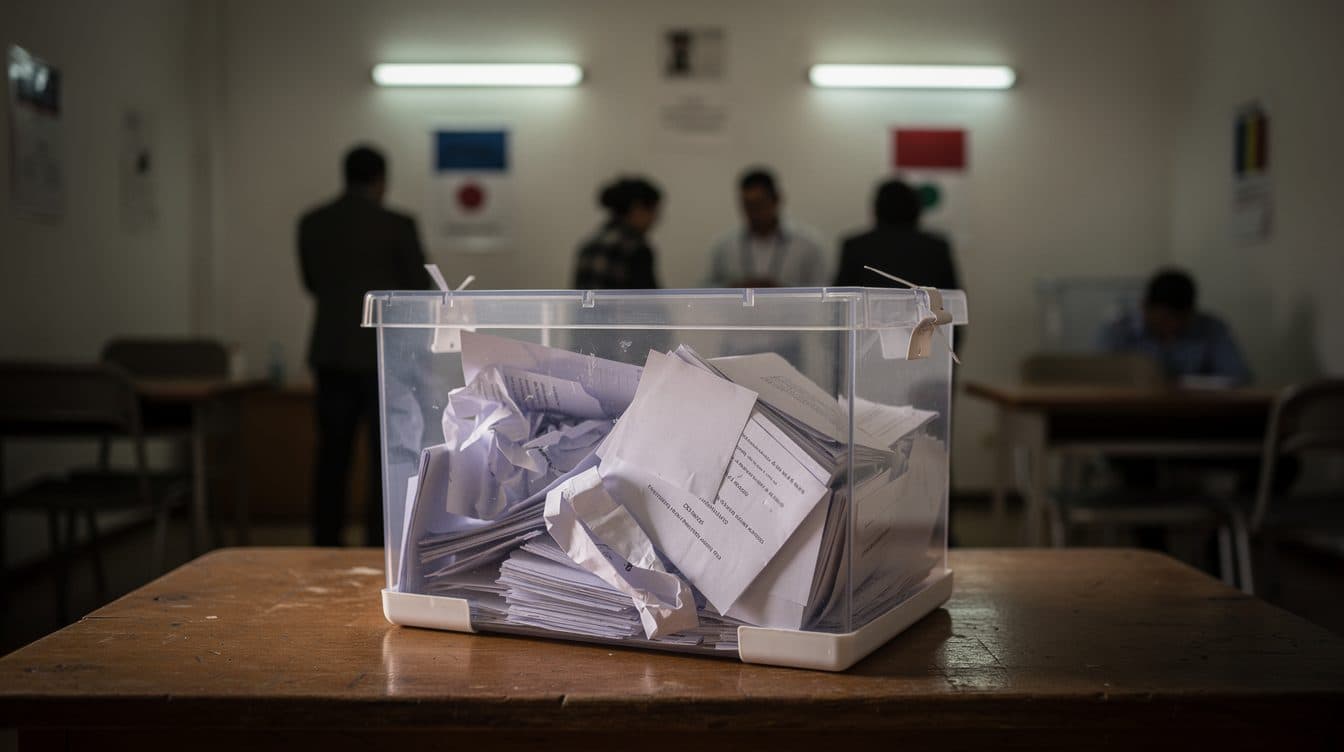
AI-generated image (flux-2/pro-text-to-image via Kie.ai)
Summary
In the runoff election for the Peruvian presidency, Keiko Fujimori held a narrow lead over left-wing politician Roberto Sánchez after more than 45 percent of votes had been counted. The electoral authority must announce the official result by mid-July; the inauguration is scheduled for July 28.
Lima, June 8, 2026
In the Peruvian presidential runoff, Keiko Fujimori (51) led her left-wing challenger Roberto Sánchez (57) by a narrow margin of roughly 53 percent to 47 percent, based on a preliminary count of more than 45 percent of the votes.
Preliminary Result and Next Steps
The Peruvian electoral authority released the preliminary result during the night of Monday (local time), according to Deutschlandfunk reporting. Fujimori received roughly 53 percent and Sánchez 47 percent of the votes counted. More than 27 million Peruvians were called upon to cast their ballots on Sunday. The Supreme Electoral Court of the South American nation, which has around 35 million inhabitants, has until mid-July after the complete count to officially announce a winner. The inauguration of the new president is scheduled for July 28.
The runoff came about because, in April, none of the 35 candidates had secured the necessary majority to prevail in the first round. Fujimori and Sánchez had each received less than 30 percent of the votes in the first round; according to polls, about one-fifth of the roughly 27 million eligible voters had made their decision only shortly before going to the polls. Even beforehand, the race was considered wide open: in the final polls, Fujimori held only a narrow lead over Sánchez.
Keiko Fujimori: Fourth Bid for the Presidency
For Fujimori, a politician with the conservative party Fuerza Popular, this is her fourth run for the presidency. She is the daughter of the late former President Alberto Fujimori, who was convicted of human rights violations. The 51-year-old is of Japanese descent and carries the nickname "La China." She has announced that, within her first 100 days, she will deploy the armed forces internally, tighten prison conditions, and deport undocumented migrants. She also plans to deregulate the economy and take a hard line against organized crime.
Sánchez, the candidate of the Juntos por el Perú alliance and a trained psychologist, is running for president for the first time. He served as minister of foreign trade and tourism in the government of imprisoned former President Pedro Castillo (2021–2022). Sánchez advocates a stronger role for the state in the economy, calls for reforms of the police and judiciary, and champions the rights of the poor rural population. In the event of an election victory, he intends to pardon Castillo, whom he considers the victim of a political maneuver. After casting his vote, Sánchez visited Castillo in prison.
Roberto Sánchez: Left-Wing Candidate Close to Castillo
Shortly before the runoff, a court had ordered proceedings against Sánchez. He is accused of having concealed party donations to Juntos por el Perú from the electoral authority between 2018 and 2020. His lawyers announced they would file legal remedies. Should Sánchez win the election, he would enjoy immunity as president.
Fujimori first ran for president in 2006 and was subsequently elected to Congress. She later focused on chairing her party Fuerza Popular. On suspicion of corruption, she was placed in pretrial detention in October 2018, a measure lifted by the Constitutional Court in October 2019. In the 2021 presidential election, she had run against Pedro Castillo and unsuccessfully sought the annulment of a portion of the votes at the time. A leading trade unionist accused her at the time of attempting to carry out a "slow coup."
The background to the new runoff is Peru's political instability: over the past ten years, the country has had eight presidents; the tenth officeholder is now being determined. The political situation in the country is marked by a constant conflict between parliament and government; Congress can remove presidents from office for "moral incapacity." Three months before the Deutschlandfunk report, the Peruvian parliament had removed President José María Balcázar from office, who has since been serving as transitional president.
Political Instability and the Parliamentary Factor
Pedro Castillo, formerly a village schoolteacher, had also won the 2021 presidential election against Keiko Fujimori. After erratic years in office, he had attempted to unconstitutionally dissolve Congress—an act considered an attempted coup—after which he was arrested. During the protests against his removal in 2023, 49 civilians were killed; no one has yet had to answer for the deaths. Among those killed was the young doctor Marco Antonio Samillán, the brother of activist and politician Milagros Samillán. He was killed by police while providing first aid during the protests.
Milagros Samillán announced she would vote against Fujimorism: "Wir sind gegen den Fujimorismus. Wieder einmal müssen wir gegen Frau Keiko Fujimori stimmen, damit sie nicht die volle Macht an sich reißt, die sie so verzweifelt begehrt." Roberto Sánchez also sharply attacks Fujimorism: "Wir müssen die korrupte Mafia besiegen, die Peru heute regiert. Nieder mit dem Mafiapakt! Nieder mit dem Fujimorismus!" He promises to release the nation's wealth, which is currently concentrated in the hands of one percent of the population.
On policy, security takes center stage for Fujimori. Before the first round, she had said: "Heute, da Peru unter Kriminellen und Erpressern leidet, verlangen die Menschen nach einer Fujimori – hier bin ich." She criticizes the left with the words: "Jene Linke, deren einzige Betätigung darin besteht, Armut zu verteilen, während wir Wohlstand schaffen. Jene Linke, die Hass schürt, wohingegen wir uns den Frieden wünschen." Fujimori announced she would abolish laws that, in her view, favor organized crime.
Policy Profiles: Security versus State Direction
Sánchez, who is the first candidate of the Juntos por el Perú alliance to seek the highest office, counters with his platform of stronger state economic steering and reform of the police and judiciary. He sees himself as a representative of the rural poor and enjoys the support of followers of the imprisoned Pedro Castillo. Against the backdrop of escalated gang violence in Peru in recent years, which has also confronted fishermen in Puerto Pizarro with extortion and murders, the vote takes place in a political climate shaped by anger and disappointment. A fisherman from Puerto Pizarro reported: "Jeder einzelne Fischer hier muss Schutzgeld zahlen, nur um überhaupt ausfahren zu können. Gestern Nacht wurden unsere Bootsmotoren gestohlen. Vor fünf Tagen wurde direkt hier vor unseren Augen ein Fischer ermordet. Wir sind traumatisiert, wir können nicht arbeiten."
According to the preliminary result, the runoff remains extremely close. Seventy percent of voters had not chosen either Fujimori or Sánchez in the first round; according to polls, one-third of voters were undecided shortly before election day. Voter turnout at polling stations, which were open until 5 p.m. local time (midnight CEST), is seen as an indicator of the country's stability; Peru last experienced a democratic turning point in 2000 with the fall of Alberto Fujimori. Observers also view the runoff as a directional decision between a hardline security approach and a leftist platform with stronger state economic steering.
Outlook: Governing Without a Majority of One's Own
Alberto Fujimori, who ruled from 1990 to 2000, was celebrated by his supporters for combating the Maoist guerrilla group "Shining Path" and for stabilizing the country's economy. In the 1990s, he implemented a neoliberal shock therapy for the Peruvian economy. At the same time, severe human rights violations and institutionalized corruption occurred during his tenure; he governed increasingly dictatorially in the 1990s.
The next officeholder must govern the country without a majority of their own in parliament. Observers also see the election as a vote on how to deal with the political class, which many voters blame for years of instability. Fujimori accuses Sánchez of contributing to the political crisis; Sánchez, in turn, accuses Fujimori's party of co-responsibility for the removal of several presidents. The election result is therefore also read as a signal to Congress, where the balance of forces is as fragmented as among the electorate.
Regardless of the official final result, Peru thus faces a difficult governing period. The combination of a polarized parliament, ongoing gang violence, and a fragmented electorate makes the coming term a test of endurance—regardless of whether Fujimori or Sánchez assumes the presidency on July 28.
Questions & Answers
Who is running against whom in the Peruvian runoff?
The runoff pits Keiko Fujimori (51) of the Fuerza Popular party against Roberto Sánchez (57) of the Juntos por el Perú alliance.
When is the official result of the runoff expected?
After the complete count, Peru's Supreme Electoral Court has until mid-July to officially announce a winner; the inauguration is scheduled for July 28.
What allegations have been made against Roberto Sánchez?
A court ordered proceedings against Sánchez shortly before the runoff; he is alleged to have concealed party donations to Juntos por el Perú from the electoral authority between 2018 and 2020.
Peru Runoff Election 2026: Fujimori vs. Sánchez – Results | allfacts360