
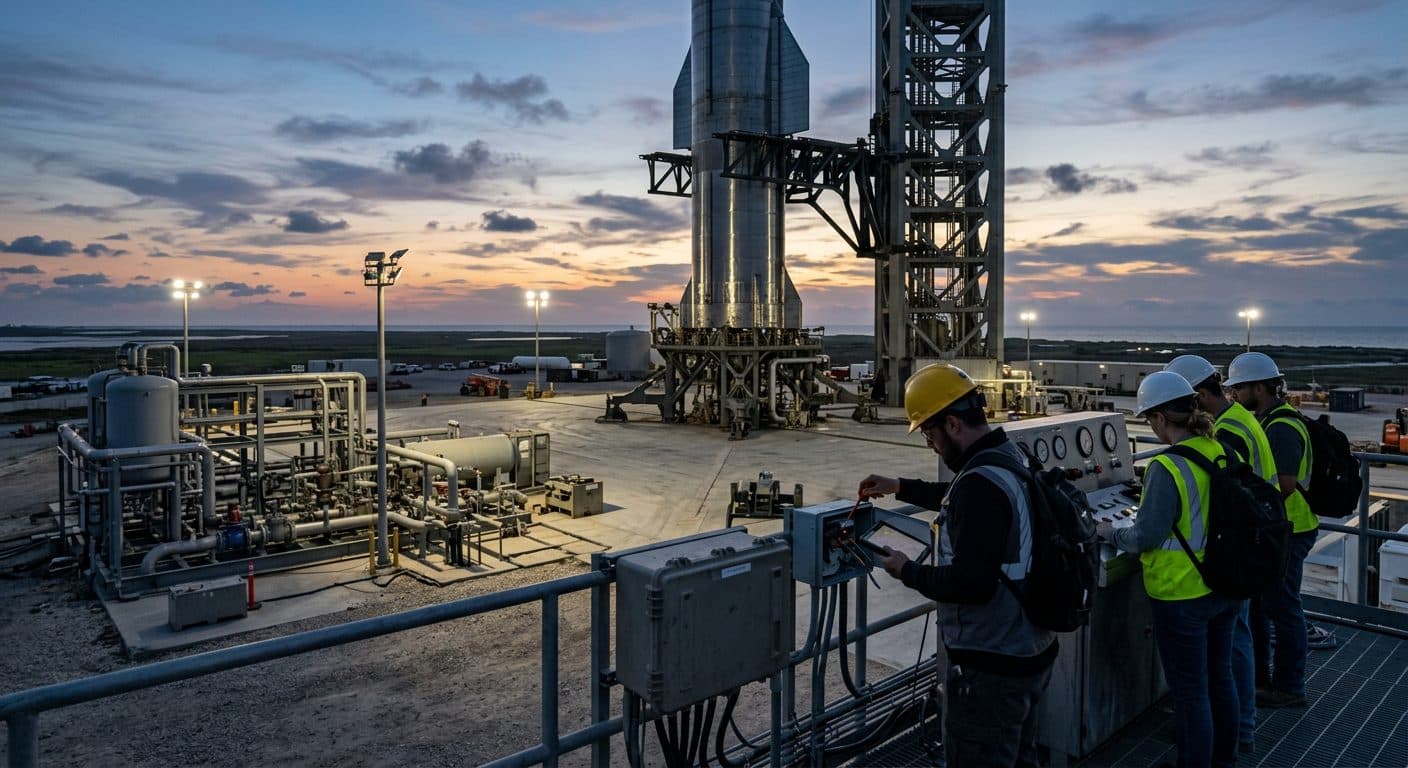
Boca Chica, Texas, 22 May 2026
SpaceX aborted the twelfth test flight of its Starship rocket late Friday night due to technical issues with fuel temperature and pressure measurements.
The Starship rocket, designed by Elon Musk's SpaceX, is intended to be the largest rocket in history, capable of transporting humans to the Moon and Mars. The rocket has undergone eleven test flights so far, with five ending in failure.
The latest launch attempt was scheduled for Friday night but was canceled after multiple interruptions in the countdown due to abnormal fuel temperature and pressure readings. Elon Musk stated, 'If this can be fixed tonight, there will be another launch attempt tomorrow at 5:30 AM CT.'
Starship is a critical component of SpaceX's ambitious plans to establish a human presence on Mars. The rocket is designed to transport one million tons of material to Mars by 2050 to support a colony of one million people.
Starship's Ambitious Goals
SpaceX aims to make Starship fully reusable, reducing costs by reusing both the Super Heavy booster and the upper stage. The company has already demonstrated progress in this area, successfully catching the booster with a tower equipped with robotic arms during the fifth test flight in autumn 2024.
The third version of Starship, which was set to be tested in this launch, is expected to carry up to 100 tons of payload. The booster features 33 Raptor-3 engines, while the upper stage has six, enabling significant payload capacity.
NASA has expressed interest in using Starship for its Artemis-IV mission, where the upper stage could serve as a Moon lander, landing upright on the lunar surface. This aligns with NASA's goal of establishing a permanent Moon base within the next decade.
NASA Collaboration
SpaceX has already made strides in reducing the cost of space travel. Using partially reusable Falcon rockets, the company has lowered the cost per kilogram of material sent into Earth orbit from approximately $10,000 to around $1,500.
Despite the setback, SpaceX remains optimistic about Starship's potential. The company has a pipeline of V3 ships and boosters ready for future tests, and Musk has assured that any failure would not delay future test flights by more than a month.
Starship's development is part of Musk's broader vision to enable a civilization on Mars and explore the universe. The rocket is also expected to support SpaceX's Starlink satellite business, deep-space exploration, and orbital data centers.
Future Prospects
The cancellation of the launch highlights the challenges of developing such advanced technology. However, SpaceX's track record of innovation suggests that these hurdles are temporary steps toward achieving its long-term goals.