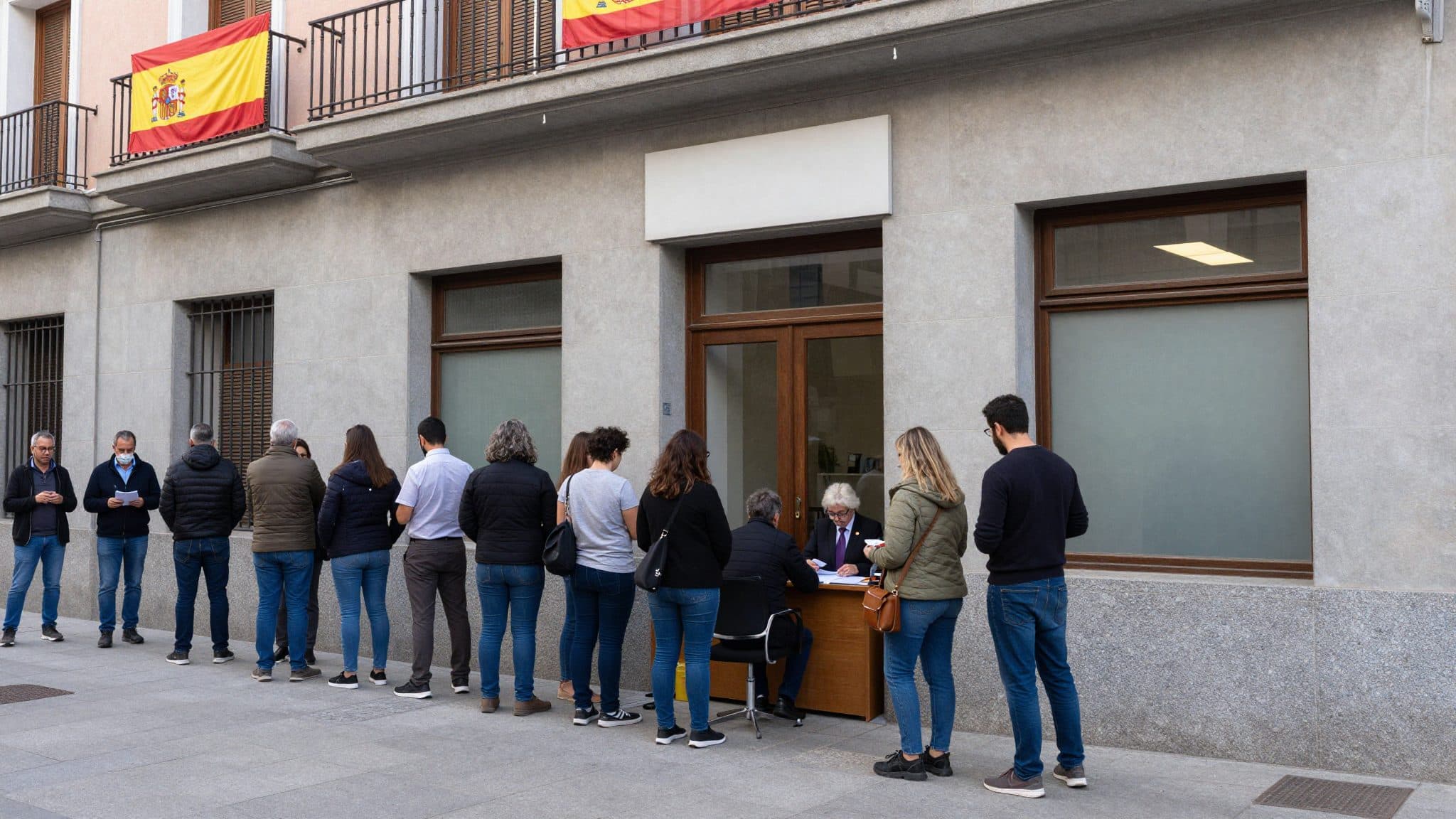
Spain's regularization program ends with 1.3 million applications – far more than expected
Madrid, June 30, 2026
AI-generated image (z-image via Kie.ai)
Summary
In Spain, around 1.3 million undocumented migrants applied for a residence and work permit by the Tuesday deadline. The government had originally expected about 500,000 applications and is now presenting a 505-million-euro integration plan.
Madrid, June 30, 2026
In Spain, around 1.3 million migrants without valid papers applied for regularization of their residence status by the Tuesday, June 30, 2026 application deadline – far more than the most recent figure of 900,000 that had been expected.
Background: The regularization program
According to the latest data from the national registration platform "Mercurio," the number of applications submitted for a legal residence permit in Spain has surged to around 1.3 million. The deadline for the action launched in April expired today. This news was broadcast on June 30, 2026 on the Deutschlandfunk program.
The program is based on a popular initiative from 2024 that collected more than 700,000 signatures and was supported by a broad coalition of NGOs, trade unions, employer associations, and the Catholic Church. Migrant organizations, trade unions, and social institutions had collected 700,000 signatures on a corresponding popular legislative proposal.
In January, Spain's left-wing government had approved the extraordinary mass legalization of migrants, which now expires on June 30. The process was initiated by the left-wing government under Socialist Pedro Sánchez. Socialist head of government Sanchez described the so-called regularization as a good decision for the Spanish economy.
Original expectations far exceeded
In Spain, a country of 50 million people, more than 900,000 irregular migrants had applied by mid-June, according to the government – far more than the approximately 500,000 applications the Ministry of Migration had expected. In January, around half a million applications had been expected. "everyone assumed between 500,000 and 800,000 affected people."
The government's original plan was to bring around half a million illegally employed migrants out of the shadow economy and into official, social-security-contributing work. Instead, more than twice as many people applied during the three months. For them and the 1.3 million other applicants, the process is more than just an administrative act, but rather a "lifeboat" and a long-awaited step out of the shadows into a life of dignity.
All immigrants who could prove that they had been in Spain for five months as of December 31, 2025 and had not committed any criminal offenses could apply for a provisional residence permit with work authorization. Those who are ultimately accepted may live and work in Spain for one year and must then renew their residence permit.
Bureaucratic hurdles in the application process
Applicants must have a clean police record both at home and in Spain. According to a report in the Spanish newspaper "El País," the biggest bureaucratic hurdle turned out to be obtaining criminal record certificates from the countries of origin. Thousands of people are "trapped in bureaucracy" and are falling victim to scammers charging exorbitant sums for fake appointments or documents, criticized parliamentary group vice-chair Aina Vidal.
More than half of the applicants come from the three countries of Colombia, Venezuela, and Morocco. More than a quarter of the applications submitted by mid-June came from people from Colombia, with the second-largest group being Moroccans (around 14 percent). Around 90 percent come from Latin America, and around 10 percent from Africa and Asia. Most applicants are between 25 and 44 years old, with roughly another quarter under 25.
Origin of the applicants
The most current figures from the Ministry of the Interior date from mid-June: at that point, more than 900,000 applications had already been received by the authorities and 360,000 had been approved for further processing. 360,000 of them had already been admitted for final processing. So far, around one third have received a positive response.
The authorities have three months to review the applications. Those who can prove that they lived in Spain continuously for at least five months before the end of 2025 and have not committed any criminal offenses in the past five years – neither in Spain nor in any previous country of residence – receive a provisional residence and work permit. What is granted is a residence and work permit valid exclusively for Spain, which does not apply to the EU Schengen area. The children of those affected are also legalized.
Many of the applicants – especially those from Latin America – had entered as tourists and then stayed. Proof of residence can be provided by bills for, say, electricity or telephone, registration in the residents' register, or documentation of doctor visits. "El País" quotes a 71-year-old Cuban woman who has been working in Madrid as a cleaner and in elderly care. For her, the process is a step out of the shadows into a life of dignity.
Resistance from the conservative opposition
The conservative Partido Popular (PP) and the far-right Vox tried in vain to stop the legalization in court. Vox and others have gone to the Supreme Court, according to the newspaper "El País." In regions governed by right-wing parties, such as Madrid, the authorities put obstacles in the way of those affected wherever possible. For example, the capital's public transport companies refused to issue receipts for the ownership of monthly bus and train passes.
The conservative opposition sharply criticized the plan. One claim was that the legalization would overwhelm the healthcare system. PP and Vox have stated that the regularization will overwhelm the healthcare system. Sanchez's left-wing coalition partner Sumar, in turn, called in recent days for an extension of the deadlines.
Government's integration plan
Prime Minister Sánchez presented an integration plan on Tuesday, right on time for the end of the application deadline. 505 million euros will go into measures designed to promote the integration of migrants into society. With the slogan "Where do they come from? They come to help build the country," he appealed for acceptance. "Integration is not possible without regularization," Sanchez had previously said.
At the same time, he acknowledged that the integration of migrants poses challenges for the country. "Migration is not a problem, but a necessity," Spain's current Prime Minister Pedro Sanchez also made clear last summer. We want the world to see Spain as a country that respects, protects, and guarantees human rights, said Sanchez.
Economic significance of migration
Spain actually needs up to 300,000 migrants per year to keep economic growth and the size of the working population stable, according to Spanish labor market expert Carlos Victoria. Spain records an annual net influx of around 600,000 immigrants. 90 percent of the jobs created between January 2024 and March 2025 were filled by immigrants. Immigrants make up 23 percent of the working population.
Historical context of earlier legalizations
This is the fifth legalization of migrants since Spain returned to democracy in the 1970s. None was as massive as this one. There were already several hundred thousand legalizations between 1985 and 2005, also under conservative governments. Conservative head of government José María Aznar initiated three extraordinary regularization procedures (1996, 2000, and 2001). In a four-month process, 576,506 immigrants without valid papers received their right of residence.
Shortly after taking office, the Socialist José Luis Rodríguez Zapatero also initiated the last major extraordinary regularization process in 2005. During his eight years in office, 524,621 immigrants from non-EU countries received a residence permit through this route. Spain is thus pursuing a different course on migration policy than most other EU states.
The number of non-EU citizens without valid residence status in Spain, at 840,000 people this year, is now eight times higher than in 2017. As of April 2025, 6.9 million foreigners live in Spain. In addition, there are 2.5 million people who have since acquired Spanish citizenship but were born outside Spain.
"Es ist nur gerecht, dass diejenigen, die zum Wohlstand und zur Entwicklung des Landes beitragen, eine schnelle Antwort auf ihre Anliegen erhalten," said Mauricio Valiente, chairman of the Spanish Commission for Refugee Aid (CEAR), already in January. She praised the program overall as "intelligent and pragmatic." Definitive figures are to be communicated this week after the deadline has passed; more than one million are expected.
Questions & Answers
Who launched the regularization program in Spain?
The program was approved by the left-wing government under Socialist Prime Minister Pedro Sánchez on the basis of a 2024 popular initiative that had received more than 700,000 signatures.
How many applications were received by the June 30, 2026 deadline?
According to the "Mercurio" registration platform, around 1.3 million applications were submitted – the government had originally expected only about 500,000 applications.
What requirements did applicants have to meet?
Applicants had to prove that they had been living in Spain without interruption for at least five months as of December 31, 2025, and they must not have a criminal record either in Spain or in any previous country of residence.
Spain: 1.3 million regularization applications – deadline | allfacts360