Royal Insignia Rediscovered in Vilnius | allfacts360
Spectacular Find in Vilnius: Royal Insignia Rediscovered After Nearly 90 Years
Vilnius, 13 July 2026
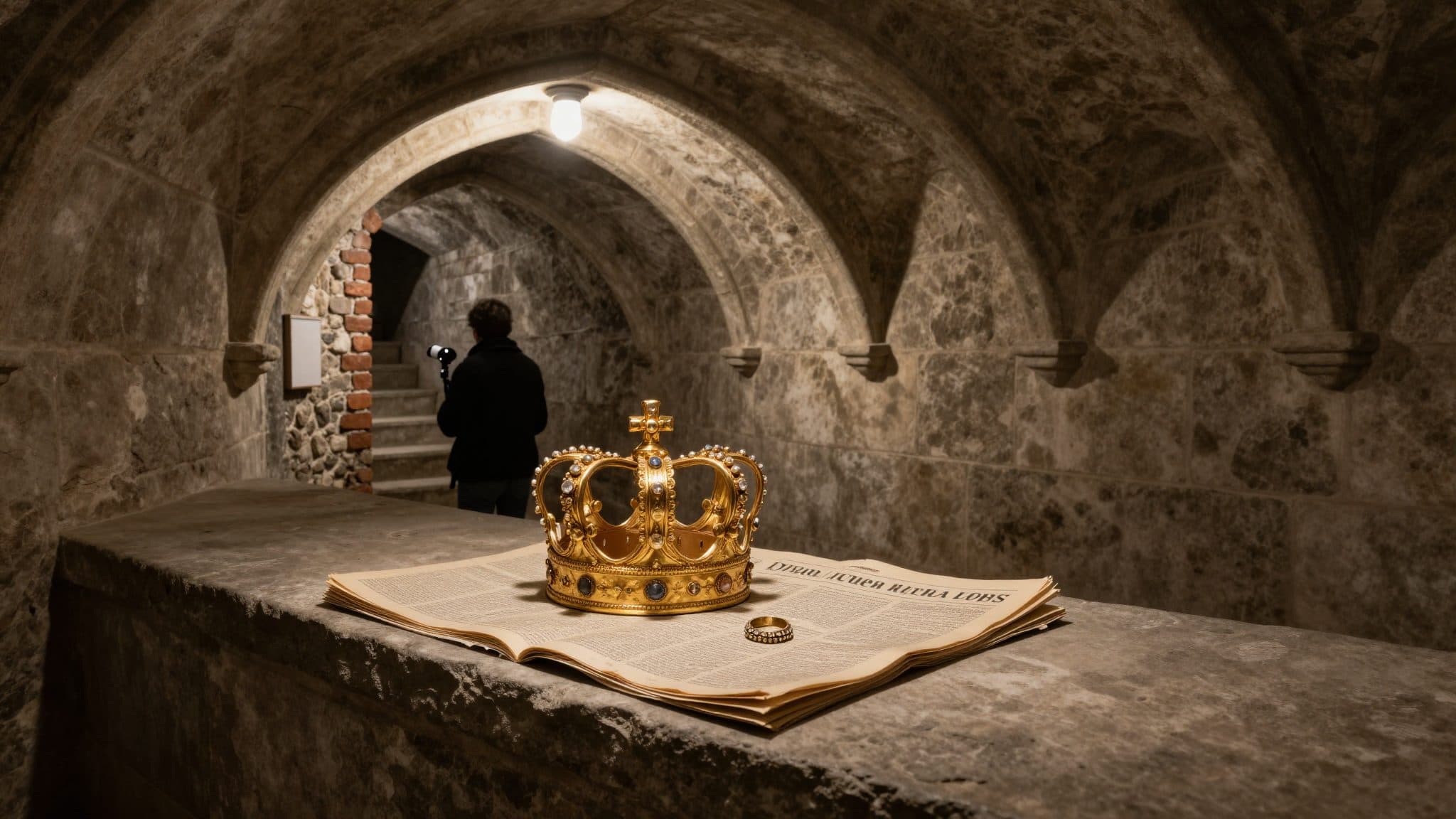
AI-generated image (z-image via Kie.ai)
Summary
In the catacombs of Vilnius Cathedral, 16th-century royal insignia have been rediscovered nearly 90 years after they were hidden. Lithuanian experts found the burial crowns and jewels of Alexander Jagiellon, Elisabeth of Habsburg, and Barbara Radziwiłł behind a bricked-up staircase niche. The relics, long considered lost, will be on view in the exhibition "Hidden Within" at the Museum of Ecclesiastical Heritage until 30 January 2027.
Vilnius, 13 July 2026
Nearly 90 years after they were hidden at the beginning of the Second World War, 16th-century royal insignia that had been considered lost for decades have been rediscovered in the vaults beneath Vilnius Cathedral.
The Find in the Crypt
The insignia were discovered in late 2024 behind a bricked-up staircase niche in a section of the crypt open to guided tours. Lithuanian experts had used endoscopic cameras to track down the relics, which had been searched for over many decades. Wrapped in newspapers from 1939, the rulers' burial crowns and personal jewellery were still lying in their original hiding place.
Art historian Giedrė Mickūnaitė, curator of the newly opened exhibition "Hidden Within" at the Museum of Ecclesiastical Heritage in Vilnius, spoke of a find of inestimable significance. "Die wiederentdeckten Artefakte sind von unschätzbarem Wert", she told the German Press Agency in the Lithuanian capital. The exhibition will be on view until 30 January 2027.
Three Rulers, Three Burial Crowns
The main exhibits include burial crowns and insignia of King Alexander Jagiellon (1461–1506), Queen Elisabeth of Habsburg (1526–1545), and Queen Barbara Radziwiłł (1522–1551). Their tombs are located in the vaults beneath Vilnius Cathedral. Alongside the royal insignia, personal jewels of the rulers were also recovered, including gold rings set with rare gemstones.
The insignia had been hidden in 1939 to protect them from destruction and looting during the Second World War. After the Soviet troops marched into Lithuania and the later German occupation, the artworks were long considered lost. Repeated attempts after Lithuanian independence to locate the relics again remained unsuccessful for decades.
Hidden in 1939, Forgotten for Decades
The objects had, however, already surfaced once before: in 1931, experts had discovered the relics — originally concealed behind a wall — after flooding in the underground burial chambers, and subsequently put them on display. But their original hiding place fell into oblivion over the decades. After they were concealed again in 1939, they were ultimately considered lost.
Just how well the insignia had truly been hidden was described by Alina Pavasaryte of the museum administration during a tour of the crypts. "Sie waren wirklich gut versteckt. Ich arbeite hier schon lange, seit über zehn Jahren. Und ich bin bestimmt 5000 Mal an diesem Versteck vorbeigegangen", she said. The niche lay in a corridor that had been regularly walked through by visitors and museum staff for years.
The history of the objects now recovered is closely tied to the history of the Polish-Lithuanian state, which in the 15th and 16th centuries formed the largest contiguous state in Europe, at times stretching from the Baltic Sea to the Black Sea. The Jagiellonians provided the kings of Poland and the grand dukes of Lithuania during this era; through marriage with the Habsburgs, dynastic ties were forged that shaped the fate of the rediscovered insignia.
Polish-Lithuanian History
Elisabeth of Habsburg, daughter of Emperor Ferdinand I, became queen as the first wife of the Polish-Lithuanian ruler Sigismund II Augustus of the House of Jagiellon. After her early death in 1545, she was interred in the tomb beneath Vilnius Cathedral. Barbara Radziwiłł, the second wife of Sigismund II Augustus, also found her final resting place there.
The Jagiellonians and the Habsburgs were among the most powerful ruling families of Europe in the 16th century. The funerary items of these three royal figures are regarded as testimonies to an era in which Lithuania and Poland played a central role in European politics. Their material preservation is of outstanding importance for Lithuanian historical scholarship.
The find also sheds new light on the turbulent history of Vilnius Cathedral in the 20th century. During the Soviet period, the building was used as a warehouse and later as a museum; the original function of the tombs faded into the background. The fact that a previously unknown niche went undetected in an area open to guided tours continues to astonish those involved to this day.
The use of endoscopic cameras ultimately brought the search to a successful conclusion. The technology made it possible to see behind the masonry of the staircase niche without damaging the historic fabric. Only in this way did the insignia — wrapped in newspapers from 1939 — come into view, having lain untouched in the darkness for decades.
Significance for Lithuania
For Lithuania, the find carries considerable significance for national identity. The burial crowns and insignia are regarded as symbols of an independent European tradition of rule that endured across the era of the partitions and Soviet occupation. The exhibition "Hidden Within" now makes this previously hidden part of the national heritage accessible to a broad public.
The Museum of Ecclesiastical Heritage in Vilnius presents the objects within a curatorial framework that combines their historical context with the story of their concealment. Visitors can view the burial crowns, insignia, and personal jewellery of the three rulers until the end of January 2027, gaining a rare direct encounter with testimonies to the 16th century.
The find brings to a close a decades-long search that had been resumed repeatedly after Lithuanian independence. Those involved themselves had not expected that modern camera technology would solve the mystery. The relief within Lithuania's cultural life is great: although the relics are no longer fully in their original tomb, they have returned to public awareness.
Voices from the Museum
Mickūnaitė emphasised that the significance of the find extends far beyond its material value. It is a reminder of how fragile cultural heritage is in wartime and of how decisive the commitment of individuals is for its preservation. The exhibition is therefore intended not only to display art treasures but also to tell the story of their rescue.
Pavasaryte spoke of a goosebump moment when she herself was able to see the uncovered insignia for the first time. The years-long search had been a recurring challenge for her and her colleagues, and has now been crowned with an unexpected success. The find has brought the museum team even closer together.
Questions & Answers
Who are the three rulers whose insignia were found in Vilnius?
The rulers are King Alexander Jagiellon (1461–1506), Queen Elisabeth of Habsburg (1526–1545), and Queen Barbara Radziwiłł (1522–1551), whose tombs are located in Vilnius Cathedral.
How were the insignia rediscovered after nearly 90 years?
Lithuanian experts located the insignia, hidden in 1939, in late 2024 with the help of endoscopic cameras, behind a bricked-up staircase niche in a crypt open to guided tours.
Where and until when are the rediscovered objects on view?
The finds are being presented in the exhibition "Hidden Within" at the Museum of Ecclesiastical Heritage in Vilnius, which runs until 30 January 2027.