St. Pölten Celebrates 40 Years as State Capital: Festive Ceremony, Economic Review, and a Goulash Comparison
St. Pölten, July 10, 2026
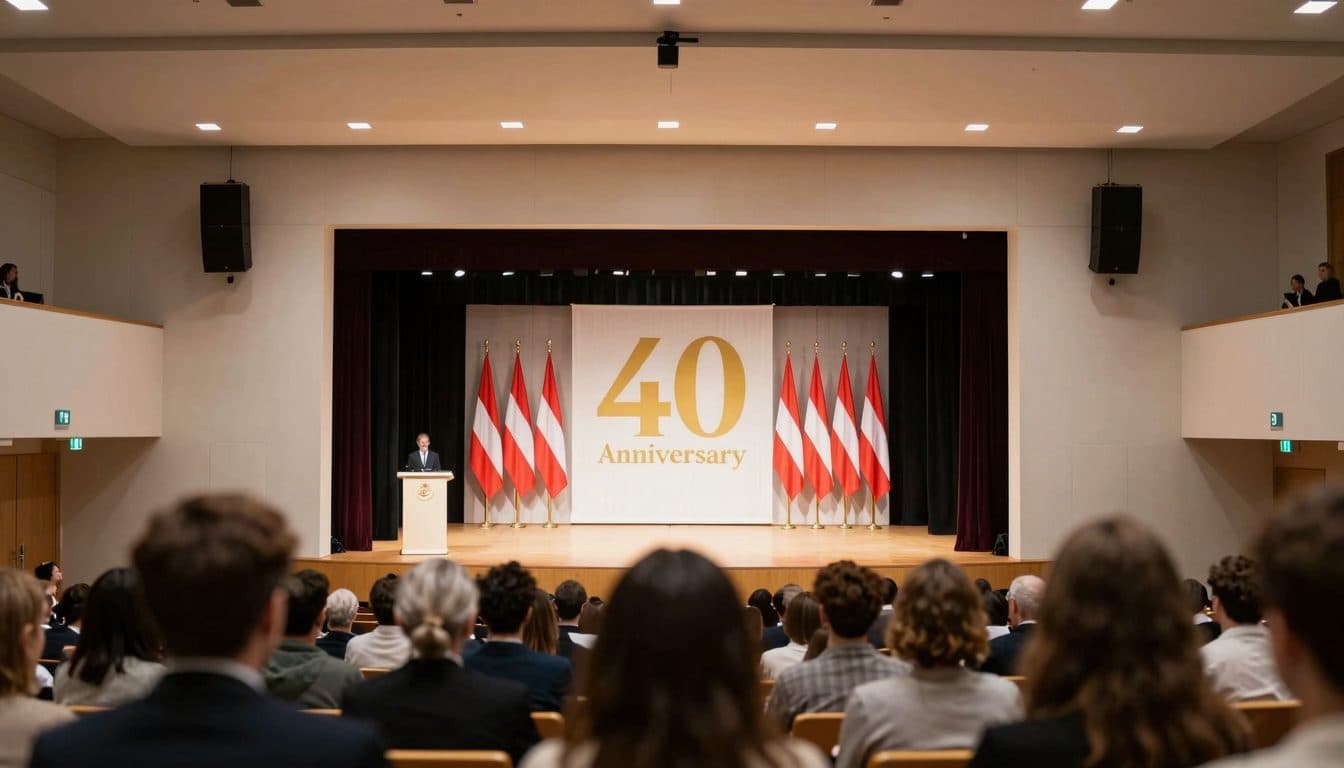
AI-generated image (z-image via Kie.ai)
Summary
St. Pölten on Friday marked the 40th anniversary of its status as the Lower Austrian state capital with a festive ceremony. State Governor Johanna Mikl-Leitner, State Parliament President Karl Wilfing, and Mayor Matthias Stadler drew a positive balance of the past four decades.
St. Pölten, July 10, 2026
With a festive ceremony at the University of Applied Sciences St. Pölten (USTP), State Governor Johanna Mikl-Leitner (ÖVP), State Parliament President Karl Wilfing (ÖVP), and Mayor Matthias Stadler on Friday honored the 40th anniversary of St. Pölten's status as the state capital of Lower Austria.
Anniversary with Historical Retrospective
The festive ceremony on Friday at the University of Applied Sciences St. Pölten was entirely dedicated to an anniversary: exactly 40 years ago, in July 1986, the Lower Austrian State Parliament had passed the resolution to elevate St. Pölten to state capital. Previously, the people of Lower Austria had decided in favor of their own state capital in a popular vote in 1986 – the choice fell on St. Pölten. This finally gave the federal state, which at the time counted 1,729,573 inhabitants, its political center.
State Governor Johanna Mikl-Leitner spoke of "einer Entscheidung mit Weitblick: für Eigenständigkeit, für eine eigene Landesidentität und für ein starkes Zentrum mitten in Niederösterreich". From a "Stadt im Dornröschenschlaf" a "moderne Landeshauptstadt" had emerged, she said. Mikl-Leitner also paid tribute to her predecessor, former State Governor Erwin Pröll (ÖVP), who had given Lower Austria "Selbstbewusstsein, Strahlkraft und ein neues Gesicht".
Tribute to the Political Pioneers
Mayor Matthias Stadler recalled that the population had consciously decided at the time in favor of a strong heart. "Wir haben lange mit dem Geruch gekämpft, aber strahlen jetzt in neuem Glanz", said Stadler. Since then, the city had developed from an industrial location into a significant administrative, educational, economic, and cultural center. St. Pölten combines "das Beste aus allen Welten": "Es ist bunt und laut, wenn man es will, aber bietet dabei so viel Natur und ist so lebens- und liebenswert."
State Parliament President Karl Wilfing (ÖVP) also drew a positive balance: from a federal state "im Schatten Wiens" a self-confident and Europe-recognized region had emerged. "Mit dem Beschluss zur Errichtung einer eigenen Landeshauptstadt haben wir Verantwortung übernommen. Denn der Auftrag bedeutete auch, dass wir in eigener Verantwortung die Entwicklung unseres Landes regeln sollen", emphasized Wilfing. "Heute ist Niederösterreich eine Premiumregion im Herzen Europas."
From Goulash Without Juice to a Recipe for Success
A central theme of the speeches was a bon mot that had accompanied the event over four decades: the remark by former State Governor Siegfried Ludwig (ÖVP), according to which "ein Land ohne Hauptstadt wie ein Gulasch ohne Saft" sei. State Governor Mikl-Leitner explained that the former "Gulasch ohne Saft" had long since become "ein echtes Erfolgsrezept". Goulash also found a place in State Parliament President Wilfing's brief speech: "Die emotionale Übersetzung war damals wie ein Gulasch ohne Saft."
Economic Balance in Figures
The sober figures underscore this review. Lower Austria's gross regional product climbed over the past 40 years from 14.8 to 73.2 billion euros – a fivefold increase. Economic output per employed person rose in the same period from 23,800 to 92,600 euros. Export volume grew from 8.7 billion euros to today's 30.3 billion euros. Since 1986, the number of business locations has nearly tripled to 130,000, as has the number of business start-ups, which today stands at over 8,500 per year.
Mikl-Leitner underscored the transformation of the federal state: Lower Austria had developed "von einem reinen Agrarland zum Agrarland Nummer eins, zum Wirtschaftsland, Tourismusland, Kulturland und Forschungsland entwickelt". St. Pölten today is not only the geographic center, but also a symbol of the new self-confidence of the homeland. "Pölten ist heute nicht nur die geografische Mitte – sondern auch ein Symbol für das neue Selbstbewusstsein unserer Heimat."
Mayor Stadler pointed to the responsibility associated with being a state capital: "Verantwortung für die Menschen, Verantwortung für die Regionen, und Verantwortung für die Zukunft unserer Kinder." A total of 66,000 people fill the city with life and enjoy the advantages of a state capital that simultaneously combines nature and urban living.
Musical Setting and Public Celebrations
The festive ceremony was musically framed by the choir of the University of Applied Sciences St. Pölten. During the joint song "Oh Heimat, dich zu lieben, getreu in Glück und Not" it resounded on Friday from the university's ceremonial hall. The event marked the start of a series of public celebrations accompanying the anniversary over the weekend.
With the street art festival "Bravissimo," an open-air evening of Cinema Paradiso, a concert, and a documentary by the ORF Lower Austria regional studio, the anniversary is also being celebrated publicly. This is intended to make the 40th anniversary visible not only in a political setting but also to the population.
As a small reminiscence of the goulash comparison, "Gulasch mit Saft" is on the menu on the day of the ceremony in the Landhausküche in the government quarter. Thus, the bon mot coined by Siegfried Ludwig four decades ago finds its culinary echo.
Outlook on the Coming Years
The speakers concluded the festive ceremony convinced that the decision of 1986 continues to hold up to this day. St. Pölten has proven itself as a state capital and has become the "heart" of Lower Austria – a center that combines independence, identity, and economic strength.
Looking ahead to the coming years, the speakers pointed to the responsibility toward future generations. The state capital should continue to grow, expand its function as an administrative, educational, and cultural center, and maintain the balance between urban life and nature.
The festive ceremony at the USTP marked the start of an anniversary year celebrating St. Pölten as a state capital – four decades after a resolution that sustainably changed Lower Austria's political landscape.
Questions & Answers
How has Lower Austria's economy developed since 1986?
Gross regional product rose from 14.8 to 73.2 billion euros, economic output per employed person from 23,800 to 92,600 euros, and export volume from 8.7 to 30.3 billion euros. The number of business locations grew to 130,000, and business start-ups today stand at over 8,500 per year.
St. Pölten 40 Years as State Capital: Festive Ceremony and | allfacts360