Suspended Sentence for Alleged NSU Supporter Susann E. in Dresden
Dresden, July 17, 2026
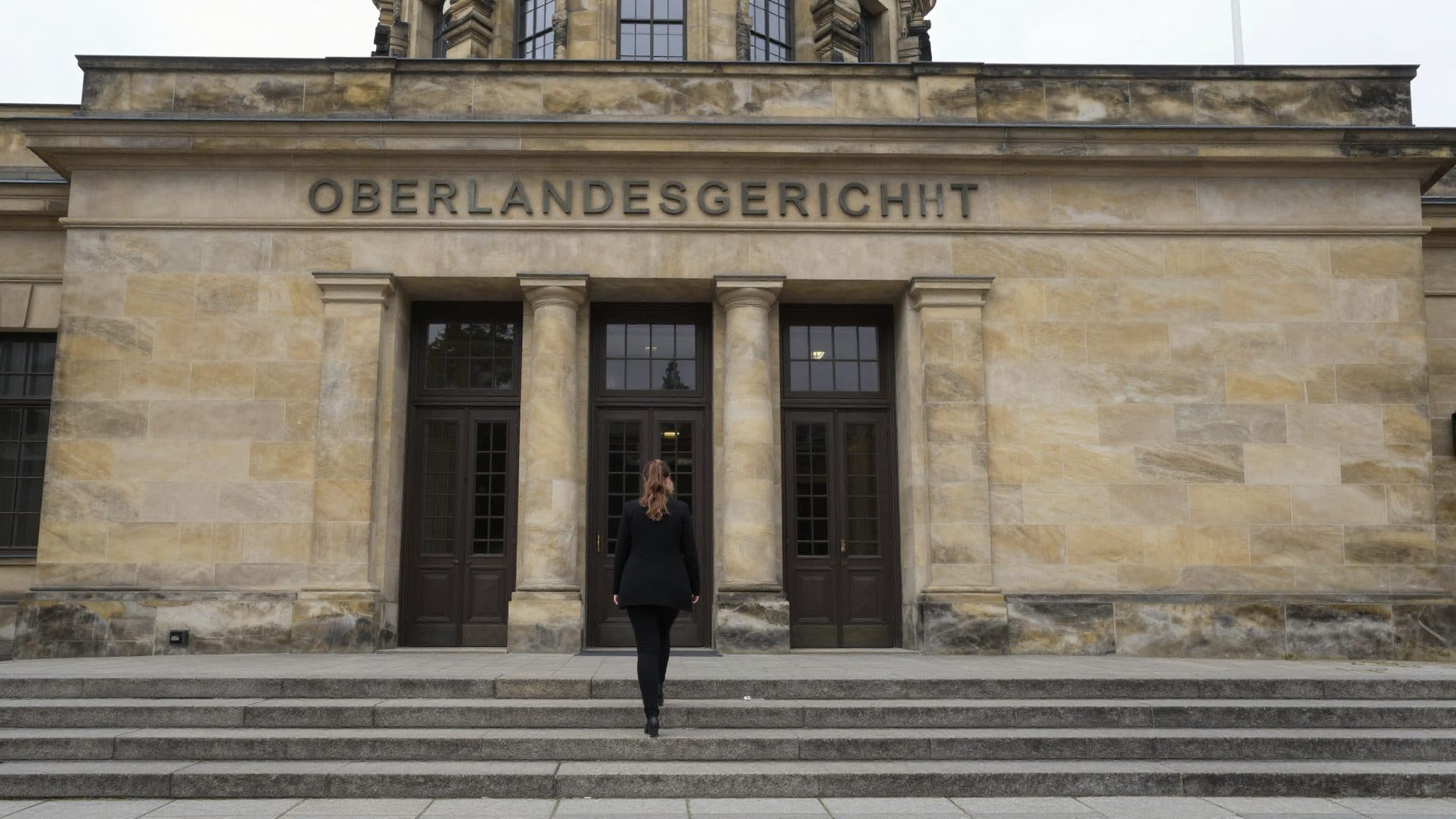
AI-generated image (z-image via Kie.ai)
Summary
The Dresden Higher Regional Court has sentenced alleged NSU supporter Susann E. to two years' imprisonment on probation for supporting a terrorist organization and aiding a serious armed extortion. The Federal Prosecutor's Office had demanded four years in prison, while the defense had argued for acquittal.
Dresden, July 17, 2026
The Dresden Higher Regional Court (Oberlandesgericht) sentenced alleged supporter of the right-wing extremist terrorist cell National Socialist Underground (NSU), Susann E., to two years' imprisonment on probation on Friday.
The verdict was handed down on Friday at the Dresden Higher Regional Court (OLG). The 5th Criminal Senate found it proven that the 45-year-old defendant had supported the NSU terrorist cell in three instances and, in one case, aided a serious armed extortion. The Federal Prosecutor's Office had previously sought a prison sentence of four years. The defense had argued for acquittal, contending that the trial produced no evidence of a transfer of knowledge.
The NSU – named after the eponymous terror network – was a neo-Nazi terrorist cell made up of three individuals: Beate Zschäpe, Uwe Böhnhardt, and Uwe Mundlos. Beginning in 2000, the trio carried out ten murders undetected for years across Germany, along with 43 attempted murders. The victims were nine businessmen of Turkish and Greek descent, as well as a German police patrol. Two bombings in Cologne injured dozens of people.
The NSU Terror Cell: A Decade of Murders
The trial against Susann E. centered on the question of the extent to which she supported the life of Zschäpe, who was living in hiding in Zwickau, and thereby helped sustain the structures of the terrorist cell. According to the Federal Prosecutor's Office's indictment, E. lent her identity to Zschäpe on multiple occasions while Zschäpe was living underground in Saxony. E. was also alleged to have given Zschäpe her health insurance card for medical visits and to have helped rent a camper van that the NSU used in their final bank robbery in Eisenach in November 2011.
In its closing arguments, the Federal Prosecutor's Office assumed that Susann E. was aware of the NSU's racist murders. However, this accusation was not upheld in its full force in the verdict. The judges concluded that the acts of support were to be classified as aiding and abetting the maintenance of the terrorist structures, but not as direct co-perpetration of the killings. Accordingly, no conviction was handed down for murder or for aiding and abetting murder.
Allegations: Identity Lent and Camper Van Arranged
Susann E. herself made no statement regarding the allegations during the main trial. The defense argued that insufficient evidence had been presented to establish a transfer of knowledge between the defendant and the core NSU members. In the defense's view, the question of whether E. had been specifically informed about the murder series remained unresolved.
The significance of the proceedings lies primarily in the judicial processing of the NSU's broader milieu. While the main trials against Beate Zschäpe and against other alleged supporters have already concluded, the case against Susann E. is regarded as one of the final chapters in the criminal prosecution of the NSU complex. Observers view the verdict as a signal that even helpers in the background – so-called supporters of the underground – can be held accountable.
Victims and Surviving Relatives: The Search for Accountability
For the victims and surviving relatives of the NSU crimes, the trial is of particular significance. In earlier proceedings, family members of those murdered repeatedly pointed out that the murder series could hardly have continued for years without a functioning support network. The Susann E. case fits into this line, even if the sentence fell short of the prosecution's expectations.
From a procedural law perspective, it is notable that the suspended sentence falls considerably below the Federal Prosecutor's Office's demand. This is unusual for an offense involving the support of a terrorist organization. The court evidently took the milder sentence as an acknowledgment that E. held no operational role within the NSU network and that no direct participation in acts of violence could be proven.
Legally, the verdict is based on Section 129a of the Criminal Code, which criminalizes the support of a terrorist organization, as well as Section 255 in conjunction with Section 250, which addresses serious armed extortion. The judges determined that the defendant, through repeatedly lending her identity and assisting with the rental of the camper van, made essential logistical contributions to maintaining the terrorist cell.
Legal Basis of the Verdict
The trio of Mundlos, Böhnhardt, and Zschäpe financed their life underground primarily through bank robberies. Following a robbery in Eisenach in November 2011, Uwe Böhnhardt and Uwe Mundlos took their own lives to avoid imminent arrest. Only afterward did the existence of the terrorist cell come to light, and Beate Zschäpe turned herself in to police.
In a broader context, the verdict also speaks to the question of how far the rule of law's reach extends when supporters were not themselves involved in acts of violence. The suspended sentence illustrates the difficulty of proving support structures conclusively – but it does not relieve the court of the task of fully clarifying the background of the murder series.
The defense announced that it would review the decision. Whether legal remedies would be filed was initially unclear. The Federal Prosecutor's Office also declined to comment initially on further steps. Should the Public Prosecutor's Office lodge an appeal, the Federal Court of Justice (Bundesgerichtshof) would have to address the case.
Assessment and Consequences of the Proceedings
Overall, the verdict closes another chapter in the criminal prosecution of the NSU terror. Attention now turns to the still-open questions regarding the role of additional supporters and the structural failures of the security authorities, which for years failed to recognize that a right-wing extremist terrorist cell was murdering undetected in Germany.
For the judiciary in Saxony, the complex remains one of the greatest challenges of the post-war era. The Dresden Higher Regional Court has established itself as a central venue for the judicial processing of the NSU terror and will continue to play a key role in upcoming proceedings.
Questions & Answers
Who is Susann E. and what role is attributed to her in the NSU complex?
Susann E. is a 45-year-old woman whom the Federal Prosecutor's Office accuses of having supported the underground NSU terrorist Beate Zschäpe in Zwickau on multiple occasions, including by lending her identity and assisting with the rental of a camper van used in a bank robbery.
Why was the verdict in Dresden more lenient than the Federal Prosecutor's Office's demand?
The Dresden Higher Regional Court imposed two years on probation rather than the four years sought, because the court found no direct participation by E. in acts of violence or murders, but only logistical support for the terrorist cell.
What was the NSU and how many people fell victim to the terrorist cell?
The NSU was a neo-Nazi terrorist cell made up of Beate Zschäpe, Uwe Böhnhardt, and Uwe Mundlos, which from the year 2000 onward carried out ten murders and 43 attempted murders in Germany, including nine businessmen of Turkish and Greek descent as well as a German police patrol.
NSU Trial: Susann E. Sentenced to Suspended Term in Dresden | allfacts360