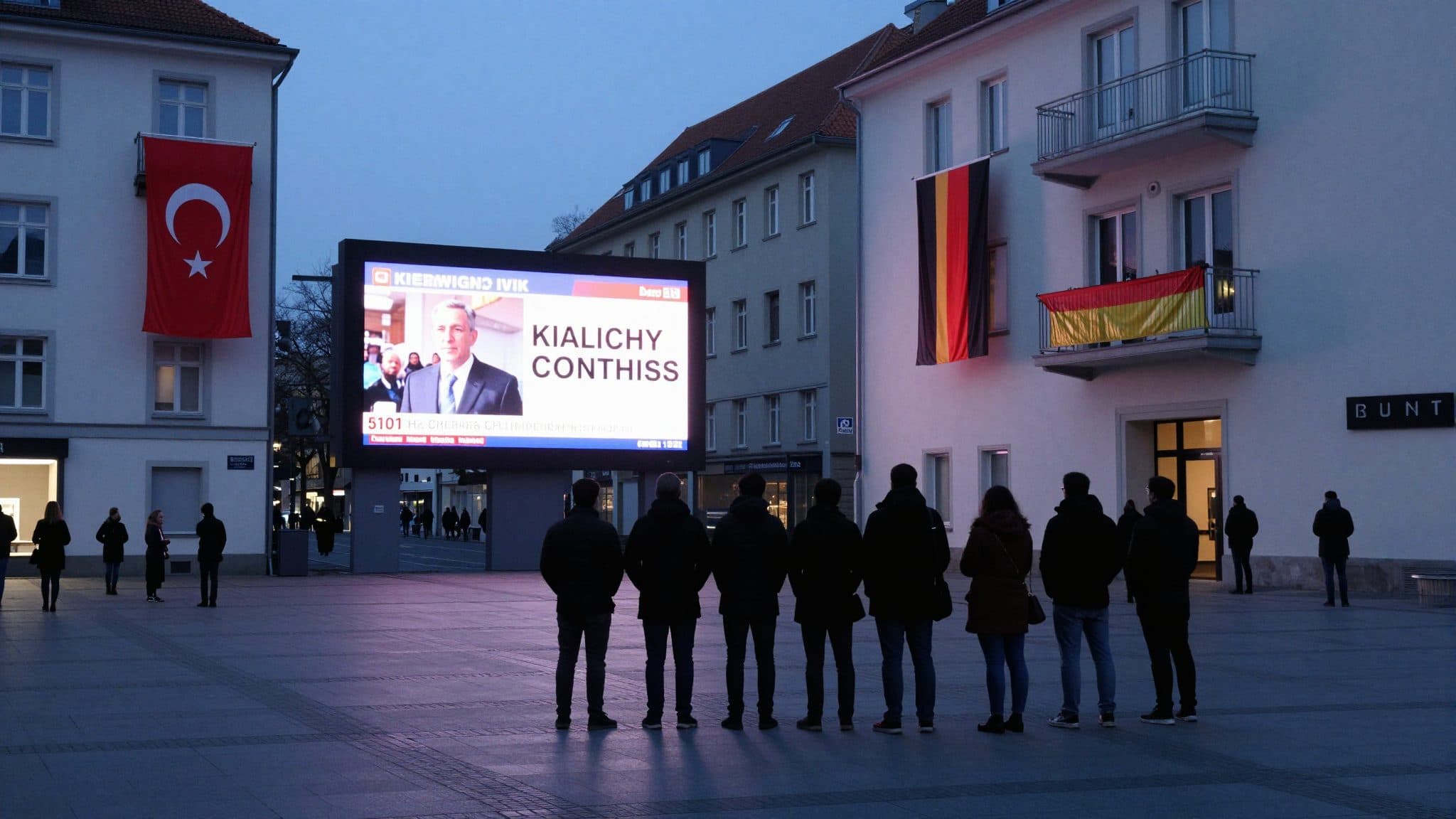
Ten Years After the Coup Attempt in Turkey: Voices from North Rhine-Westphalia Look Back
Cologne, July 15, 2026
AI-generated image (z-image via Kie.ai)
Summary
On the tenth anniversary of the failed coup attempt in Turkey, three people with Turkish roots from North Rhine-Westphalia look back on the night of July 15 to 16, 2016. The coup failed, but its consequences changed the country permanently and continue to divide communities of Turkish descent to this day.
Cologne, July 15, 2026
On the tenth anniversary of the failed Turkish coup attempt, three people with Turkish roots living in North Rhine-Westphalia recall the night of July 15 to 16, 2016, and describe how the event continues to shape their lives and the community today.
Background to the Coup Night
During the night of July 15 to 16, 2016, parts of the military positioned themselves in Ankara and Istanbul against the government and called for an uprising. "Civilians" and government-loyal security forces confronted the coup plotters. In the end, more than 250 people were killed before the uprising was suppressed. For the first time in the history of the Turkish Republic, a coup attempt did not lead to a change of power.
President Recep Tayyip Erdoğan addressed his supporters that night via a smartphone broadcast and called on them to take to the streets. The presenter on the state broadcaster TRT had been forced by the coup plotters to read out their statement. By morning, Erdoğan had the situation under control again – and later described the failed coup as a "gift from God."
For Burak Can Kaba, the coup night was formative, even though he was growing up far away in Germany. "During the coup night, Burak was just 14 years old," the WDR interviews state. The now 24-year-old from Bielefeld is writing his bachelor's thesis on the political development of Turkey. The issue that divides Turks around the world the most, the 24-year-old is certain, is Erdoğan. "Especially since the coup attempt."
Memories from NRW
Selin Günaydin also remembers the night well. The CDU politician from Werl and president of the Turkish-German Students and Academics Platform has been closely following political developments in Turkey for years. "There was a feeling of unease: Which direction is this actually going now?" she describes the mood. Especially on Turkish social media pages, two camps quickly became clear: on one side the opposition, who were sure it was a staged coup attempt, and on the other Erdoğan's supporters.
The coup failed, but had far-reaching consequences. Shortly after the coup attempt, the government imposed a state of emergency that lasted nearly two years. During this time, Erdoğan governed largely by decree. Tens of thousands of people were dismissed from public service or arrested; hundreds of thousands were taken into custody, according to statistics. More than 100,000 civilians, including teachers, lawyers, doctors, researchers, and police officers, were dismissed by decree.
Consequences of the Failed Coup
Erdoğan and his AKP government blamed the preacher Fethullah Gülen, who had been allied with Erdoğan until 2013, for the coup attempt. Gülen lived in the U.S. state of Pennsylvania and rejected any involvement in the coup attempt. The Gülen movement was classified as a terrorist organization in Turkey, and numerous media outlets and publishing houses were shut down. Ahmet Şık served twelve months in prison for the manuscript of his book "The Imam's Army," which is banned in Turkey.
Emre also remembers his father's phone call on the coup night. "On the coup night, the 30-year-old recalls, his father called. He had after all already experienced a coup attempt in 1980. 'He told me to stay home and follow the news.'" Emre and his wife moved from Turkey to Dortmund half a year ago. One reason was the economic situation in the country, which has noticeably worsened in recent years.
In 2018, the new presidential system finally came into force, significantly strengthening the president's powers. The Italian human rights organization Italian Federation for Human Rights – Italian Helsinki Committee concluded that mass dismissals and stigmatizations without completed court proceedings meant a "social death" for many of those affected. According to the state news agency Anadolu, a total of 4,891 people were convicted in connection with the coup attempt.
Open Questions and Current Developments
Vienna-based political scientist Cengiz Günay told APA that there are many open question marks. He pointed to reports that intelligence services had known about the coup plans in advance. In addition, Erdoğan and his government had used the incident to push through what they had long been planning. Günay attributed the introduction of the presidential system to a "180-degree turn" by the nationalist opposition after the coup attempt.
July 15 has since been a national holiday in Turkey, "Democracy and National Unity Day." President Erdoğan invites people to celebrations in the large Başkent Millet Park in Ankara under the motto "Our Will – Our Victory." Shortly before the anniversary, the authorities ordered the arrest of nearly 1,000 people with alleged links to the Gülen movement, according to statistics; government members spoke of a "large-scale purge."
Documentation on the Anniversary
The judiciary is also continuing to deal with the aftermath. According to the available facts, criminal proceedings are underway against the removed Istanbul mayor and CHP presidential candidate Ekrem İmamoğlu as well as 413 other defendants. In May, Özgür Özel was removed from office by a court decision, according to the available information. The consequences of the coup are thus still being felt in the present.
To mark the anniversary, WDR has produced a four-part documentary titled "Erdoğan," which traces his political rise and the restructuring of the Turkish state after 2016. The four episodes of the German version will be shown on July 15 from 10:15 p.m. on WDR Fernsehen. The series is available in German and Turkish in the ARD Mediathek. Those who want to binge-watch can see the four episodes (German version) on July 15 from 10:15 p.m. on WDR Fernsehen.
The original article "Zehn Jahre Putschversuch Türkei: Stimmen aus NRW" was published on 14.07.2025 at 2:45 p.m. on WDR.de. Sources included WDR interviews with Emre, Selin Günaydin, and Burak Can Kaba, as well as the ARD documentary "Erdoğan."
Questions & Answers
Who are the protagonists of the WDR report?
The WDR report is based on interviews with Emre (30), CDU politician Selin Günaydin from Werl, and 24-year-old student Burak Can Kaba from Bielefeld, supplemented by the ARD documentary "Erdoğan."
What happened on the night of July 15 to 16, 2016 in Turkey?
Parts of the Turkish military attempted to overthrow President Erdoğan's government in Ankara and Istanbul; more than 250 people died before the uprising was suppressed and Erdoğan called his supporters onto the streets via a smartphone broadcast.
What long-term consequences did the coup attempt have?
The government imposed a state of emergency lasting nearly two years, tens of thousands of people were dismissed or arrested, the new presidential system with significantly expanded presidential powers came into force in 2018, and the division within the community of Turkish descent in NRW continues to this day.
Turkey Coup Attempt 2016: Ten Years Later – Voices from NRW | allfacts360